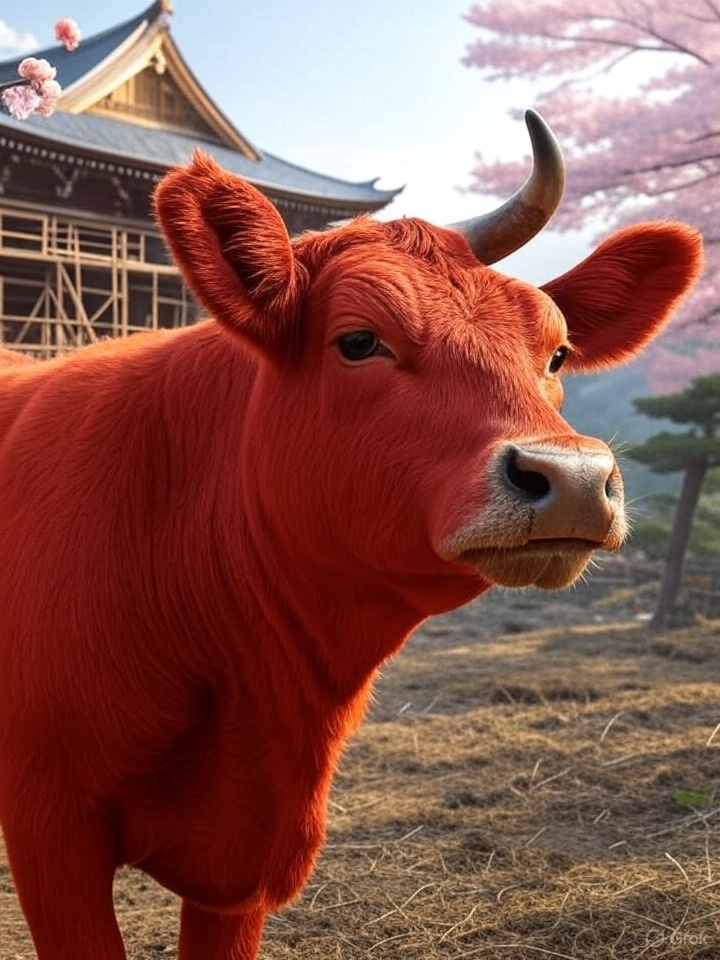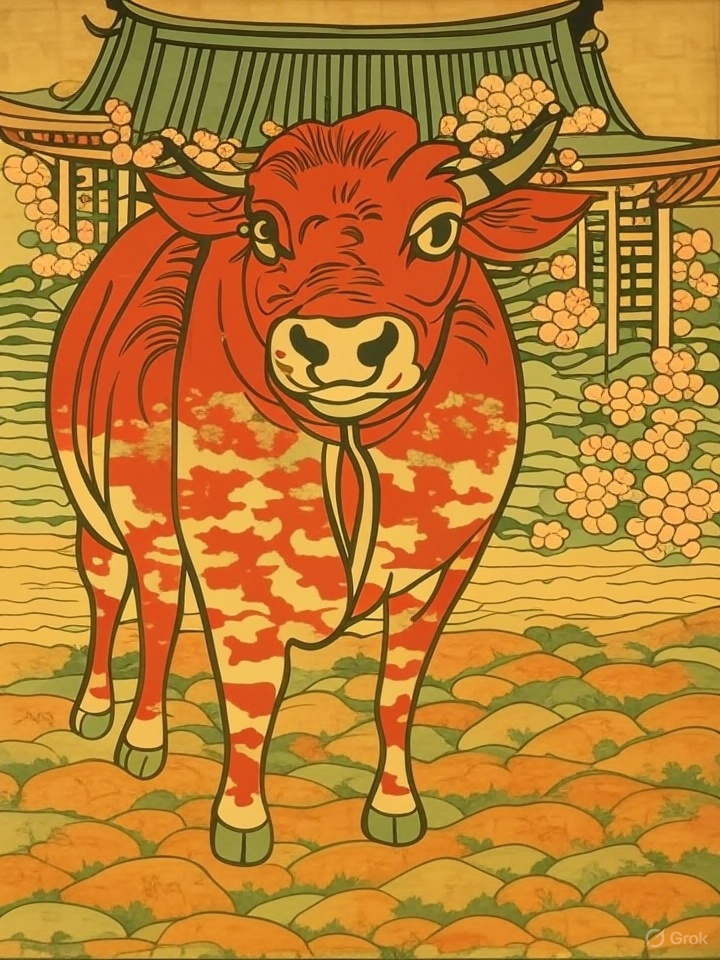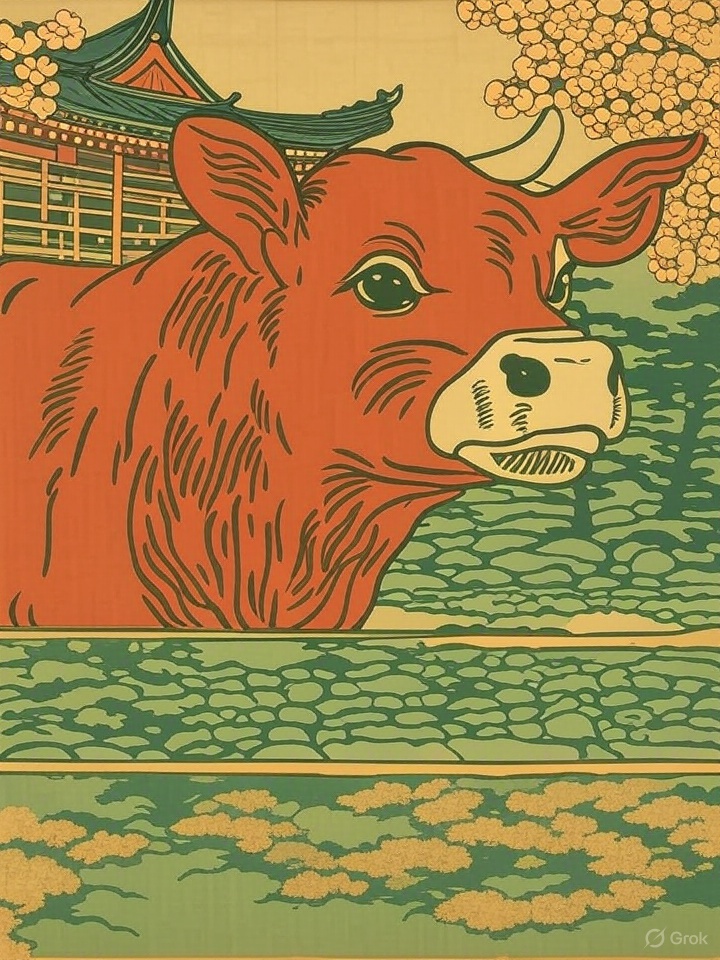

The story of Akabeko traces back to the construction of Enzō-ji Temple in Yanaizu, over a thousand years ago during the Heian period (around the 9th century). According to legend:
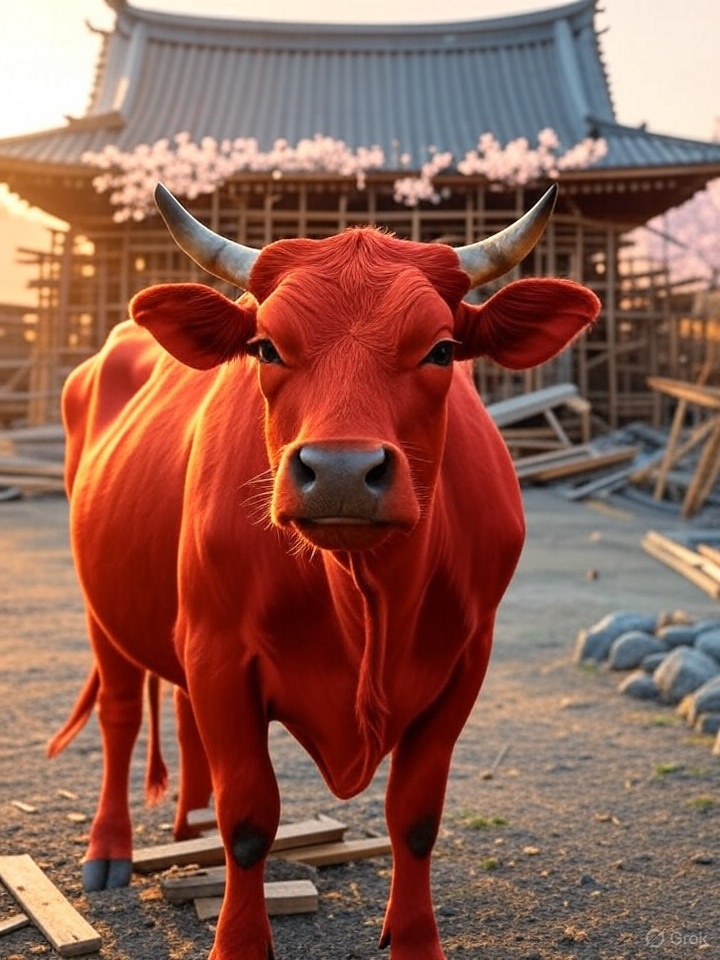
Illustrated folktale
In the village nestled at the foot of the misty mountain, there lived an elderly woodcarver named Kaito. For years, he had toiled to craft intricate ornaments for the nearby temple, his hands moving with a gentle precision that belied his advanced age. The villagers revered him for his skill and devotion to his craft.
One spring, as the snows began to melt and the days lengthened, a group of young laborers arrived at the temple site, tasked with hauling heavy lumber up the mountain. Their efforts were met with struggle and exhaustion; their sweat-labored brows furrowed in concern as they grappled with the weighty loads.
It was then that a brilliant red apparition materialized from the morning mist. A majestic cow emerged, its coat glistening like polished lacquer, black markings etched upon its flanks like brushstrokes on silk. The laborers froze, awestruck by this sudden arrival, as the cow approached them with an air of quiet authority.
Without hesitation, the Akabeko – for that is what they would later come to call it – set to work alongside the young men. Its massive body plodded up the mountain path, effortlessly hefting great trunks and bundles onto its broad shoulders. The laborers watched in wonder as the cow traversed the winding trails with an uncanny ease, as if drawn by some unseen force.
For many moons, the Akabeko labored tirelessly beside the villagers, never once faltering or complaining beneath the scorching sun or driving rain. Its presence seemed to imbue them with a renewed sense of purpose and vigor; their laughter echoed through the forest glades as they worked side by side with this noble creature.
When at last the temple's final beams were raised, the laborers gathered to marvel at their handiwork. The Akabeko stood among them, its bright red coat glistening with dew as it regarded the completed edifice with an unblinking gaze. But when the villagers turned to bid it farewell, the cow merely nodded its great head in a gentle motion, as if to say: "I shall remain here."
From that day forward, the Akabeko became an integral part of temple life. It roamed the grounds, offering protection and solace to those who sought refuge within the sacred precincts. The villagers whispered stories of its unwavering loyalty and strength; how it had stood watch over them during times of drought and pestilence, its red coat a beacon of hope in the face of adversity.
As for Kaito, the elderly woodcarver, he would often be seen sitting beside the Akabeko's massive form, his hands shaping small figurines from the same fine woods they had used to build the temple. "These," he would say with a gentle smile, "are talismans of protection and health, imbued with the essence of our noble companion." And as the children laughed and played within the temple grounds, they knew that the Akabeko's spirit watched over them all, its red coat glowing like a promise in the dappled shade.
Yokai, oni, kitsune and spirits from folklore
Directory of Japanese board games and traditional games
Verified itch.io pixel-art gacha — fair odds, no ads
Reference guides for classic Japanese ham radios
Ancient joinery techniques of Japanese master craftsmen
Explore Japan's landmarks, shrines and hidden locations
SNES and Super Famicom collection tracker
Hoshi no Isan — a Japanese-aesthetic space RPG in development
Pixel art life sim MMO — start at zero, build your life
AI-powered educational stories for kids
Japanese-aesthetic design tokens & AI-ready UI prompts
Every day, one teaching. One moment of stillness.
Kanji, meaning, and a quiet reflection — rooted in the philosophy
behind Japan's forests, seasons, and sacred silences.