

Shinigami (死神) literally means “death god” in Japanese and refers to spiritual beings that lead or lure people toward death.
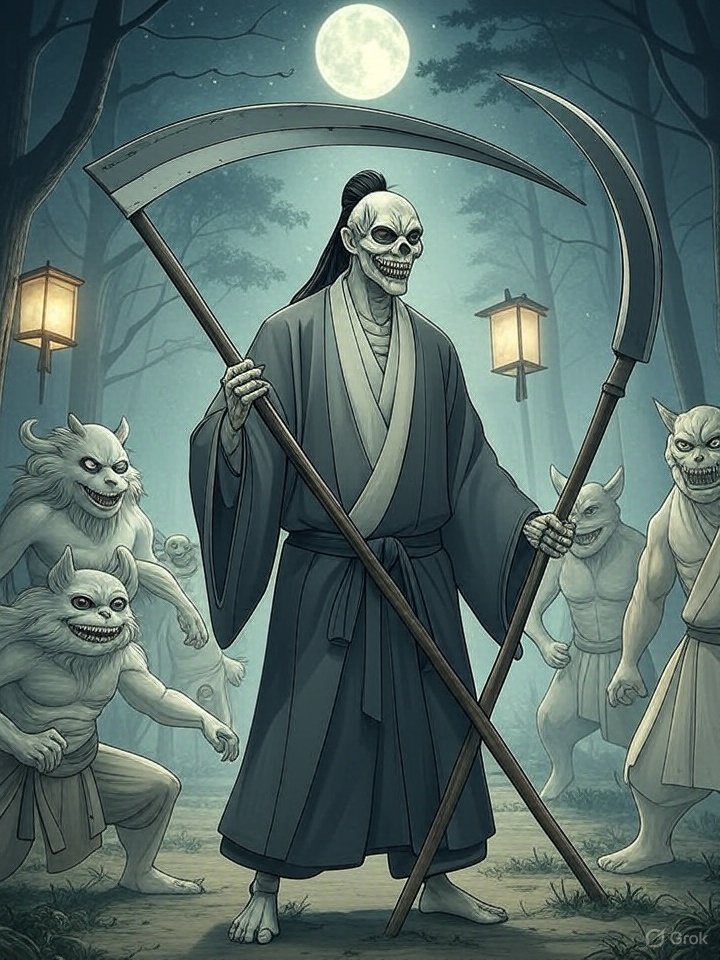
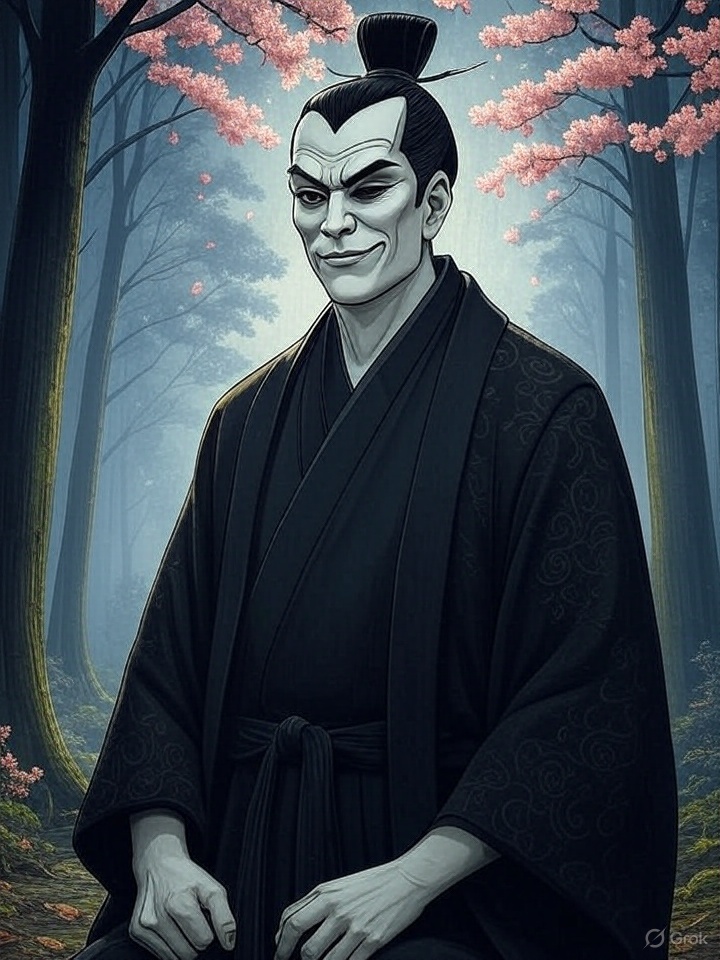
Illustrated folktale

In the autumnal twilight, when the wind whispers secrets through desolate streets, there lived an old woman named O-ku. Her village lay shrouded in mist, its residents bound by tradition and superstition. It was said that on nights like these, the Shinigami walked among them, their presence felt but unseen.
O-ku dwelled alone in her humble abode, surrounded by dusty scrolls and faded tapestries. Her life had been one of quiet devotion, tending to her ailing mother until her passing many years prior. Since then, O-ku's thoughts often strayed to the concept of monrō: the inevitability of fate that awaits us all.
One evening, as the moon dipped below the hills, O-ku sensed an oppressive presence in her home. She lit candles, casting flickering shadows on the walls, and offered a prayer for protection. However, the weight only intensified, like an unseen burden settling upon her shoulders. It was then she felt it – a mirror-like reflection of herself standing beside her.
The figure remained still, yet O-ku detected the faint scent of incense carried on its breath. A shiver ran down her spine as she recognized the unmistakable aura of the Shinigami. This encounter meant one thing: her time was drawing near.
Days passed, and O-ku found herself increasingly drawn to a place on the outskirts of the village – a spot where, rumor had it, numerous souls had abandoned their bodies in despair. The wind howled through these desolate streets like a chorus of restless spirits. As she walked among the crumbling homes, O-ku began to feel an unsettling kinship with those who had gone before her.
The Shinigami's presence followed her, always remaining just beyond perception. It was as if the creature willed O-ku to confront the shadowy realms that existed alongside their own world. With each passing night, she felt herself becoming one with the darkness – a part of the grand tapestry where lives were woven and unwoven.
In this liminal state, O-ku began to sense the Shinigami's true nature: not as an executioner, but as a harbinger of balance and order. Her encounters with the creature became less about fear and more about acceptance – an acknowledgment that her own life was but a strand in the intricate web of existence.
One autumn night, beneath a canopy of flickering candles, O-ku's time finally came. As she closed her eyes, surrounded by the echoes of lives past, the Shinigami appeared beside her once more. This time, it stood not as a mirror image, but as a guardian – a witness to her passing.
In that instant, O-ku understood: death was not an end, but a passage into another realm where lives continued their ebb and flow. As the darkness closed in, she felt no fear, only gratitude for having lived and for the Shinigami's role in guiding her through the veil of mortality. And so, surrounded by the echoes of what had been and what would be, O-ku's spirit slipped into the eternal dance of existence.
Yokai, oni, kitsune and spirits from folklore
Directory of Japanese board games and traditional games
Verified itch.io pixel-art gacha — fair odds, no ads
Reference guides for classic Japanese ham radios
Ancient joinery techniques of Japanese master craftsmen
Explore Japan's landmarks, shrines and hidden locations
SNES and Super Famicom collection tracker
Hoshi no Isan — a Japanese-aesthetic space RPG in development
Pixel art life sim MMO — start at zero, build your life
AI-powered educational stories for kids
Japanese-aesthetic design tokens & AI-ready UI prompts

Every day, one teaching. One moment of stillness.
Kanji, meaning, and a quiet reflection — rooted in the philosophy
behind Japan's forests, seasons, and sacred silences.
Content Warning: This website explores Japanese folklore and mythological beings—including yokai, oni, and other supernatural entities—that may be frightening to younger audiences or sensitive viewers. All material is presented for educational and cultural appreciation only. Viewer discretion is advised.
Parents and guardians are encouraged to preview content before sharing it with children. By continuing to use JapaneseMythicalCreatures.com, you acknowledge and accept this advisory.
Copyright © 2026 Japanese Mythical Creatures • All Rights Reserved.