

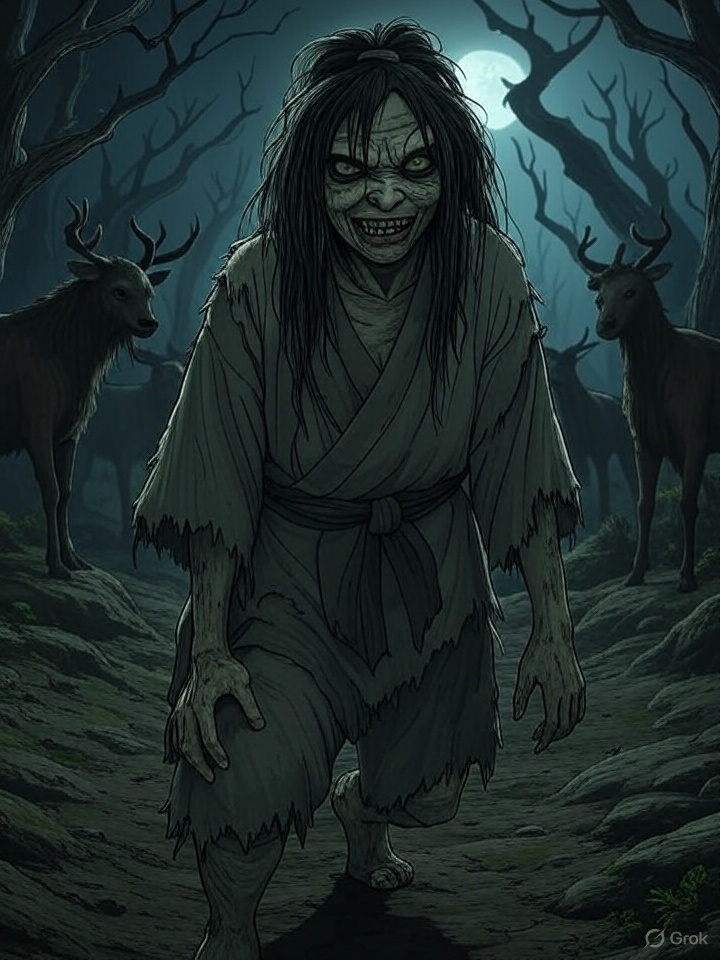
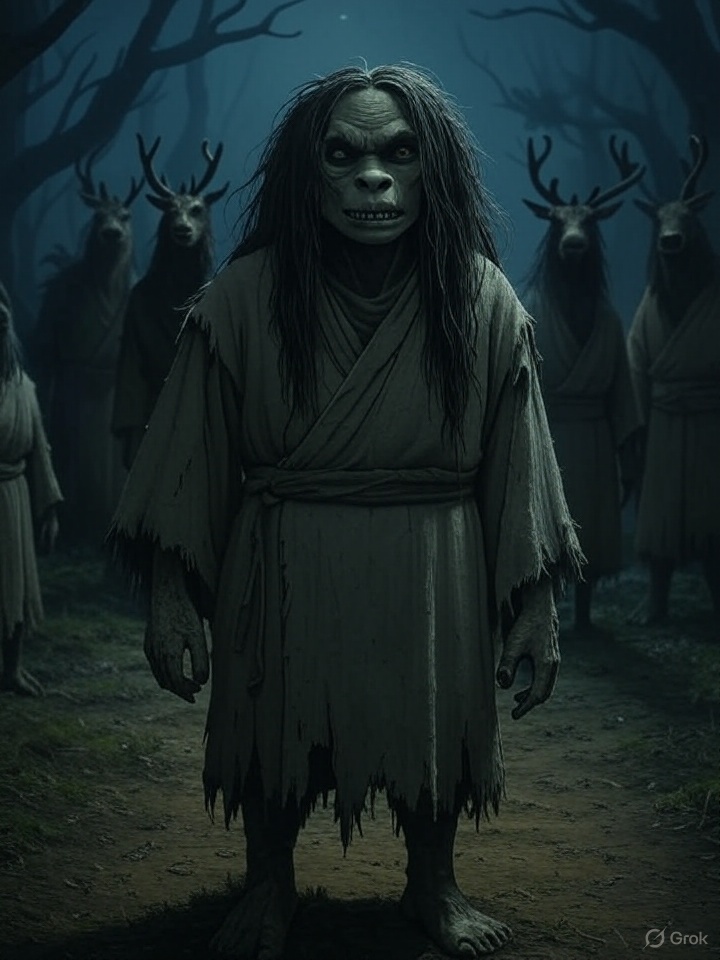
Yomotsu-shikome (黄泉醜女) translates to “ugly women of Yomi,” with “Yomi” referring to the Japanese land of the dead, and “shikome” implying ghastly or repulsive women.
Illustrated folktale

In the depths of Yomi, where the misty veil shrouds all, there dwelled a coven of Yomotsu-shikome. Their twisted forms writhed like withered vines, their rotting skin hanging in tatters as they danced to the cadence of death's whisper.
One autumn eve, when the rice fields lay dormant and the wind carried the whispers of the departed, a young woman named Emiko wandered into Yomi. She had sought solace from the world above, fleeing the pain that clung to her like the shadows on a winter's night. But in Yomi's dark heart, she found only terror.
The Yomotsu-shikome sensed Emiko's presence and gave chase, their corpse-like feet pounding against the stone path. They closed in with unholy speed, their wails echoing through the underworld like the mournful cry of a lonely spirit.
Izanami herself stirred from her slumber at the commotion, her wrath blazing like a torch kindled in a hurricane's eye. She dispatched her Yomotsu-shikome to retrieve Emiko and drag her back into the land of death, that she might suffer the same fate as those who dared trespass on the sacred domain.
As Emiko fled through the labyrinthine paths of Yomi, she stumbled upon an ancient spring bubbling with a light that seemed almost... otherworldly. She knelt beside it, washing away the dirt and fear from her face, and in its clear waters saw reflections of those who had come before: Izanagi and his consort, their love and loss forever entwined like the sacred branches of the sakaki tree.
In that moment, Emiko grasped the weight of her trespass. She comprehended why the Yomotsu-shikome pursued her with such unyielding ferocity – not as beasts, but as instruments of the dead's unforgiving law. Their rotting skin and tattered robes represented the desecration of death itself, a force that brooked no transgression.
Izanagi's story echoed within Emiko's mind: how he had entered Yomi to reclaim his lost love, only to flee in terror from the Yomotsu-shikome. How could she hope to defy the same taboos and escape unscathed? The spring's gentle voice whispered its answer – that true solace lay not in fleeing or supplication, but in acknowledging death's absolute power.
As Emiko arose from her contemplation, the Yomotsu-shikome closed in once more. But this time, she stood tall amidst their ranks, no longer cowering beneath their malevolent gaze. For in that ancient spring, she had discovered a glimmer of acceptance – and with it, a fleeting sense of peace.
The Yomotsu-shikome paused at her changed demeanor, as if sensing the shift within Emiko's heart. Their cadaverous forms faltered, their voices dying into an unsettling silence. Then, without warning, they turned to one another, their grotesque faces twisted in a shared, mirthless laugh.
As Emiko watched, transfixed by this macabre display of solidarity, the Yomotsu-shikome vanished into the shadows, leaving her alone with the whispering spring and its eternal lesson: that death's boundaries are absolute, yet within those limits, there lies a fragile peace.
Yokai, oni, kitsune and spirits from folklore
Directory of Japanese board games and traditional games
Verified itch.io pixel-art gacha — fair odds, no ads
Reference guides for classic Japanese ham radios
Ancient joinery techniques of Japanese master craftsmen
Explore Japan's landmarks, shrines and hidden locations
SNES and Super Famicom collection tracker
Hoshi no Isan — a Japanese-aesthetic space RPG in development
Pixel art life sim MMO — start at zero, build your life
AI-powered educational stories for kids
Japanese-aesthetic design tokens & AI-ready UI prompts

Every day, one teaching. One moment of stillness.
Kanji, meaning, and a quiet reflection — rooted in the philosophy
behind Japan's forests, seasons, and sacred silences.
Content Warning: This website explores Japanese folklore and mythological beings—including yokai, oni, and other supernatural entities—that may be frightening to younger audiences or sensitive viewers. All material is presented for educational and cultural appreciation only. Viewer discretion is advised.
Parents and guardians are encouraged to preview content before sharing it with children. By continuing to use JapaneseMythicalCreatures.com, you acknowledge and accept this advisory.
Copyright © 2026 Japanese Mythical Creatures • All Rights Reserved.