

Yamata-no-Orochi (八岐大蛇) means "Eight-Forked Serpent." It refers to the eight heads and eight tails of this legendary beast.
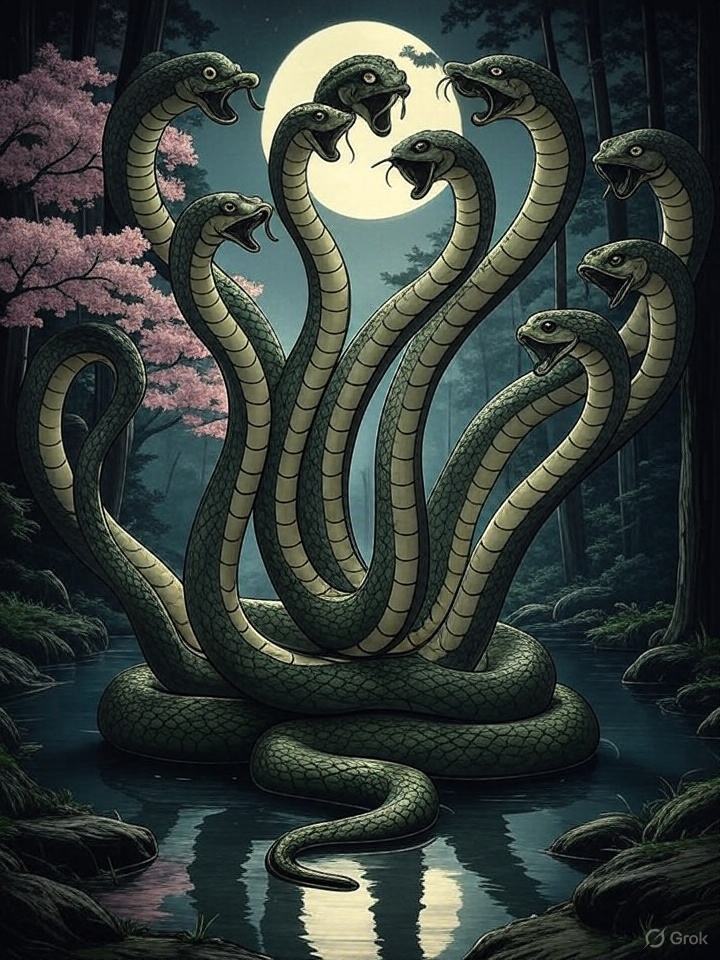
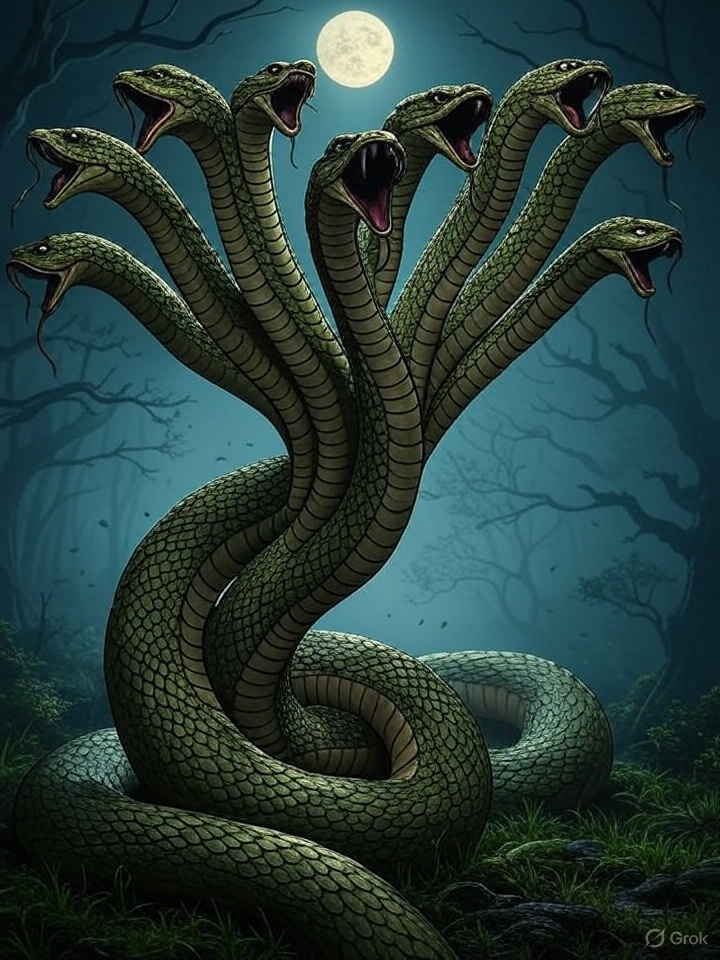
Illustrated folktale

In days when time was measured by the seasons and darkness dwelled in every shadow, there lived an ancient crone who tended to the withered gardens of her village. Her name was Hachiko, and she claimed the spirits of the land whispered secrets to her through the rustling leaves. The villagers, bound by tradition and fear, revered her wisdom and offered her gifts of sake and rice for each full moon.
One autumn evening, as Hachiko strolled along the banks of the winding river that birthed and sustained their village, she stumbled upon a hidden clearing shrouded in an eerie silence. In its center stood a colossal figure – eight serpentine heads bared against the moonlit sky, eyes blazing with a deep crimson fire that seemed to sear the very air.
The crone felt the presence of the Yamata-no-Orochi, an ancient terror born from chaos and darkness. Its body, coiled like a living mountain, sprawled across eight valleys and hills, moss-covered and verdant as if nature itself had clothed it in life-giving foliage. Hachiko sensed that the beast's hunger was a palpable force, driving it to demand an annual sacrifice – a young maiden chosen for her innocence and purity.
The villagers, unaware of the crone's discovery, continued their lives in ignorance, offering their daughters as pawns in the dark ritual. Yet Hachiko knew she could not remain silent; the weight of the Orochi's malevolent presence bore down upon her like an unyielding storm cloud.
She retreated to her garden, where the whispers of the land guided her hands to cultivate a rare and precious plant – one rumored to repel the darkness. As its petals unfolded under her care, she realized they held the essence of purification: a white light capable of soothing the very heart of chaos.
With this newfound knowledge, Hachiko wove a subtle magic that reached beyond the village boundaries, weaving an invisible thread between the crone's soul and the storm god Susanoo, slumbering in the distant mountains. The ancient one, sensing the disturbance caused by the Yamata-no-Orochi, stirred from his slumber.
As autumn merged with winter, Susanoo descended upon the clearing where Hachiko stood. Together, they devised a plan to entice the Orochi, exploiting its weakness for sake and intoxication. Under the crone's guidance, Susanoo poured libations of the sacred liquid into the creature's maw, feeding it until the Yamata-no-Orochi stumbled and fell.
With each passing moment, the storm god waded deeper into the heart of the beast, his blade, Kusanagi-no-Tsurugi, glinting with a fierce light as he struck down the monstrous heads one by one. As they fell, the valleys and hills reclaimed their former tranquility, the darkness banished by the light of purification.
As dawn broke over the landscape, Hachiko felt the pulse of chaos recede from the land, its malevolent force diminished by the triumph of order. The crone's work done, she vanished into the misty veil that shrouded her village, leaving behind a people freed from their fear and a world rebalanced by the sacred power of light.
Yokai, oni, kitsune and spirits from folklore
Directory of Japanese board games and traditional games
Verified itch.io pixel-art gacha — fair odds, no ads
Reference guides for classic Japanese ham radios
Ancient joinery techniques of Japanese master craftsmen
Explore Japan's landmarks, shrines and hidden locations
SNES and Super Famicom collection tracker
Hoshi no Isan — a Japanese-aesthetic space RPG in development
Pixel art life sim MMO — start at zero, build your life
AI-powered educational stories for kids
Japanese-aesthetic design tokens & AI-ready UI prompts

Every day, one teaching. One moment of stillness.
Kanji, meaning, and a quiet reflection — rooted in the philosophy
behind Japan's forests, seasons, and sacred silences.
Content Warning: This website explores Japanese folklore and mythological beings—including yokai, oni, and other supernatural entities—that may be frightening to younger audiences or sensitive viewers. All material is presented for educational and cultural appreciation only. Viewer discretion is advised.
Parents and guardians are encouraged to preview content before sharing it with children. By continuing to use JapaneseMythicalCreatures.com, you acknowledge and accept this advisory.
Copyright © 2026 Japanese Mythical Creatures • All Rights Reserved.