

Umi-nyōbō (海女房) literally means "sea wife" or "ocean lady," referencing her female form and marine origin.
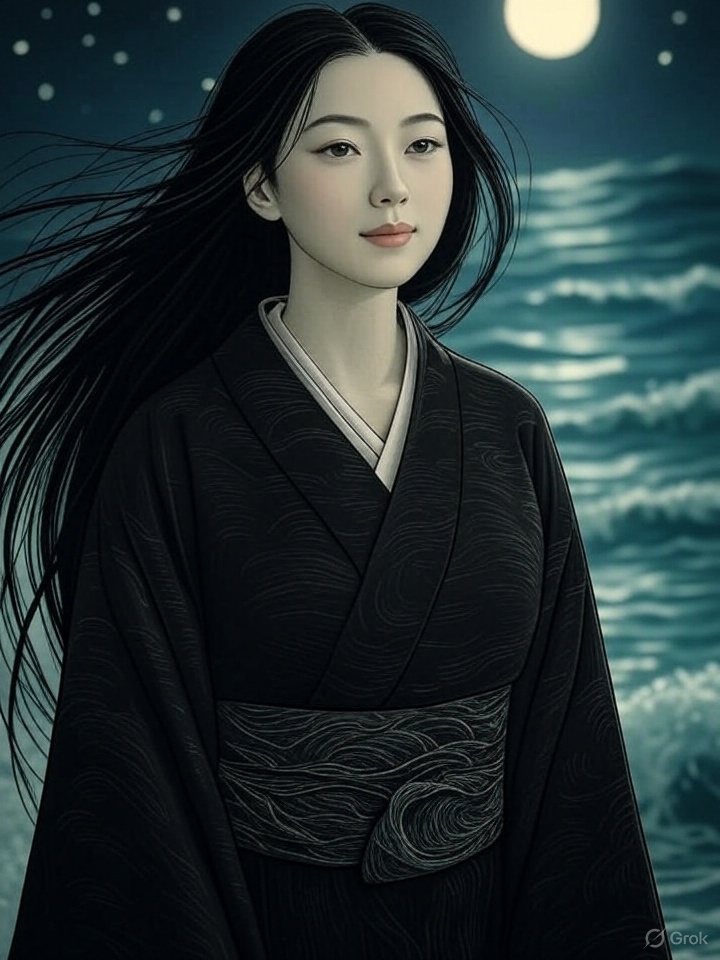
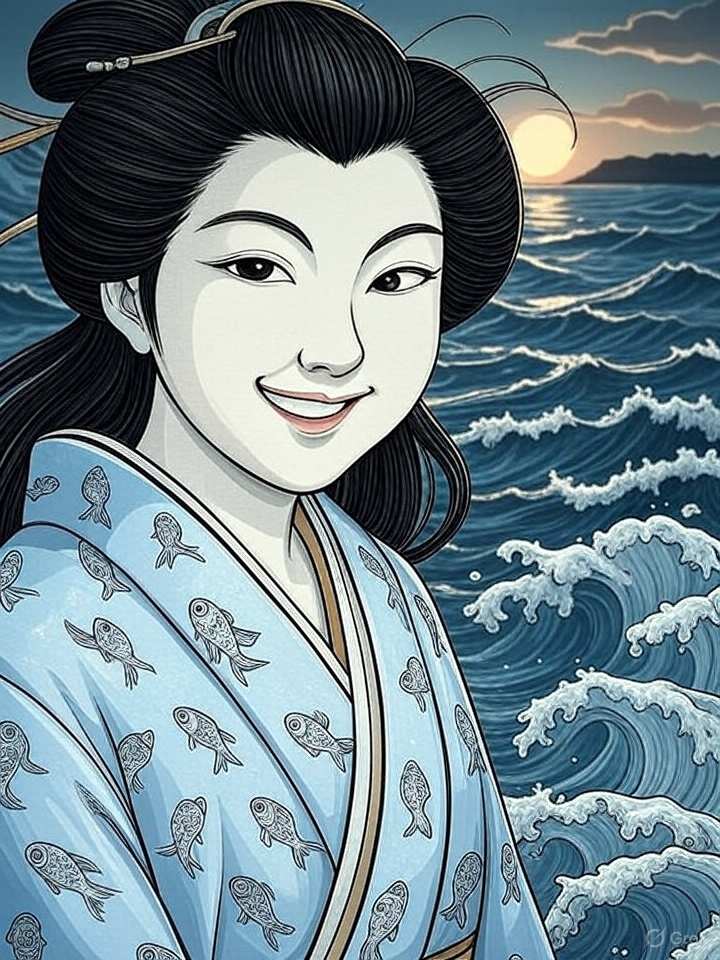
Illustrated folktale

In the mist-shrouded coves of Awa Province, where the waves caress the shore with a soothing melody, there lived a young fisherman named Kaito. He was known for his bravery and skill on the waters, but also for his recklessness in pursuing the bounty of the sea.
One autumn evening, as the sun dipped into the horizon, casting a golden glow across the waves, Kaito's boat chugged towards the open sea, its engines rumbling like a restless beast. His net was heavy with the day's catch: succulent fish that would fetch a handsome price in the market.
As night descended, a storm brewed on the horizon, its dark clouds billowing like the sails of a ghost ship. Kaito's crew huddled together, their eyes fixed on the turbulent waters ahead. Suddenly, a faint cry echoed through the howling wind: "Mōsōshin!"
The crew exchanged nervous glances. Mōsōshin was the name whispered in terror by coastal villagers whenever they spoke of the Umi-nyōbō's presence.
Kaito's boat was swept towards the rocky outcroppings that jutted from the sea like skeletal fingers. As he struggled to maneuver the vessel, a shrouded figure emerged from the darkness, its seaweed-like hair streaming behind it like a bridal veil.
The Umi-nyōbō's eyes glowed with an ethereal light, as if the moon itself had descended upon the waves. It beckoned to Kaito, its voice a mournful sigh that seemed to carry on the wind.
"Kokoro ya, kaku ya," it whispered, "Heart and hunger."
The crew trembled, sensing their captain's unease. But Kaito stood transfixed, his gaze locked upon the Umi-nyōbō as if mesmerized by a serpent's hypnotic stare. He knew that to defy its summons would invite calamity.
With slow, deliberate movements, the Umi-nyōbō extended a hand, and Kaito felt an unseen force draw him towards it. In a flash of insight, he understood: the sea's bounty was not for his taking alone; its secrets were guarded by a mysterious power that demanded reverence.
The Umi-nyōbō spoke again, its voice barely audible above the storm: "Ku o kudasai." A gift, it seemed to say. The fisherman's heart pounded in his chest as he realized what was expected of him.
With reluctant hands, Kaito tossed a small portion of their catch into the waves, offering it to the Umi-nyōbō as alms. In response, the sea creature vanished into the darkness, leaving behind only an echo of its mournful cry: "Mōsōshin."
The storm dissipated as quickly as it had begun, and Kaito's boat limped back towards shore under a calm, moonlit sky. The crew breathed a collective sigh of relief, but their captain remained lost in thought.
In the days that followed, fishermen whispered among themselves about the Umi-nyōbō's reappearance, its appetite sated by Kaito's offering. From then on, the young fisherman approached his work with a newfound respect for the sea and its mysterious guardians, knowing that the line between bounty and calamity was ever-shifting and perilously thin.
As for the Umi-nyōbō, it remained a shadowy presence in the coves of Awa Province, its ethereal eyes watching over the waves like a guardian of secrets yet to be revealed.
Yokai, oni, kitsune and spirits from folklore
Directory of Japanese board games and traditional games
Verified itch.io pixel-art gacha — fair odds, no ads
Reference guides for classic Japanese ham radios
Ancient joinery techniques of Japanese master craftsmen
Explore Japan's landmarks, shrines and hidden locations
SNES and Super Famicom collection tracker
Hoshi no Isan — a Japanese-aesthetic space RPG in development
Pixel art life sim MMO — start at zero, build your life
AI-powered educational stories for kids
Japanese-aesthetic design tokens & AI-ready UI prompts

Every day, one teaching. One moment of stillness.
Kanji, meaning, and a quiet reflection — rooted in the philosophy
behind Japan's forests, seasons, and sacred silences.
Content Warning: This website explores Japanese folklore and mythological beings—including yokai, oni, and other supernatural entities—that may be frightening to younger audiences or sensitive viewers. All material is presented for educational and cultural appreciation only. Viewer discretion is advised.
Parents and guardians are encouraged to preview content before sharing it with children. By continuing to use JapaneseMythicalCreatures.com, you acknowledge and accept this advisory.
Copyright © 2026 Japanese Mythical Creatures • All Rights Reserved.