

Okuri-inu (送り犬) literally means “sending-off dog.” It refers to a spectral canine that follows people walking alone through mountain paths at night.
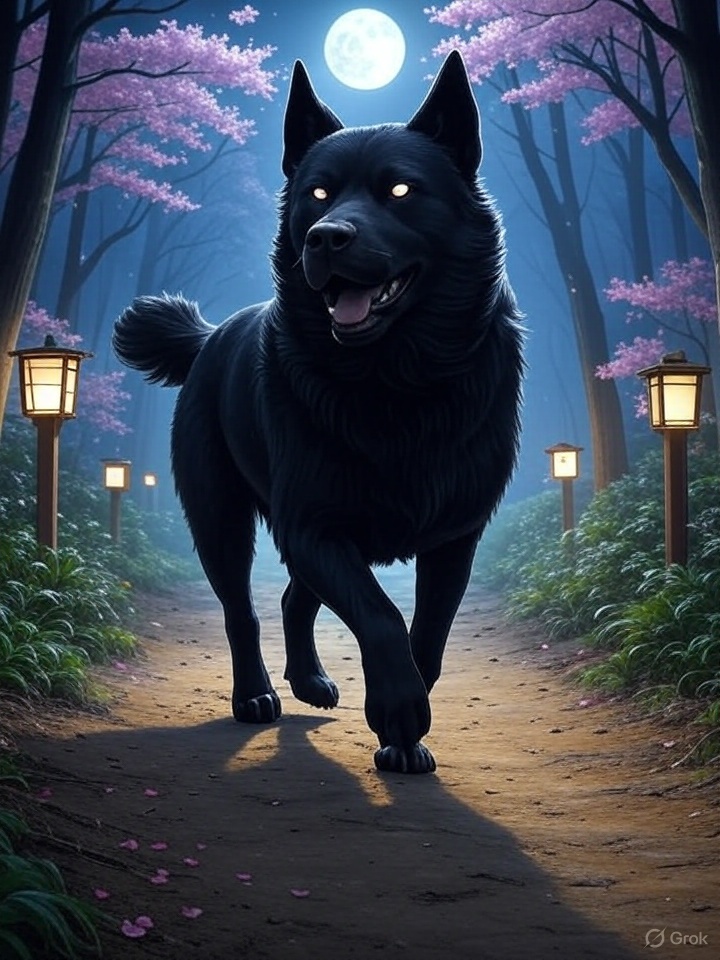
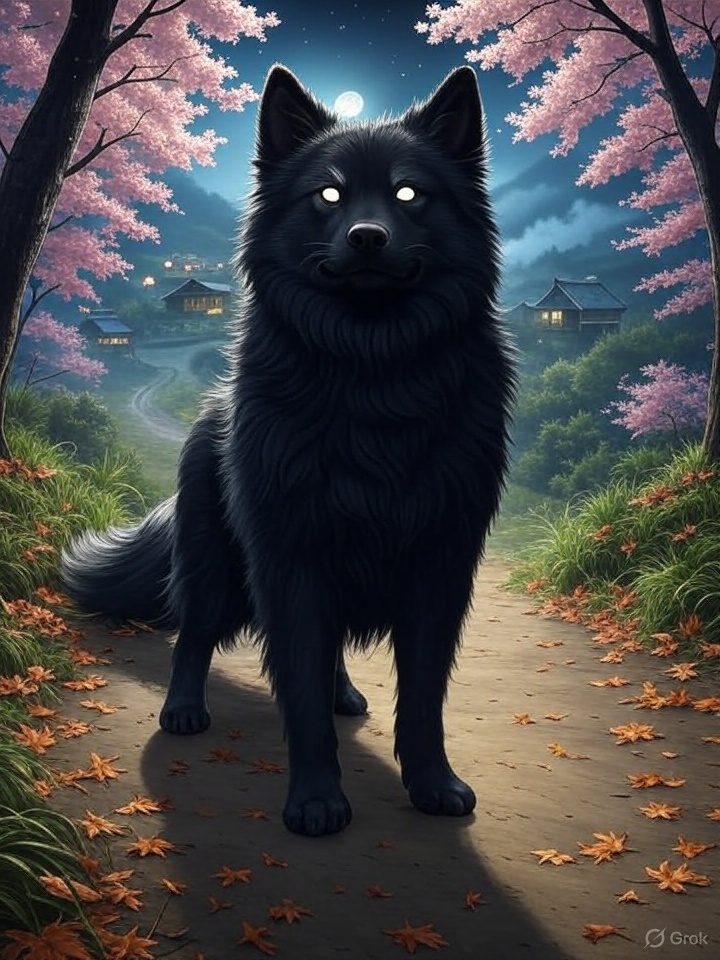
Illustrated folktale

In the village of Hakone, nestled between the mist-shrouded peaks of the Fuji range, there lived an old man named Kaito. He was a traveler, often venturing into the mountains to gather rare herbs for his wife's sake. One winter evening, as snowflakes danced in the fading light, Kaito set out on his usual route, carrying a worn satchel slung over his shoulder.
The darkness seemed to thicken around him like a damp shroud, and Kaito felt an inexplicable sense of unease. He quickened his pace, but the forest paths grew treacherous with icy patches and fallen branches. His breath misted in front of him as he stumbled, nearly losing his footing on a hidden patch of ice.
A low growl rumbled through the trees, sending shivers down Kaito's spine. A pair of glowing eyes materialized ahead, fixed upon him like lanterns in the night. The Okuri-inu had emerged from the shadows, its massive black form silhouetted against the snow-covered trees.
Kaito froze, his heart pounding in his chest. He remembered the whispered warnings from the villagers: "Tie your sandal, traveler, lest you tempt the Okuri's wrath." With a shaking hand, he fumbled for his worn leather satchel and pretended to tie the strap of his sandal, as if securing it with careful deliberation.
The Okuri-inu took a cautious step forward, its eyes never leaving Kaito. For an eternal moment, the two locked gazes, the air heavy with tension. Then, seemingly satisfied that Kaito was not in immediate danger, the Okuri-inu inclined its great head and padded silently back into the darkness.
Kaito exhaled a shaky breath and continued on his way, his senses heightened as he navigated the treacherous paths. Though the encounter left him shaken, he felt a strange sense of respect for the Okuri's vigilance. As he reached the edge of the forest, the first lights of the village twinkled like fireflies in the distance.
With gratitude, Kaito turned to the darkness and offered a quiet prayer: "Arigatou, Okuri-inu-san, for your watchful presence tonight." The night seemed to respond with a soft whisper, as if the very wind carried his words back into the forest. From that moment on, Kaito's journeys became more cautious, his steps lighter in the evening hours, and his heart filled with a deeper understanding of the hidden dangers that lurked within the shadows.
Years passed, and the villagers would speak of Kaito as one who had walked the thin line between protection and punishment. His name became synonymous with the Okuri-inu's lesson: vigilance is not only a warning, but also a blessing when tempered with etiquette and respect for the spirits that watch over us in the dark.
Yokai, oni, kitsune and spirits from folklore
Directory of Japanese board games and traditional games
Verified itch.io pixel-art gacha — fair odds, no ads
Reference guides for classic Japanese ham radios
Ancient joinery techniques of Japanese master craftsmen
Explore Japan's landmarks, shrines and hidden locations
SNES and Super Famicom collection tracker
Hoshi no Isan — a Japanese-aesthetic space RPG in development
Pixel art life sim MMO — start at zero, build your life
AI-powered educational stories for kids
Japanese-aesthetic design tokens & AI-ready UI prompts

Every day, one teaching. One moment of stillness.
Kanji, meaning, and a quiet reflection — rooted in the philosophy
behind Japan's forests, seasons, and sacred silences.
Content Warning: This website explores Japanese folklore and mythological beings—including yokai, oni, and other supernatural entities—that may be frightening to younger audiences or sensitive viewers. All material is presented for educational and cultural appreciation only. Viewer discretion is advised.
Parents and guardians are encouraged to preview content before sharing it with children. By continuing to use JapaneseMythicalCreatures.com, you acknowledge and accept this advisory.
Copyright © 2026 Japanese Mythical Creatures • All Rights Reserved.