

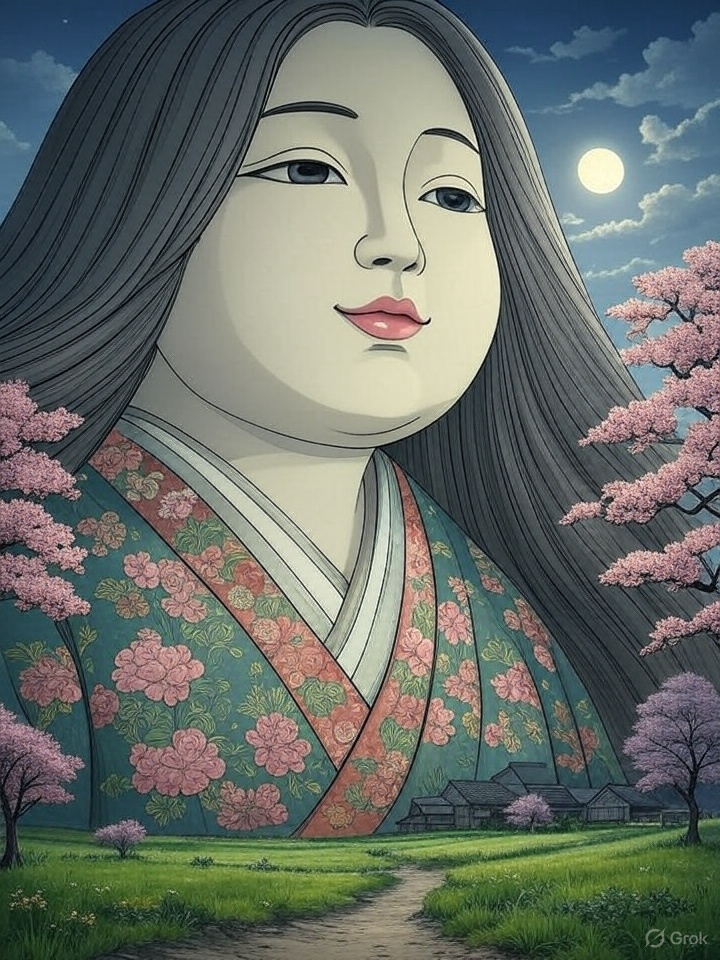
Ōkubi (大首) means “great head” or “giant face,” typically appearing as an enormous female face floating in the sky, bringing unease or terror.
Illustrated folktale

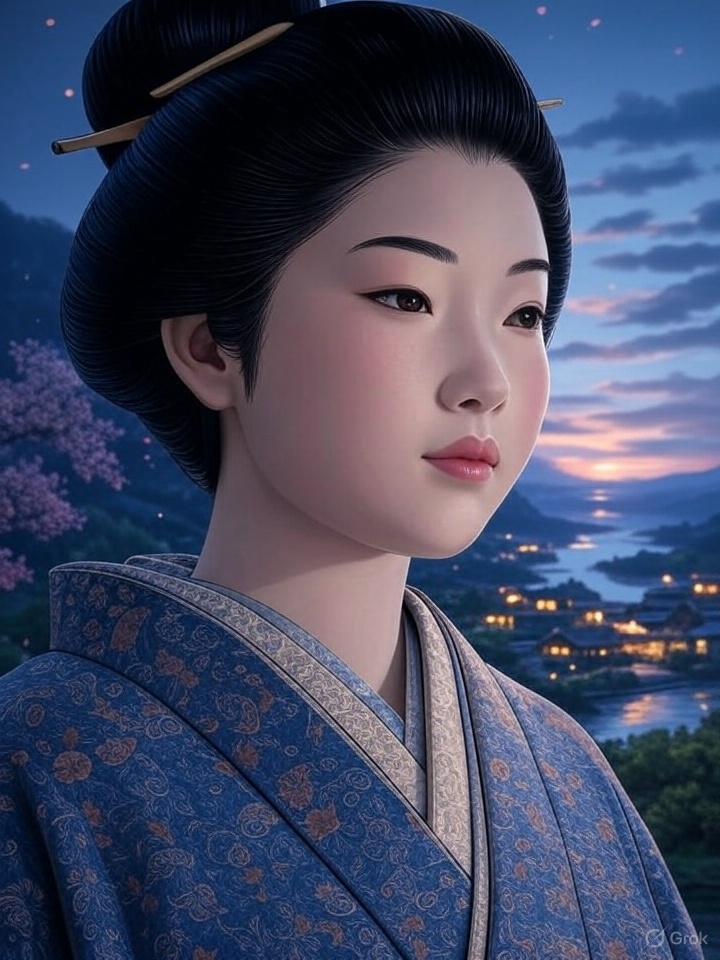
In a small village nestled in the mist-shrouded mountains, there lived a young woman named Emiko. She was known for her beauty and kindness, but also for her stubbornness and pride. Emiko had a husband who worked tirelessly to provide for their family, yet she never ceased to complain about the meager food they ate or the small house they lived in.
One fateful evening, as the sun dipped below the horizon, a strong gust of wind swept through the village, extinguishing the lanterns and plunging the streets into darkness. The villagers, huddled indoors, heard a faint whisper on the wind – the sound of a woman's mournful cry.
The next morning, Emiko ventured out to tend to her garden, only to find that her usually tranquil surroundings had been transformed overnight. A massive face loomed above the rooftops, its features twisted in agony. The villagers trembled with fear as they beheld the Ōkubi's visage, frozen in a silent scream.
Emiko, however, was transfixed by the apparition. She felt an inexplicable connection to the face, as if it spoke directly to her soul. The wind carried the stench of rot and decay, making her stomach turn, yet she couldn't tear her gaze away.
The villagers fled in terror, but Emiko remained rooted to the spot, her heart heavy with a sense of recognition. As the sun climbed higher in the sky, the Ōkubi's face began to shift, its features sagging and elongating like a mask on a puppet. Its eyes, once full of anguish, now seemed to hold a deep sadness.
Emiko felt an overwhelming urge to reach out to the apparition, to comfort it as one would a suffering friend. She raised her hands, but they passed through the face as if it were smoke. The Ōkubi's gaze locked onto hers, and for an instant, Emiko saw a glimmer of peace in those depths.
The villagers returned cautiously, bearing offerings of incense and rice to appease the vengeful spirit. But Emiko knew that the Ōkubi was not there to exact revenge; it was searching for something lost – a sense of justice, perhaps, or an end to its eternal suffering.
As night descended once more, the face vanished as suddenly as it appeared. The wind died down, and an eerie stillness fell over the village. Emiko walked back home with her head held high, aware that she had been given a rare gift: a glimpse into the mysteries of the Ōkubi's sorrow.
From that day on, Emiko tended to her garden with newfound care, tending not only to its plants but also to her own heart. She realized that true beauty lay not in material wealth or social status, but in compassion and understanding. The villagers whispered among themselves about the change in Emiko, how she seemed to carry a quiet strength within her. And though they never saw the Ōkubi again, its presence continued to echo through the village, reminding them of the power of empathy and redemption.
Yokai, oni, kitsune and spirits from folklore
Directory of Japanese board games and traditional games
Verified itch.io pixel-art gacha — fair odds, no ads
Reference guides for classic Japanese ham radios
Ancient joinery techniques of Japanese master craftsmen
Explore Japan's landmarks, shrines and hidden locations
SNES and Super Famicom collection tracker
Hoshi no Isan — a Japanese-aesthetic space RPG in development
Pixel art life sim MMO — start at zero, build your life
AI-powered educational stories for kids
Japanese-aesthetic design tokens & AI-ready UI prompts

Every day, one teaching. One moment of stillness.
Kanji, meaning, and a quiet reflection — rooted in the philosophy
behind Japan's forests, seasons, and sacred silences.
Content Warning: This website explores Japanese folklore and mythological beings—including yokai, oni, and other supernatural entities—that may be frightening to younger audiences or sensitive viewers. All material is presented for educational and cultural appreciation only. Viewer discretion is advised.
Parents and guardians are encouraged to preview content before sharing it with children. By continuing to use JapaneseMythicalCreatures.com, you acknowledge and accept this advisory.
Copyright © 2026 Japanese Mythical Creatures • All Rights Reserved.