

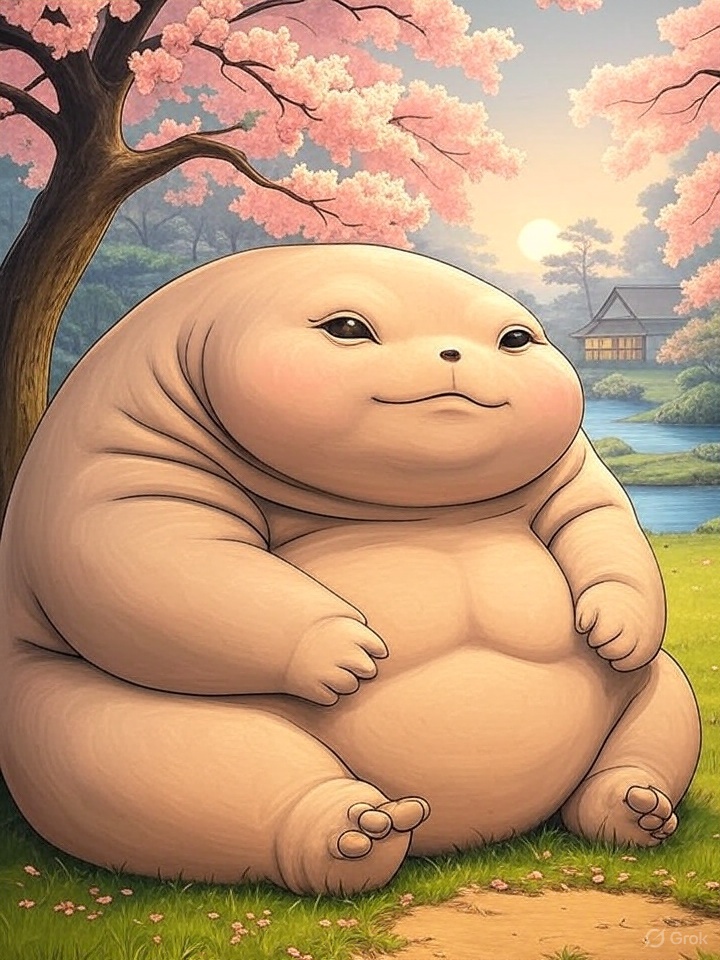
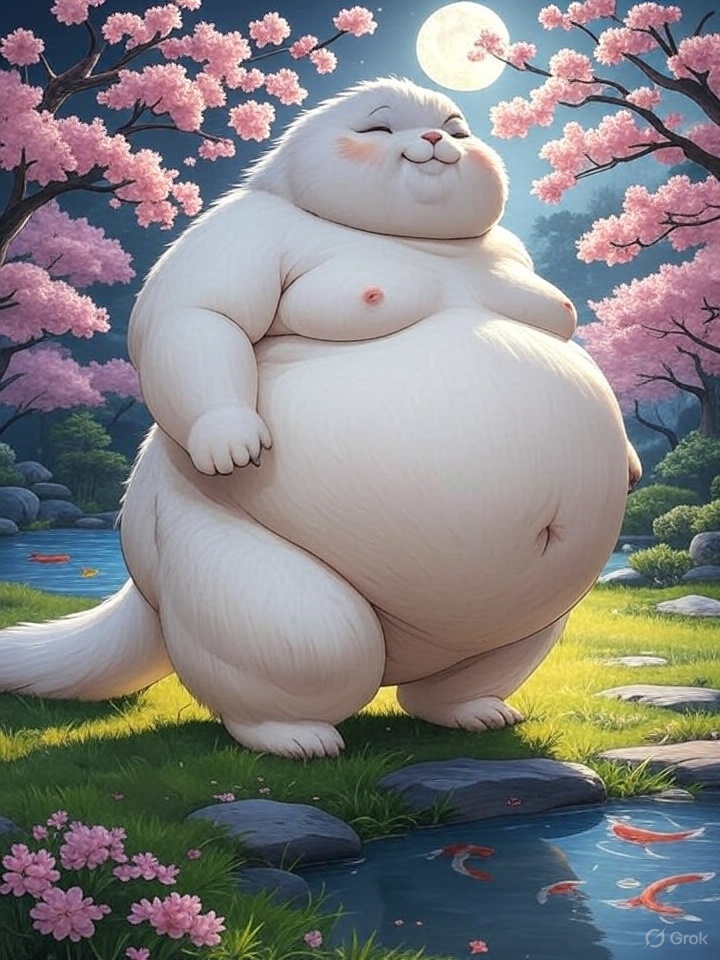
Nebutori (寝太り) means “to grow fat while sleeping,” and refers to a strange yokai-like affliction that causes unnatural lethargy and obesity through supernatural influence.
Illustrated folktale

In a small village nestled between two great mountains, there lived a young woman named Emiko. She was known for her beauty and her love of fine cooking, but also for her tendency to indulge in rich foods and idle pleasures. As the seasons passed, Emiko's appetite only grew stronger, and she spent most of her days lounging on her cushions, feasting on sweet pastries and steaming broth.
One evening, as the sun set over the mountains, a faint rustling sound could be heard coming from Emiko's room. At first, no one thought much of it, assuming it was just the wind or a stray animal in the house. But soon, other strange noises began to echo through the village: creaking floorboards, groaning door hinges, and an eerie whispering that seemed to emanate from nowhere.
It wasn't until Emiko's family noticed her sudden weight gain and listless demeanor that they realized something was amiss. Her once- slender figure now bulged like a ripe melon, and she could hardly stir from her bed without gasping for breath. The villagers whispered among themselves, suspecting that Nebutori had claimed another victim.
As the days passed, Emiko's condition worsened. She would sleep for hours at a time, only to wake with a start and demand more food, more comfort, and more rest. Her skin grew sallow, her eyes sunken, and her once-lively spirit was reduced to a mere shadow of its former self.
Desperate to save their beloved Emiko, the villagers called upon the wise woman of the village, who specialized in healing the supernatural afflictions that plagued their community. The old woman listened carefully as Emiko's family described the strange occurrences and the girl's rapid decline. She nodded knowingly, her eyes clouding with concern.
"Nebutori's influence is clear," she said gravely. "It feeds on excess, on laziness, and on the neglect of one's duties. But there is still a way to free Emiko from its grasp."
The old woman led Emiko's family through a series of rituals: prayers offered to the gods, purification ceremonies at the local shrine, and offerings of rice and sake to appease Nebutori's ire. They also performed a special dance, designed to awaken the spirit within Emiko and guide her back onto the path of balance and moderation.
As they danced around the sleeping girl, the villagers recited an ancient incantation:
"Oh, Nebutori, wicked spirit, Leave our sister be, Release your hold on Emiko's form, And let her find health anew."
Slowly but surely, a transformation began to take place. Emiko's body started to shed its excess weight, and she stirred from her torpor, looking around with confusion but also with a hint of recognition. The villagers continued their rituals, reinforcing the spell of release, until finally, Nebutori's influence was broken.
Emiko rose from her bed, weak but determined, vowing never again to surrender to her baser appetites. As she walked among the villagers, who had watched over her with concern and compassion, a newfound light shone within her eyes – a light that illuminated not only her physical form but also her spirit, now freed from the grip of Nebutori's malevolent presence.
Yokai, oni, kitsune and spirits from folklore
Directory of Japanese board games and traditional games
Verified itch.io pixel-art gacha — fair odds, no ads
Reference guides for classic Japanese ham radios
Ancient joinery techniques of Japanese master craftsmen
Explore Japan's landmarks, shrines and hidden locations
SNES and Super Famicom collection tracker
Hoshi no Isan — a Japanese-aesthetic space RPG in development
Pixel art life sim MMO — start at zero, build your life
AI-powered educational stories for kids
Japanese-aesthetic design tokens & AI-ready UI prompts

Every day, one teaching. One moment of stillness.
Kanji, meaning, and a quiet reflection — rooted in the philosophy
behind Japan's forests, seasons, and sacred silences.
Content Warning: This website explores Japanese folklore and mythological beings—including yokai, oni, and other supernatural entities—that may be frightening to younger audiences or sensitive viewers. All material is presented for educational and cultural appreciation only. Viewer discretion is advised.
Parents and guardians are encouraged to preview content before sharing it with children. By continuing to use JapaneseMythicalCreatures.com, you acknowledge and accept this advisory.
Copyright © 2026 Japanese Mythical Creatures • All Rights Reserved.