

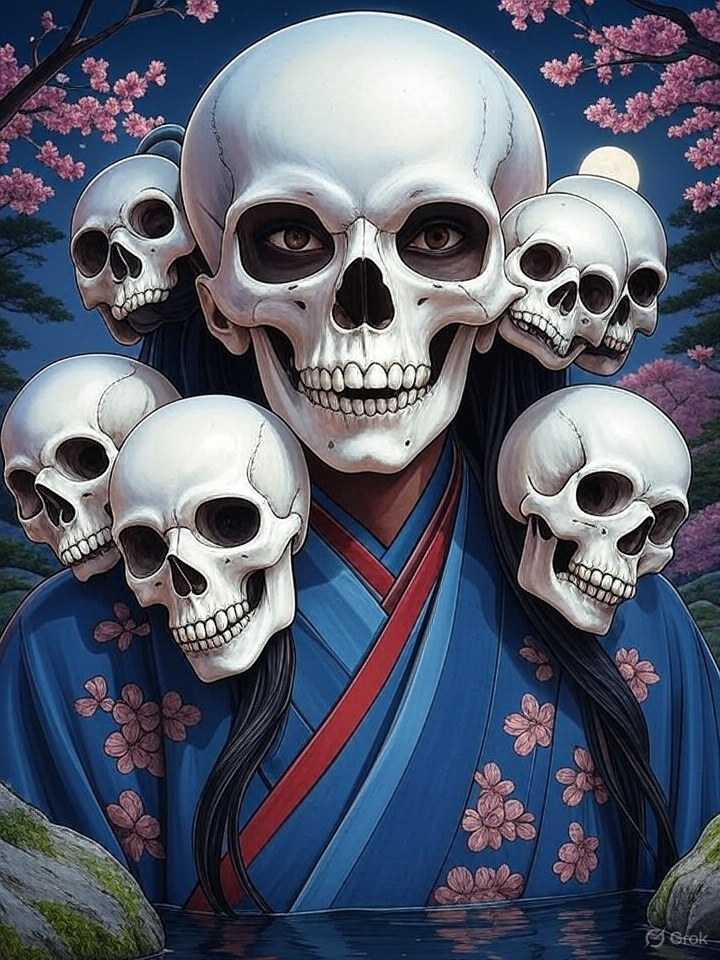
Mekurabe (目競) means “eye contest” or “staring match,” referring to the eerie sensation of being watched by a mass of glaring skulls.
Illustrated folktale

In the mist-shrouded hills of Akashi, where the wind whispers secrets to the pines, there lived a samurai named Hiro. He was a just and honorable warrior, beloved by his comrades and respected by his lord. Yet, despite his noble reputation, Hiro harbored a dark secret: he had abandoned his family's ancestral home after a bitter dispute with his brother.
Years passed, and Hiro built a new life in Akashi. However, the memories of that fateful day still lingered in his dreams. His family's shrine, once a symbol of their prosperity, now stood empty and unvisited. The wind rustled through its gates, whispering tales of resentment to the spirits within.
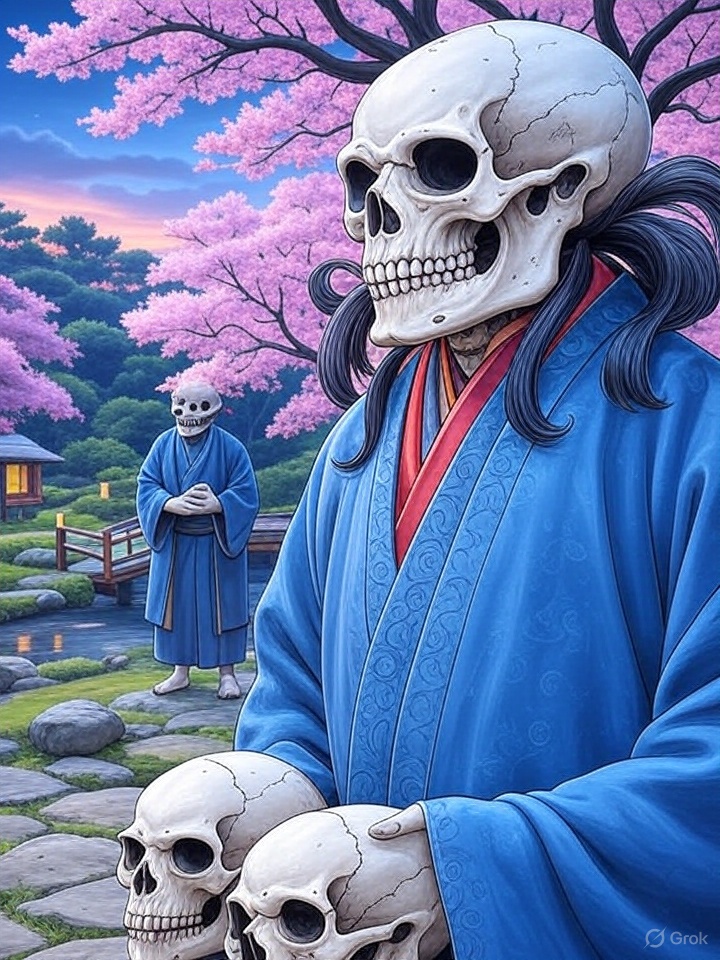
One evening, as Hiro walked along the hillside path, he noticed a faint glow emanating from the direction of the old shrine. He quickened his pace, sensing an omen. Suddenly, a swirling cloud of skulls materialized before him. The Mekurabe, as they were known in whispers, seemed to multiply and shift shape with every step. Their empty sockets glowed like lanterns in the darkness, casting an eerie light on Hiro's face.
Hiro tried to flee, but his feet felt rooted to the spot. The Mekurabe surrounded him, their eyes burning with a malevolent energy. He knew that he could not defeat them by force – only through exorcism and confession of his wrongs could he hope to pacify these vengeful spirits.
With trembling hands, Hiro uncovered the secret he had kept hidden for so long: his family's shrine had been neglected, and their ancestors' grudges left unaddressed. The Mekurabe, manifestations of collective curses and unburied souls, sensed his contrition and began to dissipate. Their glowing eyes dimmed, and the skulls lost their menacing form.
As Hiro watched, a solitary skull drifted forward, its gaze piercing the darkness. It hovered before him, and in a voice that was both whisper and wind, spoke a single phrase: "Kizami no mi o tatsu" – "To atone for the unspoken." With those words, the Mekurabe vanished into the night, leaving Hiro shaken but redeemed.
Hiro returned to his family's shrine, where he spent many moons making amends. He restored the neglected tombstones, honored his ancestors with offerings of incense and rice, and composed a poem to confess his transgressions:
"In Akashi hills, where winds do whisper, A lesson learned, I now take heed. Forgiveness sought, from spirits keen, May their rest be peaceful, my heart freed."
From that day on, Hiro's path was illuminated by the gentle glow of redemption. The Mekurabe never returned to haunt him, and his name became synonymous with honor and respect among his people. In Akashi, where shadows danced upon the hills, Hiro's story spread as a cautionary tale: that karmic justice is ever vigilant, and only through acknowledgment and atonement can one find peace amidst the whispers of the past.
Yokai, oni, kitsune and spirits from folklore
Directory of Japanese board games and traditional games
Verified itch.io pixel-art gacha — fair odds, no ads
Reference guides for classic Japanese ham radios
Ancient joinery techniques of Japanese master craftsmen
Explore Japan's landmarks, shrines and hidden locations
SNES and Super Famicom collection tracker
Hoshi no Isan — a Japanese-aesthetic space RPG in development
Pixel art life sim MMO — start at zero, build your life
AI-powered educational stories for kids
Japanese-aesthetic design tokens & AI-ready UI prompts

Every day, one teaching. One moment of stillness.
Kanji, meaning, and a quiet reflection — rooted in the philosophy
behind Japan's forests, seasons, and sacred silences.
Content Warning: This website explores Japanese folklore and mythological beings—including yokai, oni, and other supernatural entities—that may be frightening to younger audiences or sensitive viewers. All material is presented for educational and cultural appreciation only. Viewer discretion is advised.
Parents and guardians are encouraged to preview content before sharing it with children. By continuing to use JapaneseMythicalCreatures.com, you acknowledge and accept this advisory.
Copyright © 2026 Japanese Mythical Creatures • All Rights Reserved.