

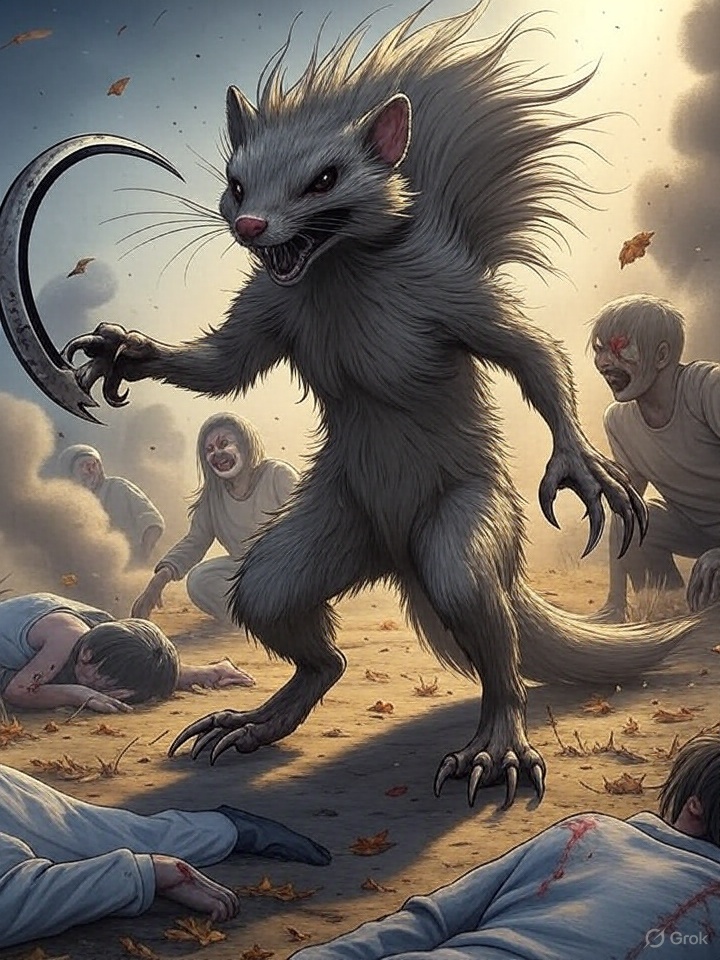
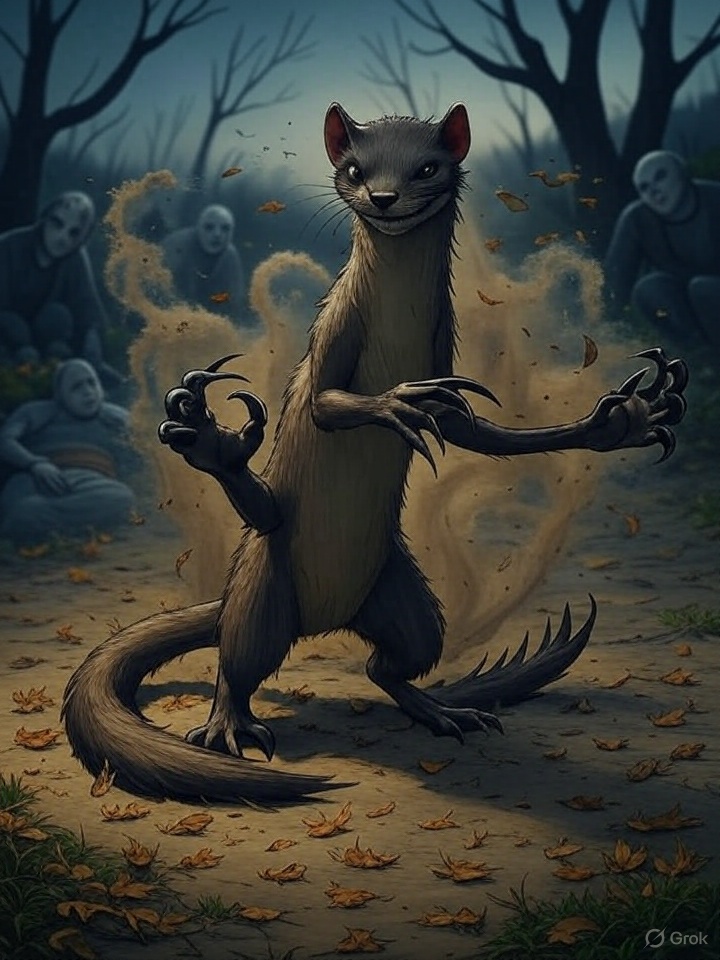
Kamaitachi (鎌鼬) literally means "sickle weasel," referring to its blade-like claws and swift strikes.
Illustrated folktale

In the mist-shrouded mountains of Akakawa, where the wind whispers secrets to the trees, there lived an elderly woodcutter named Kaito. For generations, his family had harvested firewood from these hills, their axes slicing through the silence like a symphony of steel on stone.
One autumn evening, as Kaito made his way home, he stumbled upon a trio of small, swift creatures darting between the ferns. Their eyes glinted like polished obsidian in the fading light, and their fur seemed to ripple with an otherworldly sheen. A breeze carried the faint scent of mountain herbs and damp earth as they vanished into the undergrowth.
Days passed, but Kaito's thoughts kept drifting back to those enigmatic creatures. He couldn't shake the feeling that his encounter was more than mere coincidence. His axe arm ached with an unfamiliar soreness, as if an invisible blade had sliced through his sleeve and caressed the bone beneath.
Rumors began to circulate among the villagers: mysterious cuts on travelers' arms and legs, often accompanied by tales of gusty winds and unexplained chilliness. The elderly priestess of the nearby shrine spoke of kamaitachi, mischievous spirits born from the wind's fury, which sometimes took the form of weasels with sickle-like claws.
Kaito, a practical man with little patience for superstition, dismissed these warnings as mere village gossip. Yet, the wounds persisted – small, bloodless lacerations that seemed to appear and vanish like wisps of cloud. His axe arm now throbbed constantly, as if some unseen force had taken up residence within him.
One morning, while Kaito was gathering firewood, a gust swept through the forest, sending leaves swirling around his feet. As he raised his arms to shield himself, a figure emerged from the whirlwind's edge – one of the trio he'd encountered before. Its eyes locked onto Kaito's, and for an instant, they seemed to hold a glimmering understanding.
In that flash of recognition, Kaito felt an unseen hand grasp his wrist, guiding him deeper into the forest. The wind died down, leaving behind only the soft crunch of leaves underfoot. There, nestled between two ancient trees, lay a small bundle wrapped in a fragment of worn cloth. Inside, a delicate piece of bamboo had been carved with a crude yet elegant symbol – the mark of the kamaitachi.
As Kaito's fingers closed around the token, his wounds began to heal at an alarming rate. The ache within him subsided, replaced by a subtle understanding: some forces are not to be battled or ignored, but respected and listened to. He knew then that his encounter with the kamaitachi was less a threat than a warning – a reminder of nature's unforgiving power, and the need for humility when traversing her untamed realms.
From that day on, Kaito approached his work in the mountains with reverence and caution, offering silent thanks to the enigmatic trio as he set foot each morning into their domain. And though the kamaitachi remained elusive, their presence whispered through the wind like a perpetual reminder: in these mountains, some secrets are best left unspoken.
Yokai, oni, kitsune and spirits from folklore
Directory of Japanese board games and traditional games
Verified itch.io pixel-art gacha — fair odds, no ads
Reference guides for classic Japanese ham radios
Ancient joinery techniques of Japanese master craftsmen
Explore Japan's landmarks, shrines and hidden locations
SNES and Super Famicom collection tracker
Hoshi no Isan — a Japanese-aesthetic space RPG in development
Pixel art life sim MMO — start at zero, build your life
AI-powered educational stories for kids
Japanese-aesthetic design tokens & AI-ready UI prompts

Every day, one teaching. One moment of stillness.
Kanji, meaning, and a quiet reflection — rooted in the philosophy
behind Japan's forests, seasons, and sacred silences.
Content Warning: This website explores Japanese folklore and mythological beings—including yokai, oni, and other supernatural entities—that may be frightening to younger audiences or sensitive viewers. All material is presented for educational and cultural appreciation only. Viewer discretion is advised.
Parents and guardians are encouraged to preview content before sharing it with children. By continuing to use JapaneseMythicalCreatures.com, you acknowledge and accept this advisory.
Copyright © 2026 Japanese Mythical Creatures • All Rights Reserved.