

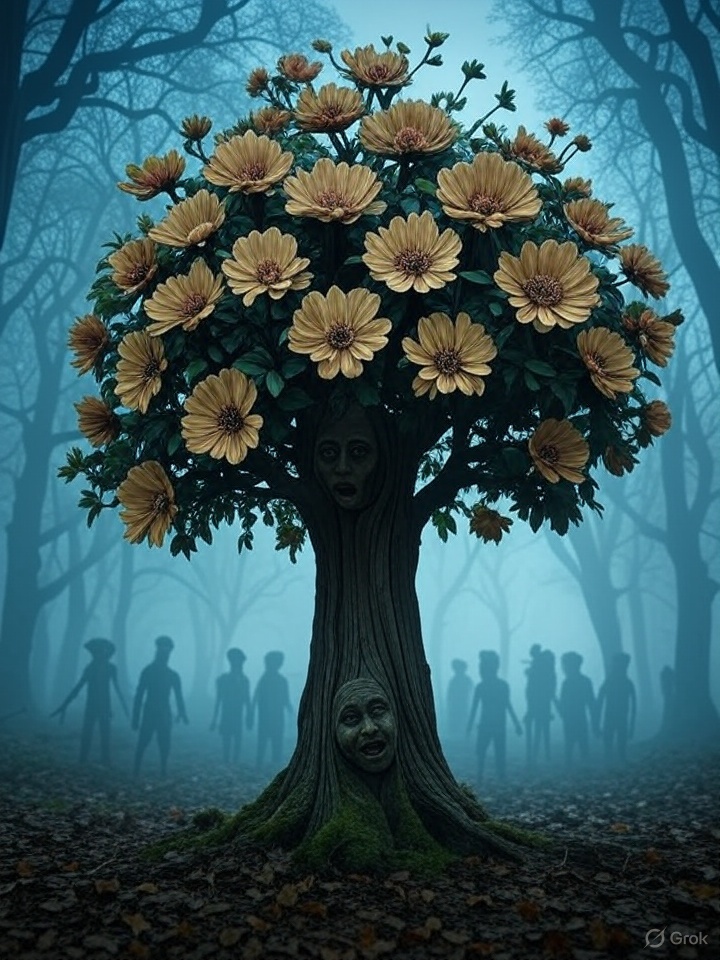
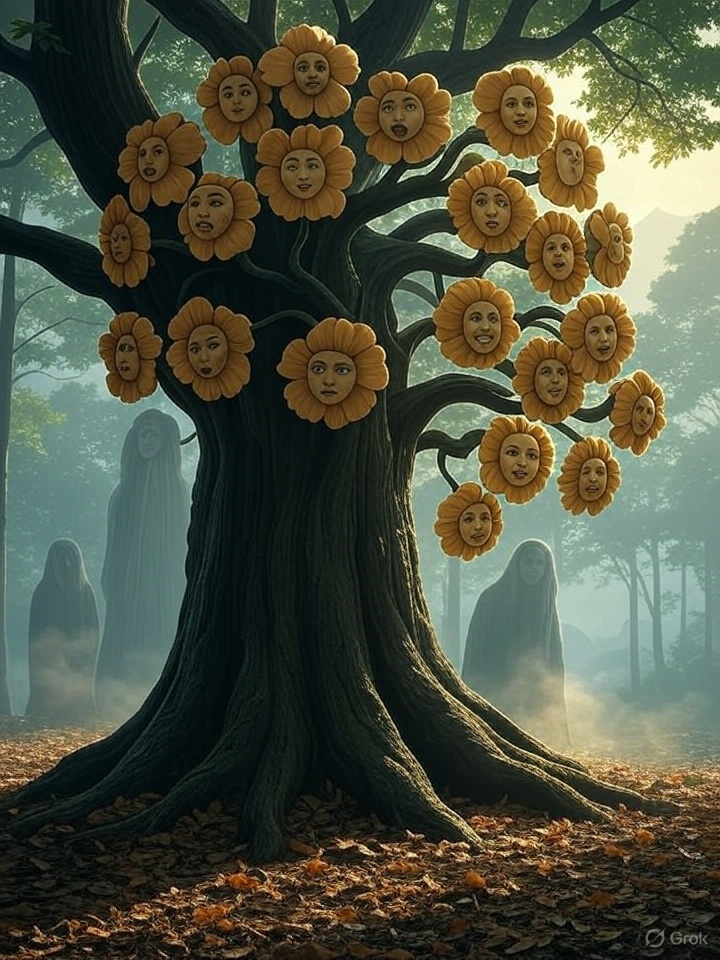
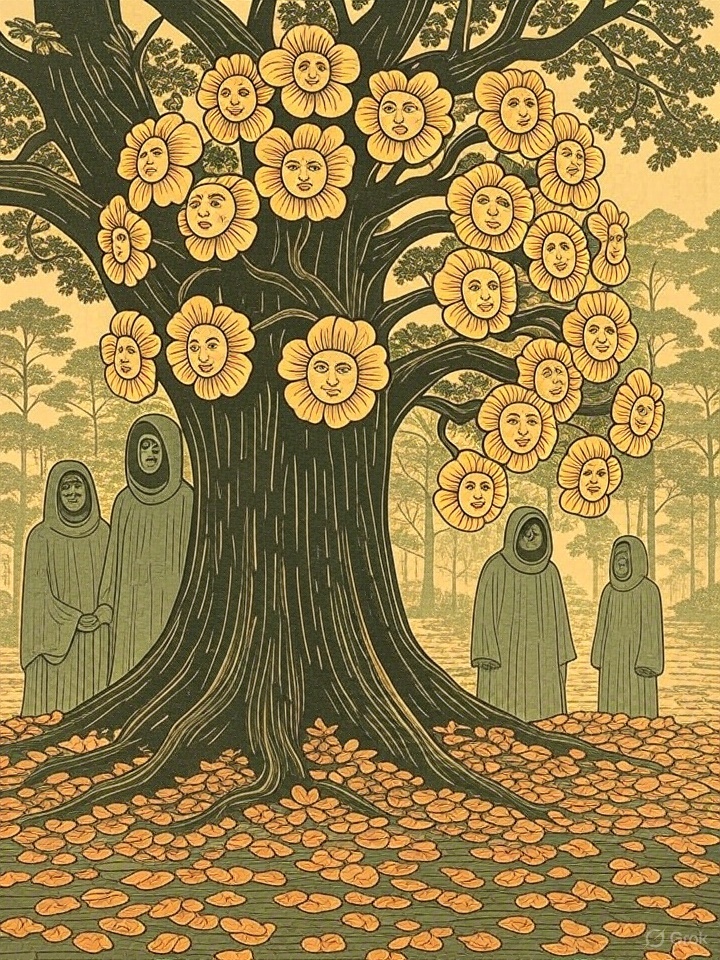
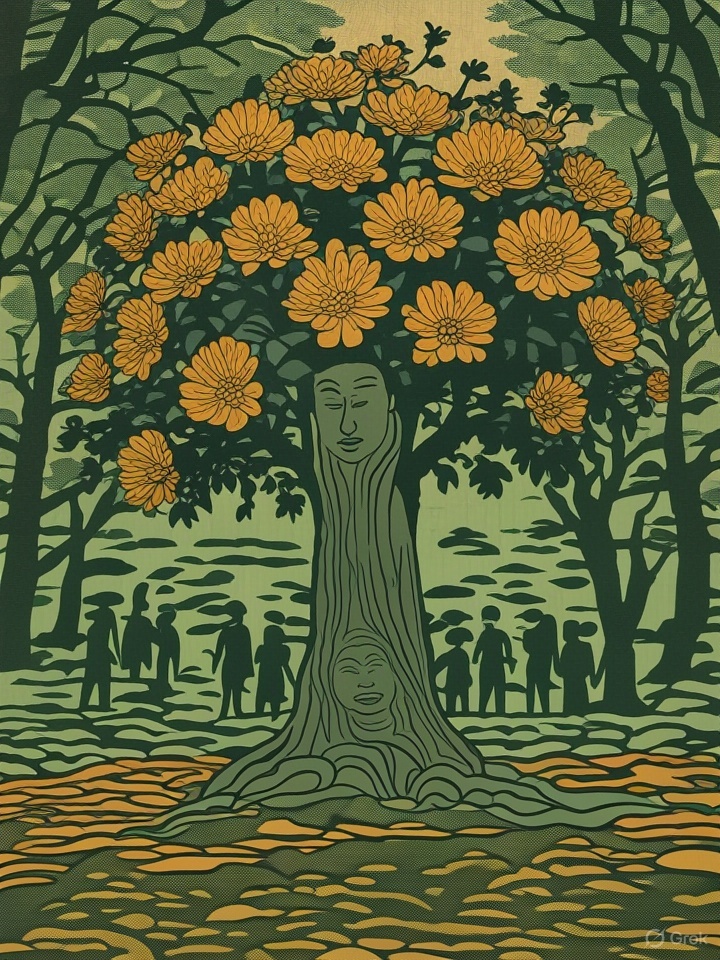
Jinmenju (人面樹) literally means “human-faced tree.” It is said to bear fruit or flowers resembling human heads that grin and laugh.
Illustrated folktale

In the heart of a mist-shrouded valley, where the morning sun struggled to penetrate the grey veil, there stood an ancient tree with branches that seemed to defy gravity itself. Its limbs twisted and curved like living serpents, laden with flower-like heads that bloomed in every color of the rainbow. But it was not their vibrant hues or delicate petals that drew the attention of those who stumbled upon this mystical place – it was the faces.
Faces that laughed, always laughing, without reprieve or respite. They were the very embodiment of mirth, their smiles so wide and genuine they seemed to pierce the heart like a dagger. Their eyes sparkled with an unquenchable joy, as if privy to some secret known only to themselves.
A young traveler named Kaito wandered into this valley seeking solace from his own troubles. His village had been plagued by drought for seasons on end, and the crops lay withering in the sun. The elder's predictions spoke of a cursed land, one where the spirits of nature had turned their backs on humanity. Kaito hoped to find some respite among the whispers of ancient wisdom carried by the wind.
As he approached the Jinmenju, its branches seemed to reach out like skeletal fingers, beckoning him closer. The faces laughed on, a cacophony that was both mesmerizing and unnerving. Kaito felt his heart heavy with foreboding, yet he couldn't help but be drawn in by their infectious glee.
He reached out a trembling hand to touch one of the smiling heads, and as soon as he did, the face turned towards him. Their laughter grew louder, until it was almost deafening. The tree's branches swayed violently, as if trying to shake off the weight of its own merriment.
Kaito stumbled backward, his eyes wide with fear. He had never seen anything like this before – a living entity so consumed by joy that it seemed to feed on itself. Yet, even in his terror, he couldn't help but feel a twinge of sadness. These faces, these laughing flowers, were not just whimsical trinkets of nature; they were a reflection of humanity's own fragmented psyche.
As the mist swirled around him, Kaito realized that the Jinmenju was not just a tree – it was a guardian, a harbinger of secrets hidden beneath the surface. The faces laughed on, but their mirth now seemed tinged with sorrow, as if they held within them the weight of all humanity's pain.
Kaito fled the valley, his heart heavy with the knowledge that some mysteries were better left unspoken. He never forgot the Jinmenju and its laughing faces, though he dared not speak of it to anyone lest he be deemed mad by association. The memory haunted him, a reminder of the surreal beauty that lurked in every corner of this world – a beauty that was both captivating and suffocating.
From that day on, Kaito made it a point to carry a small, delicate flower with him at all times, one with petals as soft as silk and as pale as moonlight. It was said that these flowers could ward off the madness brought on by gazing upon the Jinmenju's faces for too long – but only if one had truly seen the tree, truly understood its secrets.
Yokai, oni, kitsune and spirits from folklore
Directory of Japanese board games and traditional games
Verified itch.io pixel-art gacha — fair odds, no ads
Reference guides for classic Japanese ham radios
Ancient joinery techniques of Japanese master craftsmen
Explore Japan's landmarks, shrines and hidden locations
SNES and Super Famicom collection tracker
Hoshi no Isan — a Japanese-aesthetic space RPG in development
Pixel art life sim MMO — start at zero, build your life
AI-powered educational stories for kids
Japanese-aesthetic design tokens & AI-ready UI prompts

Every day, one teaching. One moment of stillness.
Kanji, meaning, and a quiet reflection — rooted in the philosophy
behind Japan's forests, seasons, and sacred silences.
Content Warning: This website explores Japanese folklore and mythological beings—including yokai, oni, and other supernatural entities—that may be frightening to younger audiences or sensitive viewers. All material is presented for educational and cultural appreciation only. Viewer discretion is advised.
Parents and guardians are encouraged to preview content before sharing it with children. By continuing to use JapaneseMythicalCreatures.com, you acknowledge and accept this advisory.
Copyright © 2026 Japanese Mythical Creatures • All Rights Reserved.