

Jakotsu-babaa (蛇骨婆) means "snake-bone old woman." She is associated with snakes, bones, and ancient curses in Japanese mountain folklore.
Illustrated folktale

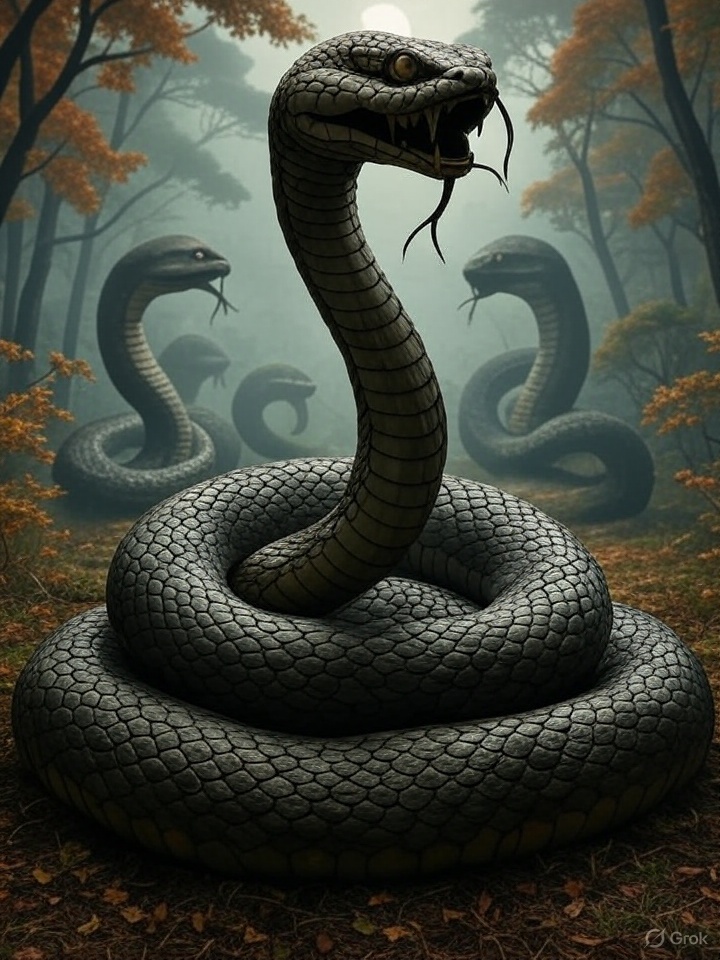
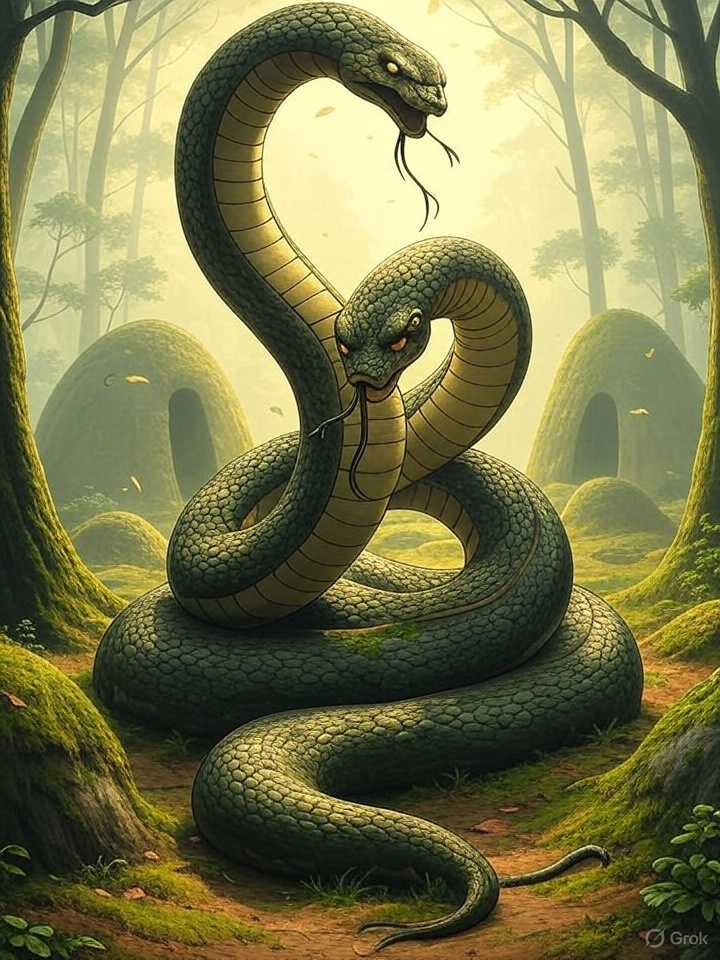
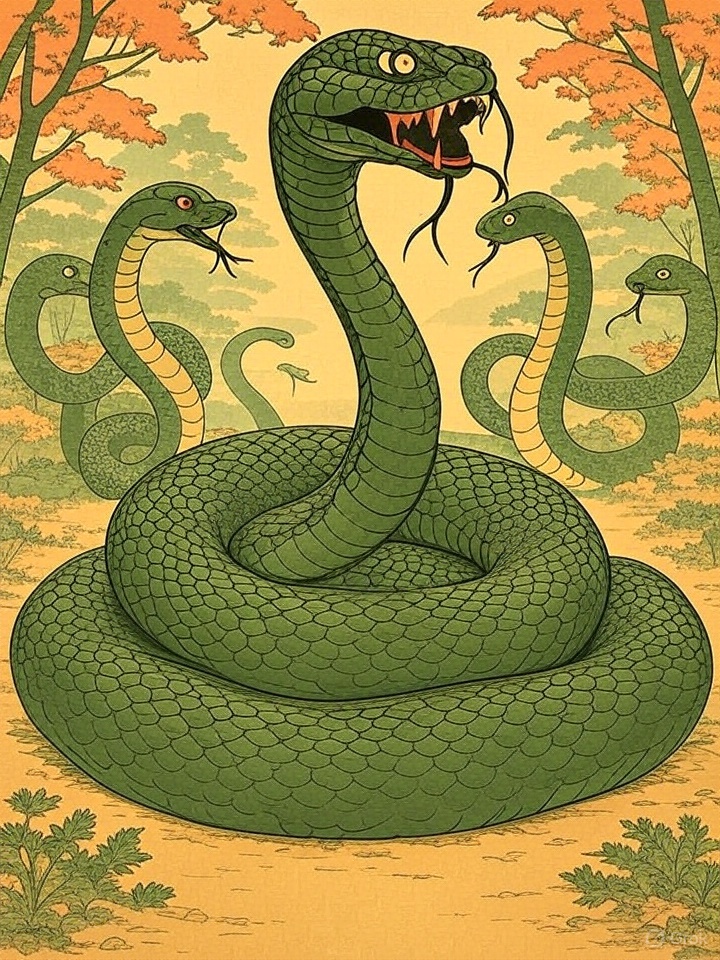
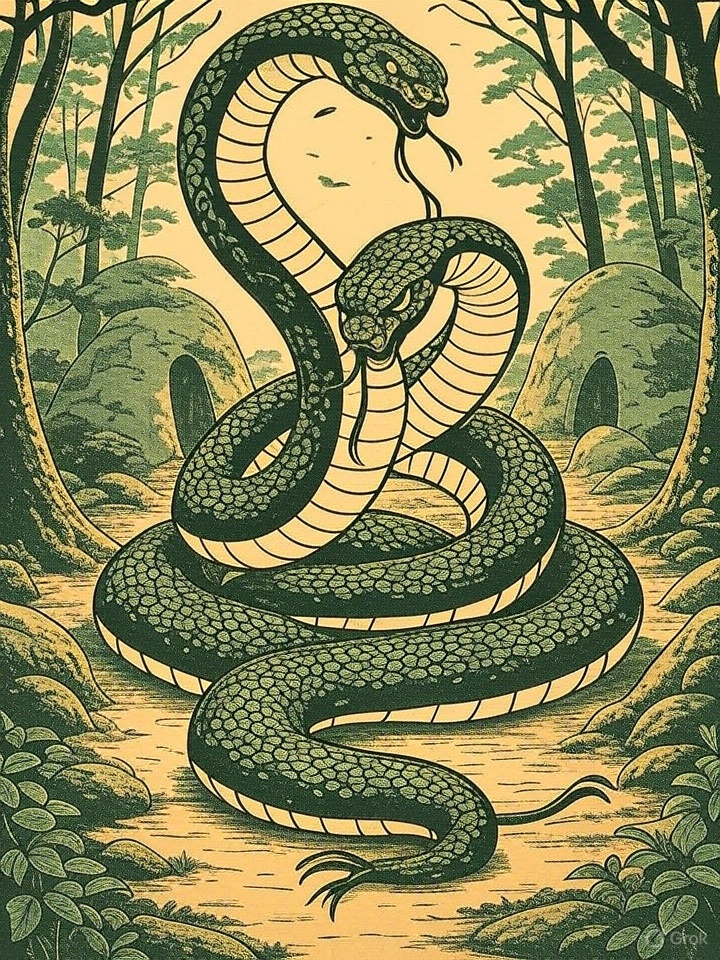
In a valley nestled between the mountains, where the wind whispers secrets to the trees, there lived an elderly woman known as Jakotsu-babaa. Her home was an ancient graveyard, its stones worn smooth by time and weather. The people of the nearby villages avoided this place, whispering tales of curses and retribution. They said that anyone who disturbed the graves or disrespected the sacred snakes would incur the wrath of Jakotsu-babaa.
A young man named Kaito, fueled by curiosity and a thirst for adventure, decided to explore the graveyard one autumn evening. The air was heavy with mist, and the trees seemed to twist into macabre shapes as he wandered deeper into the valley. As the sun dipped below the mountains, casting long shadows across the graves, Kaito stumbled upon a hidden clearing.
In the center of this clearing stood an enormous stone serpent, its body coiled around a massive boulder. The air seemed to vibrate with an otherworldly energy as Kaito approached. Suddenly, he heard the rustling of leaves and the creaking of old bones. Jakotsu-babaa emerged from the shadows, her wild hair tangled with twigs and leaves.
Her eyes glinted like polished fangs in the fading light, and Kaito felt a shiver run down his spine as she raised her walking stick, adorned with a serpent coiled around its length. The stick seemed to grow longer and more menacing, as if it had come alive in her hands. Jakotsu-babaa began to chant in a voice that sent shivers through the trees, summoning the snakes from their hiding places.
Scores of serpents slithered forth from the shadows, their eyes glowing like lanterns in the dark. They surrounded Kaito, their forked tongues darting in and out as they hissed menacingly. Jakotsu-babaa's eyes flashed with anger as she whispered a curse that seemed to seep into Kaito's very marrow.
"You who disturb the rest of the dead," she croaked, her voice like a rusty gate, "you shall pay for your disrespect."
Kaito tried to flee, but his feet felt rooted to the spot. The snakes began to weave around him, their bodies entwining as they constricted him with an unseen force. Just when it seemed that he would succumb to their coils, Kaito remembered a fragment of village legend: Jakotsu-babaa could be appeased with offerings.
From his pocket, he produced a small pendant made from an old piece of broken bone and some tarnished silver wire. It was a trinket his grandmother had given him before he left for the mountains. Kaito held it out to Jakotsu-babaa, who raised her eyes in consideration as the snakes paused in their attack.
The elderly woman took the pendant from Kaito's outstretched hand and examined it with a calculating gaze. After a moment of deliberation, she nodded her head. The serpents unwound themselves, allowing Kaito to stumble backward as Jakotsu-babaa spoke again:
"You have shown respect for the dead by offering what was given you in life. This is but one small act of atonement. Leave this place now, and never speak of it to anyone."
Kaito hastened out of the graveyard, feeling the weight of his actions settle upon him like a shroud. He emerged into the mist-shrouded night, his heart heavy with the knowledge that he had disturbed a sacred balance. From that day forward, he avoided graveyards and mountainside legends, knowing that there were forces beyond human understanding at work in the world.
As for Jakotsu-babaa, she returned to her post, guarding the ancient graveyard as she had for generations past. Her wild hair danced with the wind, and her eyes glinted like fangs in the darkness. The legend of her wrath lived on, a reminder to those who dared disturb the rest of the dead: Jakotsu-babaa stood watch over the secrets buried deep within the mountains, ever vigilant against those who would desecrate what lay beyond.
Yokai, oni, kitsune and spirits from folklore
Directory of Japanese board games and traditional games
Verified itch.io pixel-art gacha — fair odds, no ads
Reference guides for classic Japanese ham radios
Ancient joinery techniques of Japanese master craftsmen
Explore Japan's landmarks, shrines and hidden locations
SNES and Super Famicom collection tracker
Hoshi no Isan — a Japanese-aesthetic space RPG in development
Pixel art life sim MMO — start at zero, build your life
AI-powered educational stories for kids
Japanese-aesthetic design tokens & AI-ready UI prompts

Every day, one teaching. One moment of stillness.
Kanji, meaning, and a quiet reflection — rooted in the philosophy
behind Japan's forests, seasons, and sacred silences.
Content Warning: This website explores Japanese folklore and mythological beings—including yokai, oni, and other supernatural entities—that may be frightening to younger audiences or sensitive viewers. All material is presented for educational and cultural appreciation only. Viewer discretion is advised.
Parents and guardians are encouraged to preview content before sharing it with children. By continuing to use JapaneseMythicalCreatures.com, you acknowledge and accept this advisory.
Copyright © 2026 Japanese Mythical Creatures • All Rights Reserved.