

Futakuchi-onna (二口女) literally means “two-mouthed woman.” She appears outwardly normal but harbors a hidden, supernatural mouth at the back of her head.

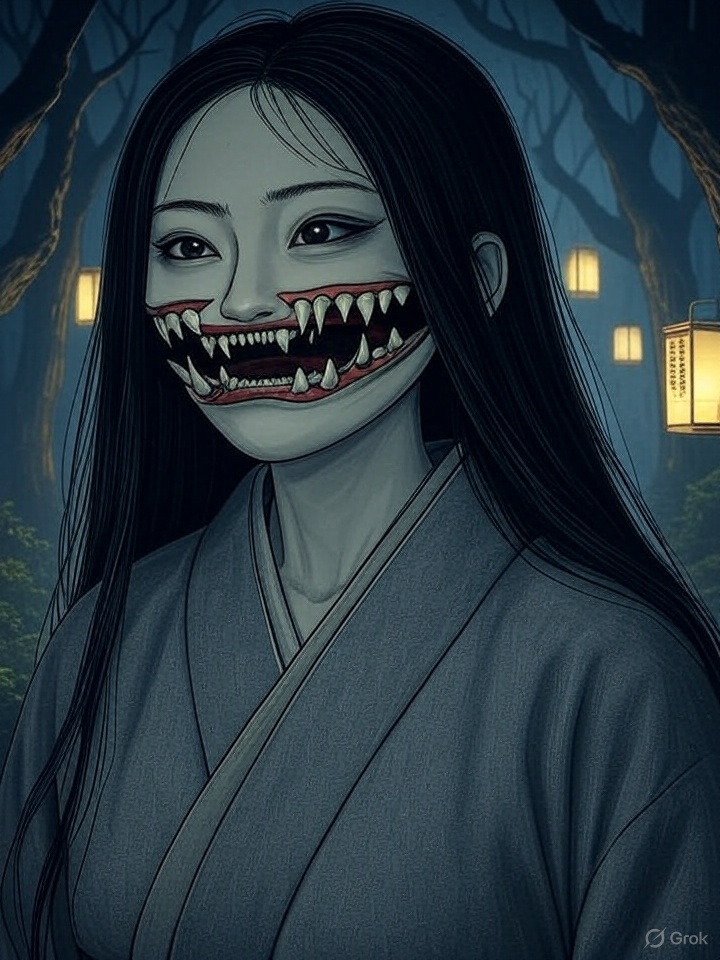
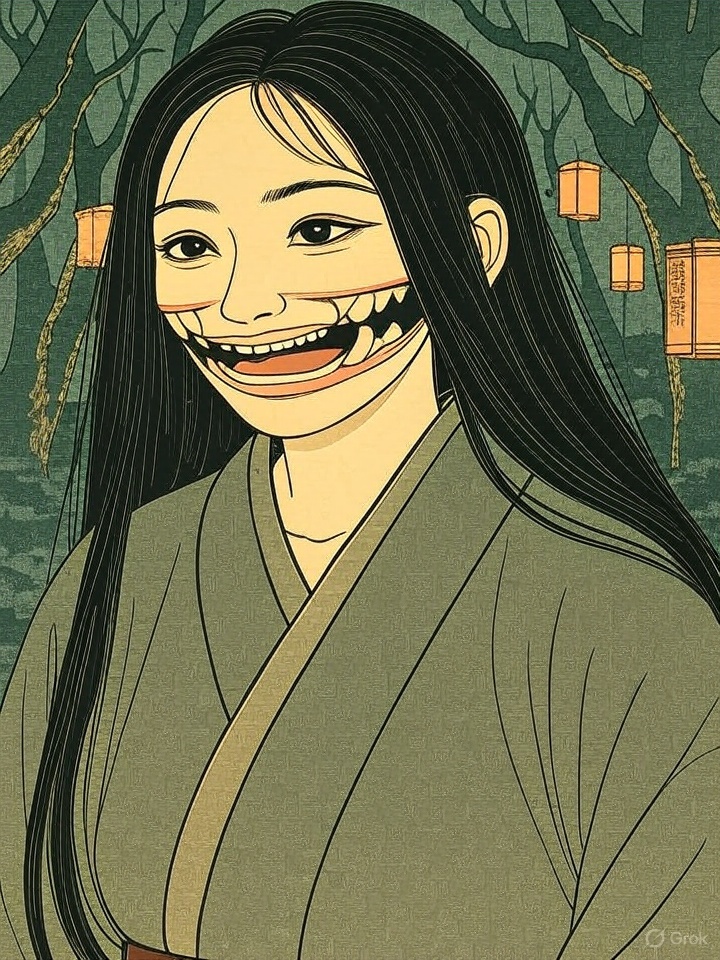

Illustrated folktale

In a small village nestled between two great mountains, there lived a woman named Otohime. She was known for her thriftiness and self-reliance, able to eke out a living from the tiniest scraps of food and fuel. Neighbors would often remark on her remarkable frugality, but also whisper among themselves about the eerie aura that surrounded her.
As the seasons changed, Otohime's appearance seemed to shift with them. In spring, her skin was pale and gaunt, like the first tender shoots of rice. Summer sun tanned her dark, but also accentuated the deep lines etched on her face, like the cracks in an ancient wooden bridge. Autumn leaves rustled through her hair, which hung down her back like a cascade of golden silk, but also seemed to move and twist on its own, as if alive.
People began to notice that Otohime would often excuse herself during meals, disappearing for short stretches into the nearby forest. They assumed she was hunting for wild greens or berries, but some claimed to have seen her return with an unshakeable hunger in her eyes. Her neighbors grew uneasy, sensing a darkness at work beneath her stoic surface.
One night, under a moon so full it seemed to be spilling over the thatched roofs of their homes, Otohime's hidden nature burst forth. As she sat by the fireside, mending a torn piece of fabric, her hair began to writhe like living serpents. A low growl rumbled from within its tangled mass, and two jaws opened in unison – one at the front of her head, the other beneath her hairline.
The sound that emerged was unlike anything anyone had ever heard: a keening wail that shredded the night air, accompanied by the clatter of teeth grinding against each other. Otohime's eyes rolled back in her head, and she began to rock back and forth, as if trying to lull the beast within into silence.
Her neighbors fled in terror, but one brave young woman named Emiko remained transfixed by the spectacle. She saw that Otohime's second mouth was not just eating away at her from beneath; it was also speaking, its voice a constant litany of demand and complaint. "Feed me," it wailed. "Fill my belly." The sound sent shivers down Emiko's spine, but she felt an odd sense of recognition – as if the Futakuchi-onna's cries were a mirror held up to her own heart.
As the night wore on, Otohime's struggle grew more frenzied. Her body began to wither away, as if the very life force was being drained from her. Emiko realized that this was not just a monster; it was a symptom of something deeper – the hidden hunger within Otohime herself.
When dawn broke, the Futakuchi-onna's second mouth finally fell silent. The villagers gathered around their fallen neighbor, but found only a husk-like shell where Otohime had once stood. Her eyes were sunken, her skin papery thin. A single phrase, scrawled on the floor in rice dust, seemed to capture the essence of her transformation: "Kono kuchi wa kanarazu" – This mouth never stops.
From that day forward, Emiko carried Otohime's story within her like a secret. She knew that sometimes, what lies hidden beneath our surface can consume us entirely – and that only by facing these darkest aspects could we hope to heal.
Yokai, oni, kitsune and spirits from folklore
Directory of Japanese board games and traditional games
Verified itch.io pixel-art gacha — fair odds, no ads
Reference guides for classic Japanese ham radios
Ancient joinery techniques of Japanese master craftsmen
Explore Japan's landmarks, shrines and hidden locations
SNES and Super Famicom collection tracker
Hoshi no Isan — a Japanese-aesthetic space RPG in development
Pixel art life sim MMO — start at zero, build your life
AI-powered educational stories for kids
Japanese-aesthetic design tokens & AI-ready UI prompts

Every day, one teaching. One moment of stillness.
Kanji, meaning, and a quiet reflection — rooted in the philosophy
behind Japan's forests, seasons, and sacred silences.
Content Warning: This website explores Japanese folklore and mythological beings—including yokai, oni, and other supernatural entities—that may be frightening to younger audiences or sensitive viewers. All material is presented for educational and cultural appreciation only. Viewer discretion is advised.
Parents and guardians are encouraged to preview content before sharing it with children. By continuing to use JapaneseMythicalCreatures.com, you acknowledge and accept this advisory.
Copyright © 2026 Japanese Mythical Creatures • All Rights Reserved.