

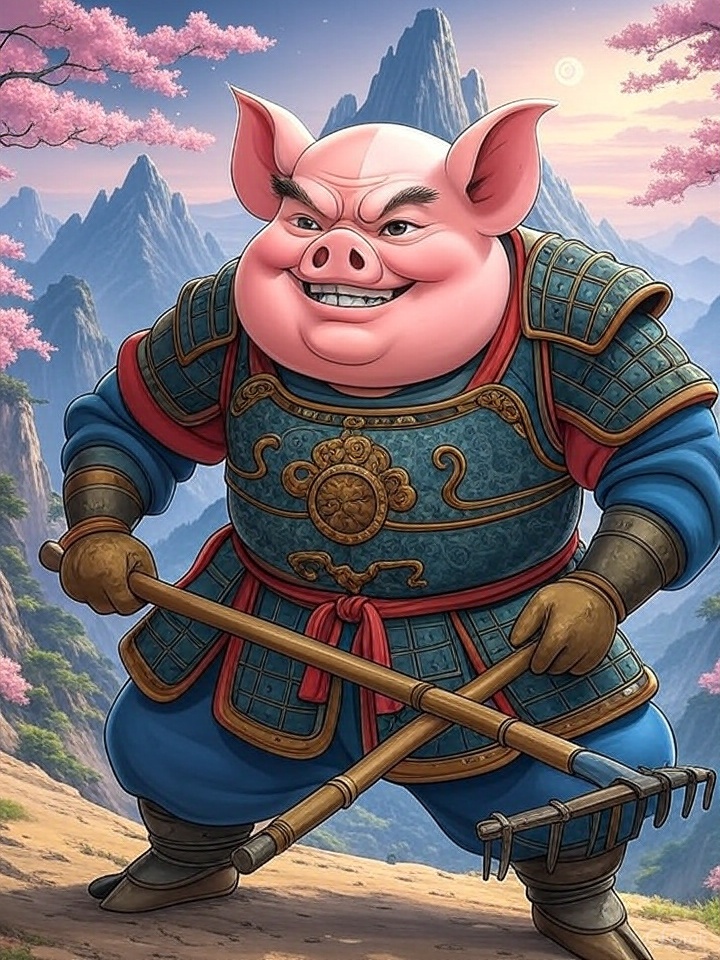
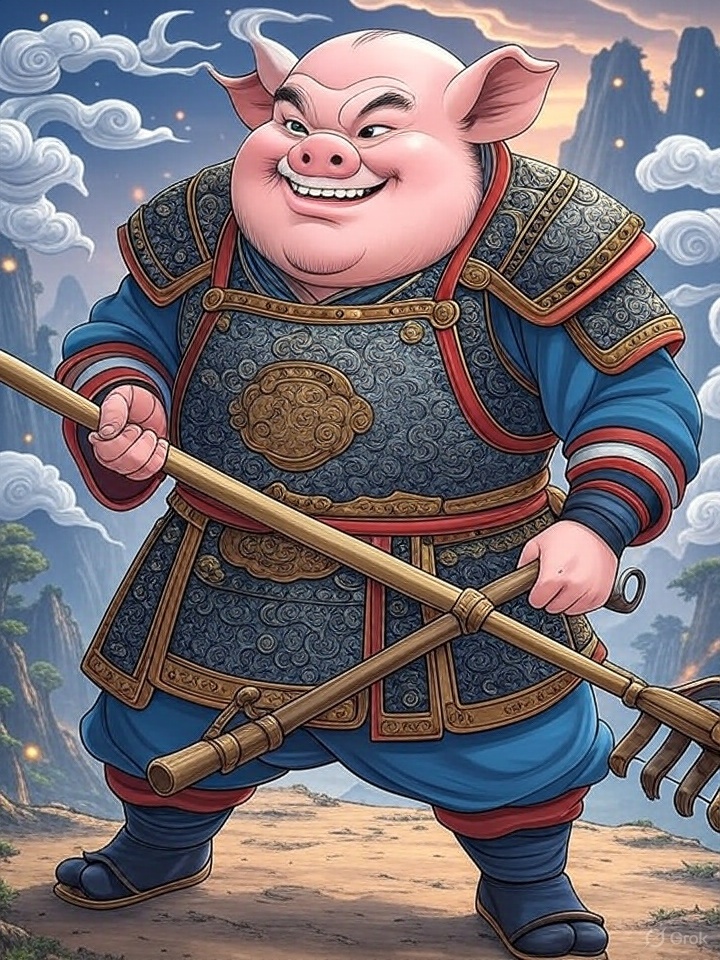
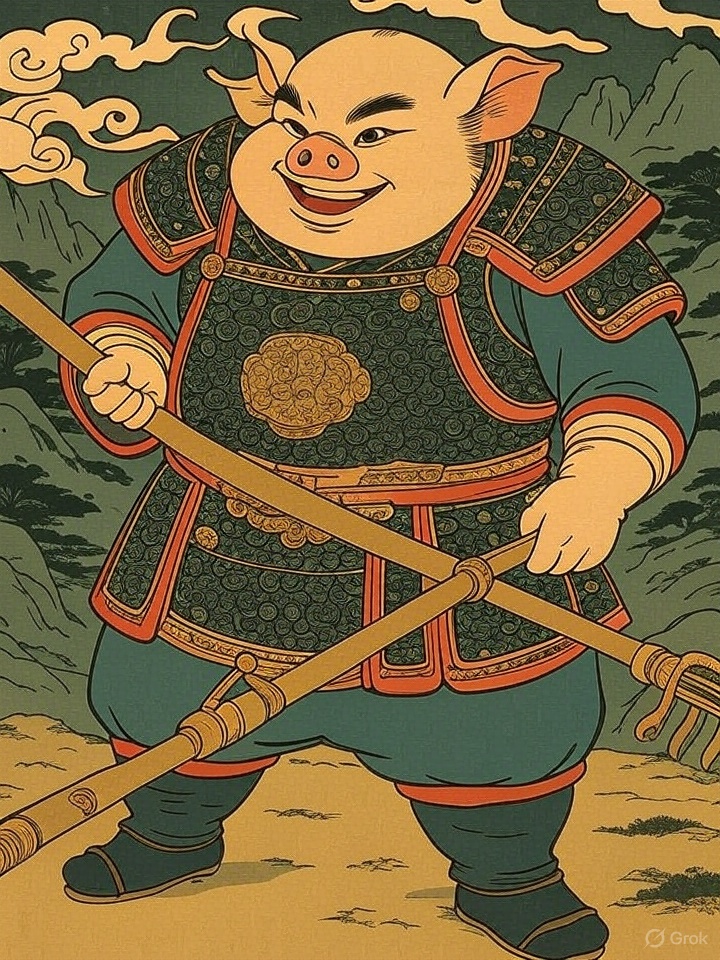
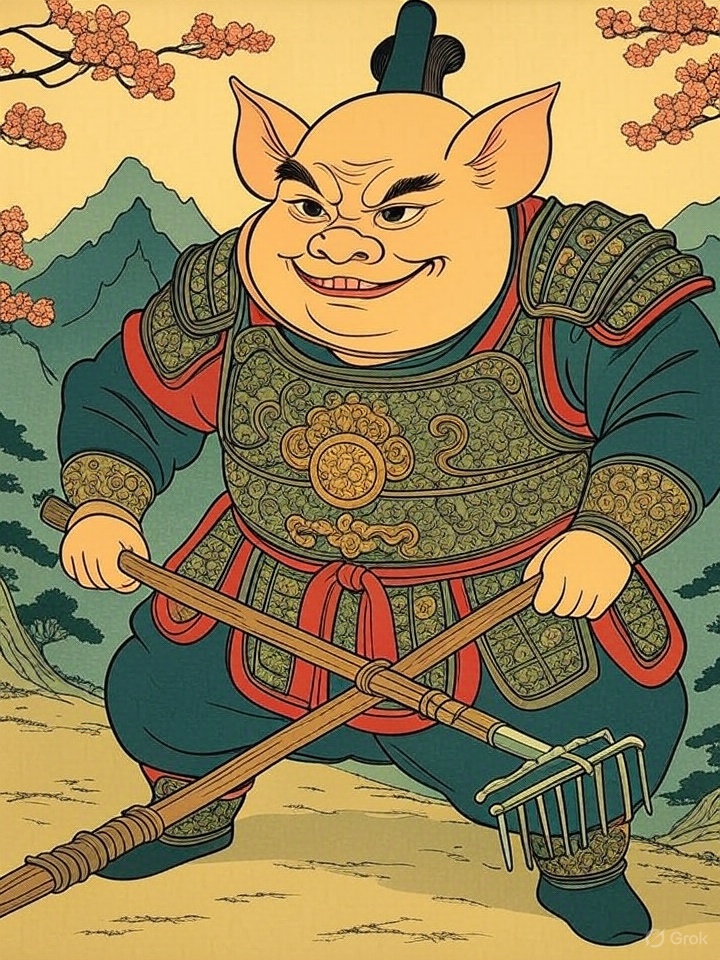
Cho Hakkai (猪八戒) is the Japanese name for Zhu Bajie, a major character from the Chinese classic *Journey to the West*. Known for his gluttony and lust, he also exhibits moments of great loyalty and bravery.
Illustrated folktale

In the mist-shrouded mountains of old Japan, where the cypress trees whispered secrets to the wind, and the snowflakes danced like tiny lanterns in the night sky, there lived a humble village nestled among the pines. It was said that on certain evenings, when the moon hung low and the air grew heavy with the scent of cherry blossoms, one could catch glimpses of Cho Hakkai, the heavenly general reborn as a pig-like man.
Rumors spread like autumn leaves about his exploits: how he would steal fish from the nets of unsuspecting villagers, or sneak into the temple kitchen to devour all the offerings meant for the gods. Some said he was a trickster, born of heaven's punishment for his own misdeeds, while others claimed he was simply a lost soul, wandering the mortal realm in search of redemption.
One winter evening, as the first snows began to fall, a young monk named Kaito arrived at the village, seeking refuge from the cold. He had heard tales of Cho Hakkai's presence and hoped to find guidance on his own journey toward enlightenment. As he walked through the snowy streets, the sound of clanging metal echoed through the air, followed by the unmistakable grunting of a pig-like creature.
Kaito followed the noise to a nearby garden, where he found Cho Hakkai surrounded by a scattering of fruit and vegetables, which he was devouring with reckless abandon. The heavenly general's eyes sparkled with mirth as he caught sight of Kaito, but his expression quickly turned serious as he realized the young monk's presence.
"A traveler," Cho Hakkai said, wiping his mouth with the back of his hand, "I suppose you're here to judge me?"
Kaito hesitated, unsure how to respond. "No, sir. I seek guidance, and your reputation... precedes you."
Cho Hakkai snorted, sending a spray of snow into the air. "Reputation? Ha! In my day, I was a mighty general, feared by demons and mortals alike. Now, I'm little more than a pest, devouring all in sight."
As they spoke, the snowfall grew heavier, and the wind began to howl like a chorus of restless spirits. Kaito noticed that Cho Hakkai's usual rake lay abandoned, its wooden handle half-buried in the snow.
"Why do you still carry this?" Kaito asked, nodding toward the rake.
Cho Hakkai looked down at his hands, as if surprised to find them holding the familiar tool. "A reminder of my duty," he said softly, "to serve and protect, even when all I want is to indulge in the fleeting pleasures of life."
The storm raged on outside, but within the garden, an unexpected calm descended. As Kaito watched, Cho Hakkai's expression transformed from one of self-pity to resolve.
"I have walked this path for many years," he said, "yet still I stumble, again and again. But perhaps, with your company, I may find a way to redeem myself."
As the snow finally began to let up, Kaito felt an unshakeable sense that Cho Hakkai was more than just a flawed and amusing creature – he was a beacon of hope for those struggling on their own journeys toward enlightenment. And as they walked through the village together, hand in hand with the pig-like man who wore the face of heaven's punishment, Kaito knew that he would never forget the lessons learned in that snowy garden.
Yokai, oni, kitsune and spirits from folklore
Directory of Japanese board games and traditional games
Verified itch.io pixel-art gacha — fair odds, no ads
Reference guides for classic Japanese ham radios
Ancient joinery techniques of Japanese master craftsmen
Explore Japan's landmarks, shrines and hidden locations
SNES and Super Famicom collection tracker
Hoshi no Isan — a Japanese-aesthetic space RPG in development
Pixel art life sim MMO — start at zero, build your life
AI-powered educational stories for kids
Japanese-aesthetic design tokens & AI-ready UI prompts

Every day, one teaching. One moment of stillness.
Kanji, meaning, and a quiet reflection — rooted in the philosophy
behind Japan's forests, seasons, and sacred silences.
Content Warning: This website explores Japanese folklore and mythological beings—including yokai, oni, and other supernatural entities—that may be frightening to younger audiences or sensitive viewers. All material is presented for educational and cultural appreciation only. Viewer discretion is advised.
Parents and guardians are encouraged to preview content before sharing it with children. By continuing to use JapaneseMythicalCreatures.com, you acknowledge and accept this advisory.
Copyright © 2026 Japanese Mythical Creatures • All Rights Reserved.