

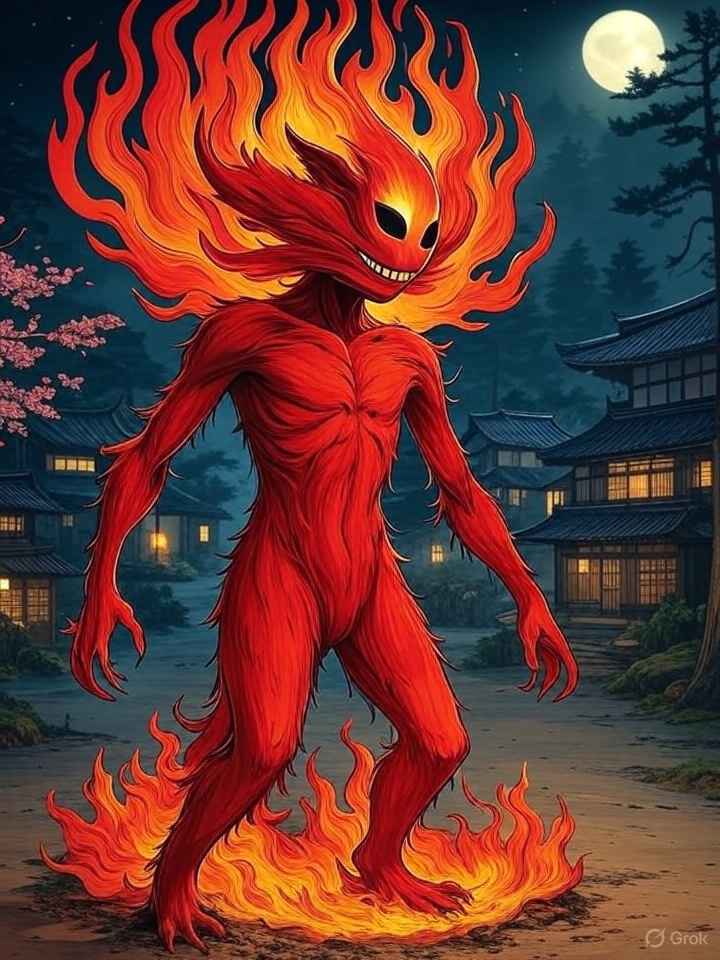
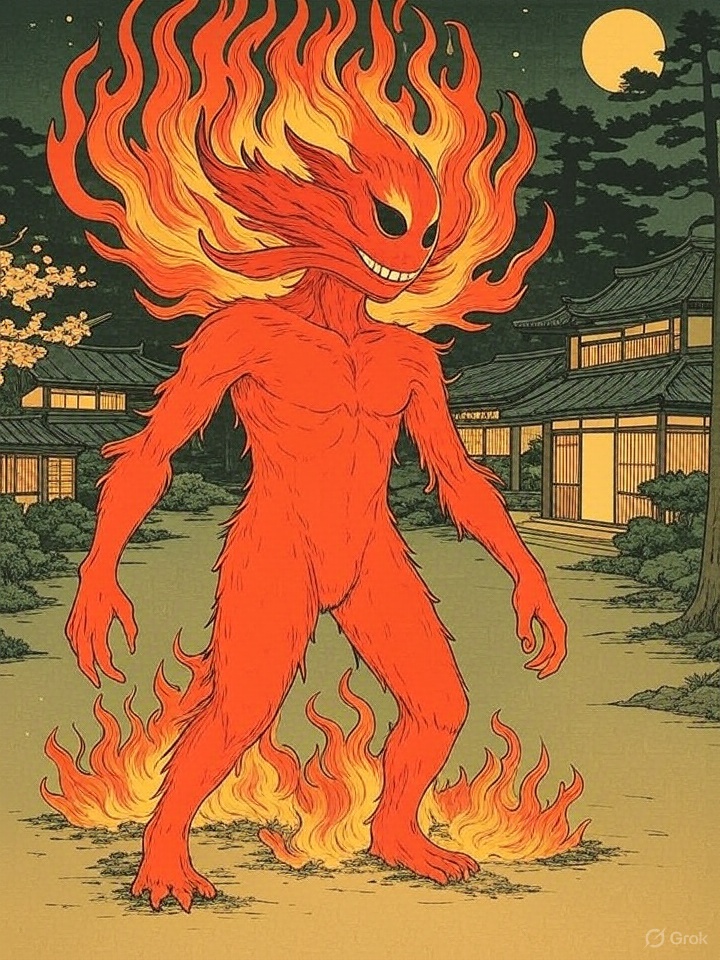
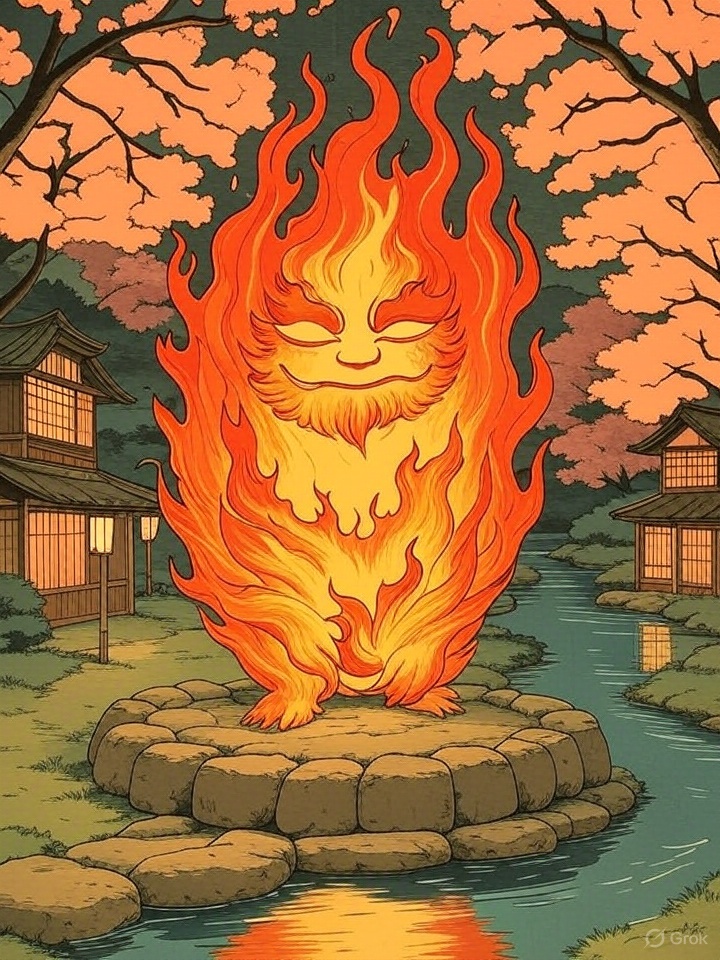
Ayakashi-no-ayashibi (綾かしの怪火) refers to a mysterious and supernatural flame seen drifting along the coasts and countryside of Ishikawa Prefecture. It is considered a type of will-o’-the-wisp or yokai flame.

Illustrated folktale

In the fog-shrouded hills of Hokuriku, where the sea meets the land and the rice fields stretch far and wide, there lived an old woman named Kiyomi. She dwelled in a small village on the edge of a great graveyard, where the wind whispered secrets to the tombstones at night.
Kiyomi was known throughout the village for her skill in gathering rare herbs and seaweed from the coastal paths. But as she grew older, her steps slowed and her eyesight weakened. She relied on her keen sense of smell and the guidance of the land spirits to find what she sought.
One evening, while making her way home through the misty hills, Kiyomi noticed a flickering light dancing in front of her. It was a small, blue-green flame that seemed to hover just above the ground, beckoning her deeper into the fog. The old woman felt a shiver run down her spine as she realized it must be an Ayakashi-no-ayashibi.
According to legend, such lights appeared when the balance of the dead and the living was disrupted. Some said they were warnings from restless spirits, while others claimed they led travelers astray on purpose. Kiyomi's grandmother had told her stories of the Ayakashi-no-ayashibi, cautioning that following its flame too closely could invite illness or misfortune.
But Kiyomi felt an inexplicable pull towards the light. She followed it through the winding paths and across the rice fields, her heart pounding in her chest. The flame led her to a forgotten corner of the graveyard, where the tombstones were overgrown with weeds and the wind howled like a mournful sigh.
As Kiyomi approached, the flame suddenly vanished, leaving behind an unsettling silence. The old woman stood there for a moment, feeling the weight of the dead around her. She remembered her grandmother's words: "Respect the balance, Kiyomi-chan. Let the spirits rest."
With a sense of reverence, Kiyomi made an offering to the land and its inhabitants – a handful of rice, a sprig of mint from her garden, and a whispered apology for disturbing their peace. As she turned to leave, she noticed that the fog had begun to clear, revealing the outlines of the surrounding hills.
From that day on, Kiyomi's steps felt lighter, as if the Ayakashi-no-ayashibi's visit had reminded her of the importance of harmony with the natural world and its spirits. She continued to tend to her garden and harvest the sea's bounty, but now she did so with a deeper respect for the balance that governed all living things.
And when the villagers asked about the strange light they saw on their own paths, Kiyomi would simply smile and say, "Ah, it's just the Ayakashi-no-ayashibi, reminding us to walk in harmony with the land and its secrets."
Yokai, oni, kitsune and spirits from folklore
Directory of Japanese board games and traditional games
Verified itch.io pixel-art gacha — fair odds, no ads
Reference guides for classic Japanese ham radios
Ancient joinery techniques of Japanese master craftsmen
Explore Japan's landmarks, shrines and hidden locations
SNES and Super Famicom collection tracker
Hoshi no Isan — a Japanese-aesthetic space RPG in development
Pixel art life sim MMO — start at zero, build your life
AI-powered educational stories for kids
Japanese-aesthetic design tokens & AI-ready UI prompts

Every day, one teaching. One moment of stillness.
Kanji, meaning, and a quiet reflection — rooted in the philosophy
behind Japan's forests, seasons, and sacred silences.
Content Warning: This website explores Japanese folklore and mythological beings—including yokai, oni, and other supernatural entities—that may be frightening to younger audiences or sensitive viewers. All material is presented for educational and cultural appreciation only. Viewer discretion is advised.
Parents and guardians are encouraged to preview content before sharing it with children. By continuing to use JapaneseMythicalCreatures.com, you acknowledge and accept this advisory.
Copyright © 2026 Japanese Mythical Creatures • All Rights Reserved.