

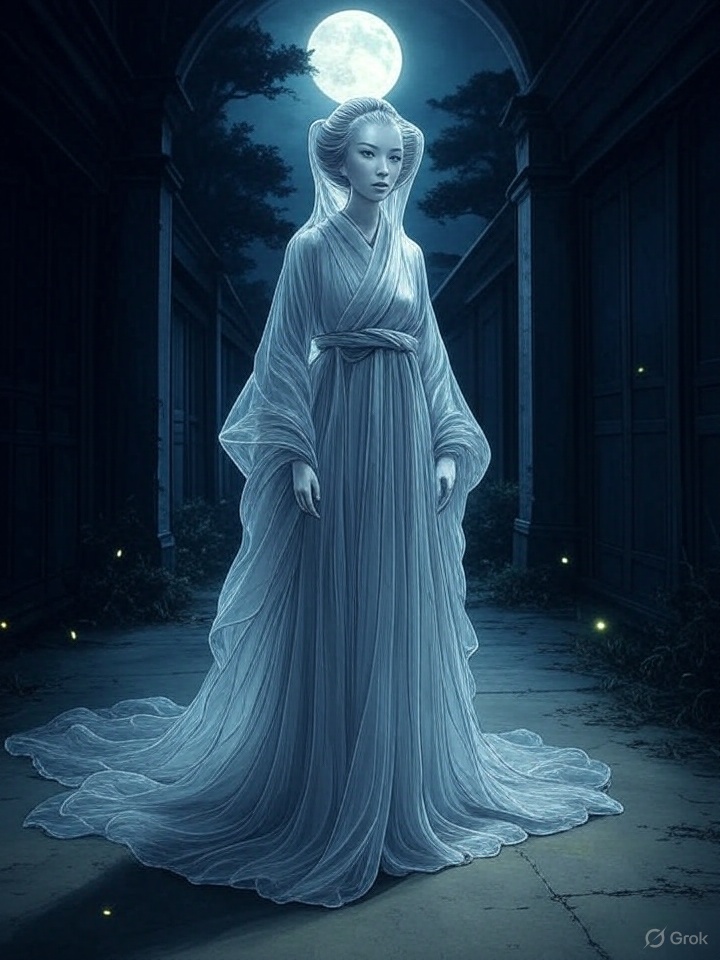
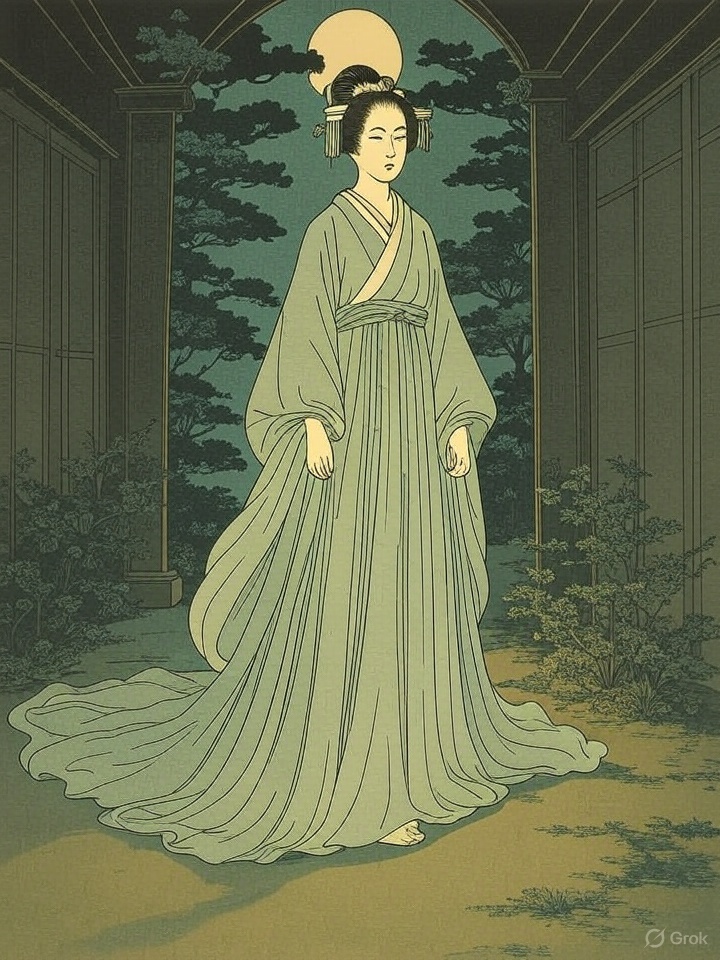
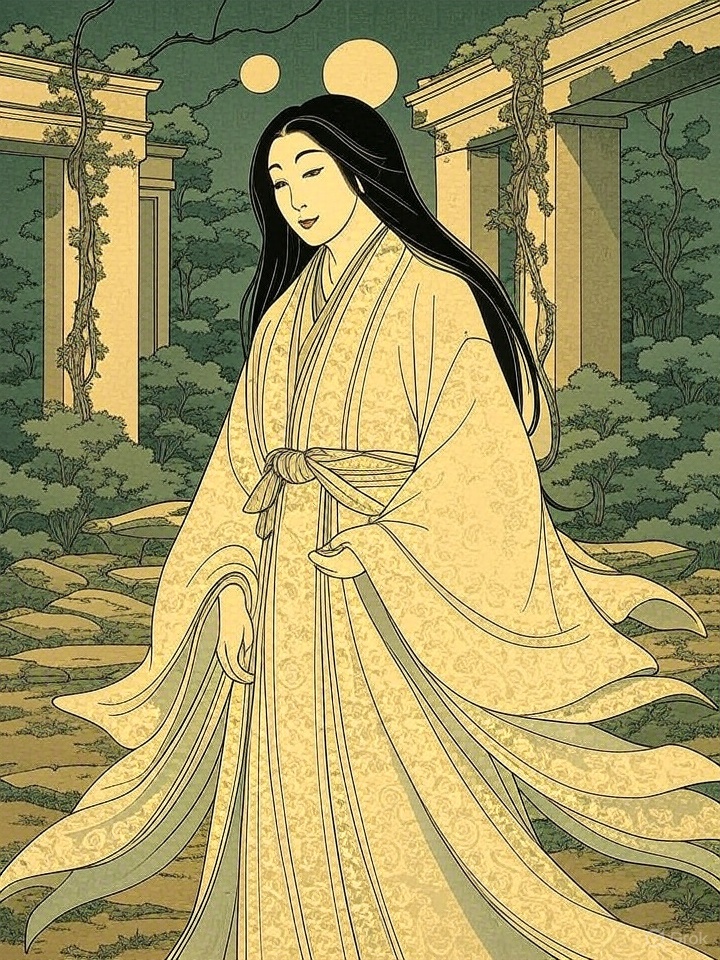
Aonyōbō (青女房) means “blue lady-in-waiting.” She is a haunting female spirit dressed in ancient court attire who lingers in forgotten aristocratic mansions or abandoned palaces.

Illustrated folktale

In twilight's hush, where shadows danced upon the walls of Akakawa Manor, a lone figure sat amidst the silence. Her skin was as pale as a winter's moon, her court robes rustling softly as she moved. Aonyōbō, the noble spirit, applied kohl to her painted face with precision, each stroke a testament to her devotion to beauty.
Years had passed since the last of her suitors departed, leaving behind only whispers and forgotten promises. The once-stately halls now echoed with her solitary footsteps, a poignant reminder that time, like autumn leaves, had slipped through her grasp. As she sat, lost in thought, the flickering candles cast eerie shadows on the walls, making it seem as though the ghostly lady was surrounded by an entourage of attendants.
The scent of incense wafted from the nearby shrine, carried on the wind that rustled through the abandoned gardens. It was said that on certain evenings, when the moon hung low in the sky, Aonyōbō would rise and pace the halls, searching for one last suitor to share her glory with. But those who claimed to have seen her were never quite sure if they had glimpsed a fleeting apparition or merely the reflection of their own desires.
One such wanderer, a young samurai named Kaito, found himself lost in Akakawa Manor's labyrinthine corridors. As he searched for an exit, his footsteps seemed to echo with each step, awakening the spirit within the walls. Aonyōbō sensed his presence and rose from her seat, her long hair cascading down like a waterfall of night as she glided toward him.
Their paths converged in the grand hall, where the fading light of day struggled to penetrate the grimy windows. For an instant, their eyes met, and Kaito felt the weight of years upon him. Aonyōbō's gaze was as unfathomable as a still pond, yet it seemed to hold a deep sorrow that spoke directly to his own heart.
"Come," she whispered, her voice like the rustling of silk on stone. "Stay awhile, and let us reminisce about the glory days when nobility walked these halls."
Kaito hesitated, sensing the futility of this encounter. He knew that in staying, he would only prolong Aonyōbō's sorrow, clinging to a dream as fragile as the autumn leaves outside.
As if reading his thoughts, she smiled – a faint, melancholic smile that hinted at the transience of their meeting. With an air of resignation, she vanished into the shadows, leaving behind only the scent of incense and the fading echo of her footsteps.
Kaito, sensing the passage of time, knew he must depart. In leaving, he realized that Aonyōbō's story was not one of longing for glory, but rather a poignant reminder of how easily even the most exquisite beauty can wither like the autumn leaves outside. As he emerged from Akakawa Manor into the moonlit night, the wind whispered secrets in his ear – tales of forgotten nobility and the impermanence that awaited us all.
Yokai, oni, kitsune and spirits from folklore
Directory of Japanese board games and traditional games
Verified itch.io pixel-art gacha — fair odds, no ads
Reference guides for classic Japanese ham radios
Ancient joinery techniques of Japanese master craftsmen
Explore Japan's landmarks, shrines and hidden locations
SNES and Super Famicom collection tracker
Hoshi no Isan — a Japanese-aesthetic space RPG in development
Pixel art life sim MMO — start at zero, build your life
AI-powered educational stories for kids
Japanese-aesthetic design tokens & AI-ready UI prompts

Every day, one teaching. One moment of stillness.
Kanji, meaning, and a quiet reflection — rooted in the philosophy
behind Japan's forests, seasons, and sacred silences.
Content Warning: This website explores Japanese folklore and mythological beings—including yokai, oni, and other supernatural entities—that may be frightening to younger audiences or sensitive viewers. All material is presented for educational and cultural appreciation only. Viewer discretion is advised.
Parents and guardians are encouraged to preview content before sharing it with children. By continuing to use JapaneseMythicalCreatures.com, you acknowledge and accept this advisory.
Copyright © 2026 Japanese Mythical Creatures • All Rights Reserved.