

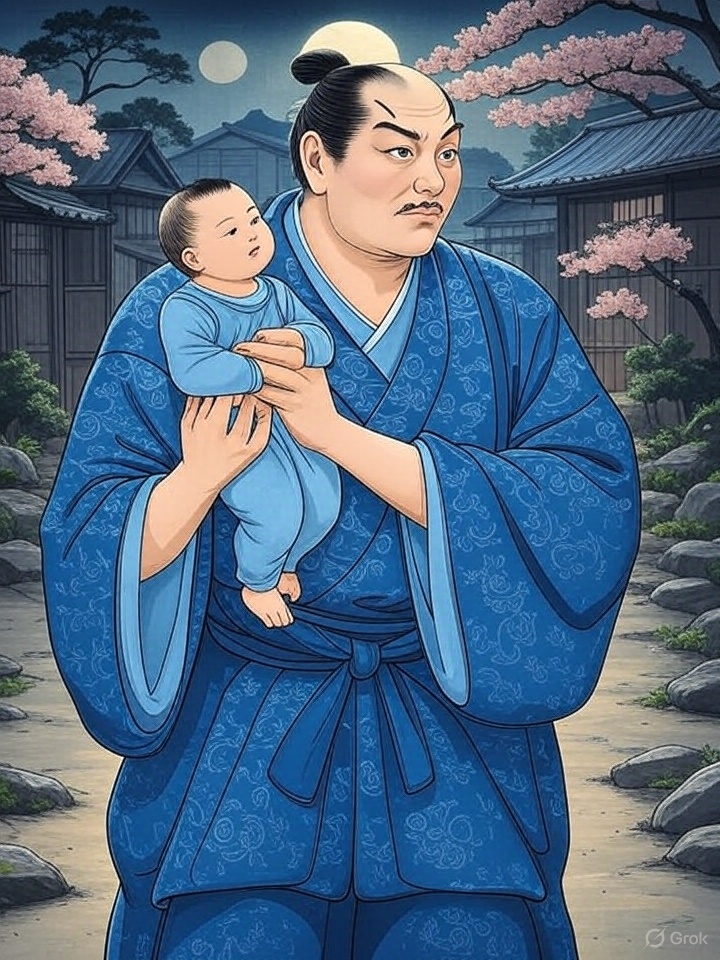
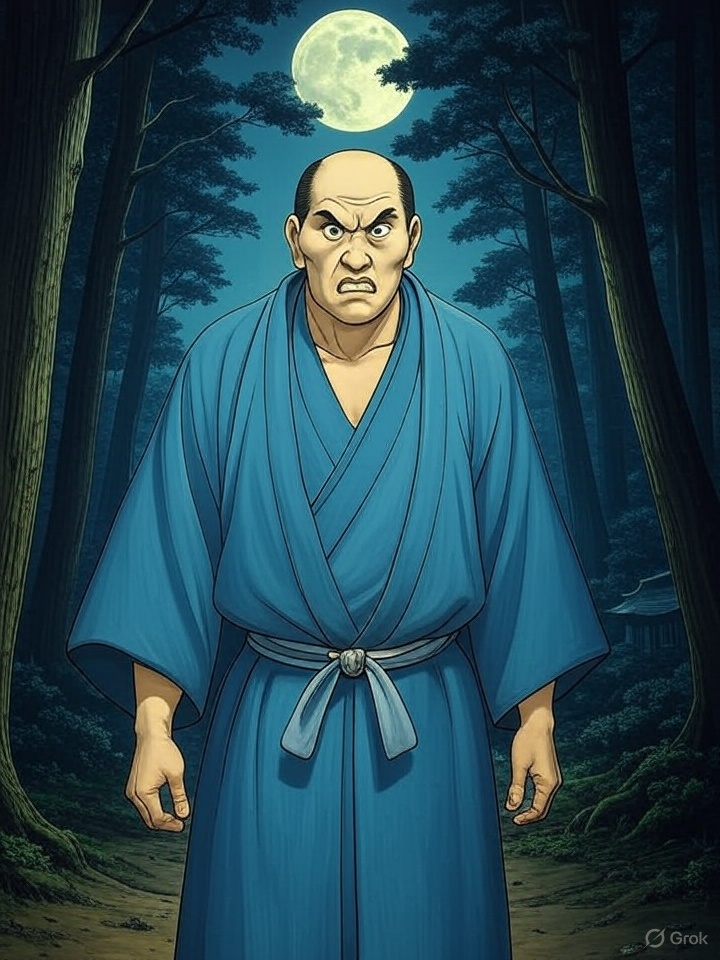
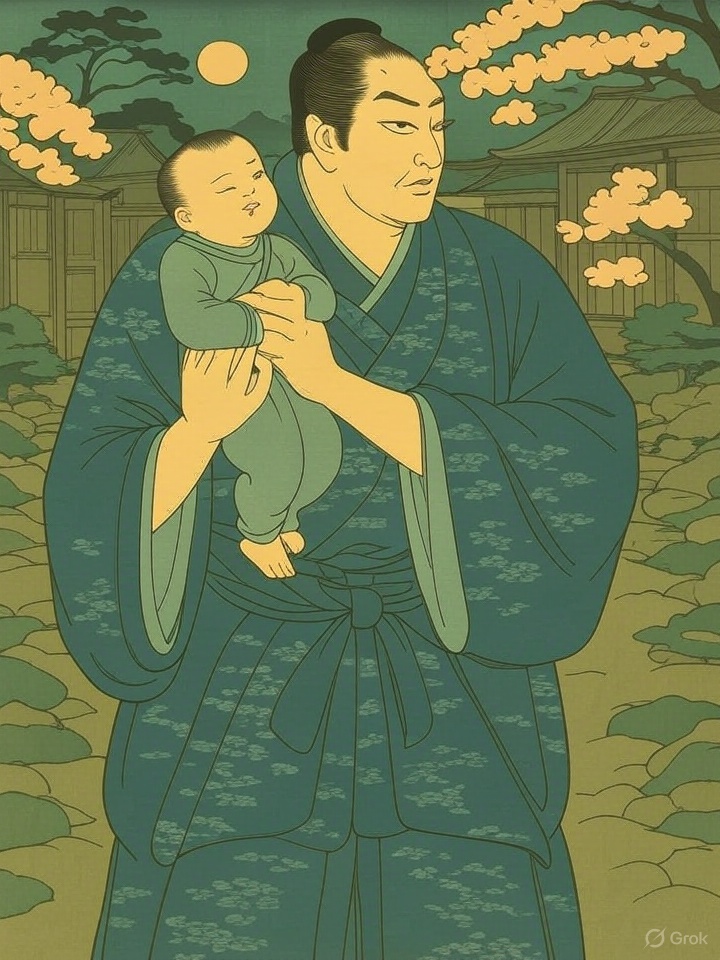
Aobōzu (青坊主) literally means “blue monk.” Despite his name, he is not a peaceful figure—this yōkai is feared for luring and kidnapping children in remote mountain villages.

Illustrated folktale

In the mountains where the cherry blossoms bloomed white as snow, there lived a young boy named Kaito. He was always fascinated by the tales of his village elder, who spoke of the Aobōzu that roamed these woods, snatching children away from their homes.
Kaito's curiosity got the better of him one day. As dusk approached, he decided to sneak out of his house and explore the forest beyond the village. His parents, busy preparing dinner, didn't notice his absence. The sunlight filtering through the trees cast long shadows on the ground as Kaito wandered deeper into the woods.
Suddenly, a chill ran down his spine. He heard the rustling of leaves and the soft crunching of twigs beneath an unseen foot. A figure emerged from the darkness – the Aobōzu. His skin was a pale blue hue, almost like the mist that clung to the mountainside. The monk's gaze seemed to bore into Kaito's soul, making him tremble with fear.
Kaito tried to run, but his legs felt heavy as if rooted to the spot. The Aobōzu took a step closer, his eyes fixed on the boy. His grin, like a crescent moon, seemed to grow wider with each passing moment. Kaito thought he heard the faint whisper of his name carried on the wind.
Just when all hope seemed lost, Kaito remembered the words of his village elder: "Courage is not the absence of fear, but the willingness to face it head-on." He took a deep breath and stood up straight, looking the Aobōzu in the eye. The monk's grin faltered for an instant, and Kaito seized the opportunity.
He shouted at the top of his lungs, "I will not be afraid! I will find my way back home!" The words seemed to carry far beyond the woods, echoing through the mountains. The Aobōzu recoiled, his eyes flashing with a brief, eerie glow before returning to their normal state. He turned and vanished into the trees, leaving Kaito shaken but unharmed.
As the boy stumbled back to his village, he noticed that the air grew warmer and the stars began to twinkle in the night sky. His parents, frantic with worry, rushed out to meet him, tears of relief streaming down their faces.
From that day on, Kaito told no one about the Aobōzu's encounter. But whenever he looked up at the mountains, he felt a strange sense of respect for the mysterious figure who roamed those woods. The villagers whispered among themselves about the boy who had faced the fearsome Aobōzu and lived to tell the tale. Some said it was a miracle; others claimed Kaito's bravery was what kept him safe.
As the seasons passed, Kaito grew into a young man, but he never forgot that night in the woods. He knew that the line between courage and fear was thin, and sometimes it took great heart to confront the unknown. The Aobōzu remained a whispered legend in the mountains, a reminder of the dangers that lurked in the shadows – and the strength required to face them head-on.
Yokai, oni, kitsune and spirits from folklore
Directory of Japanese board games and traditional games
Verified itch.io pixel-art gacha — fair odds, no ads
Reference guides for classic Japanese ham radios
Ancient joinery techniques of Japanese master craftsmen
Explore Japan's landmarks, shrines and hidden locations
SNES and Super Famicom collection tracker
Hoshi no Isan — a Japanese-aesthetic space RPG in development
Pixel art life sim MMO — start at zero, build your life
AI-powered educational stories for kids
Japanese-aesthetic design tokens & AI-ready UI prompts

Every day, one teaching. One moment of stillness.
Kanji, meaning, and a quiet reflection — rooted in the philosophy
behind Japan's forests, seasons, and sacred silences.
Content Warning: This website explores Japanese folklore and mythological beings—including yokai, oni, and other supernatural entities—that may be frightening to younger audiences or sensitive viewers. All material is presented for educational and cultural appreciation only. Viewer discretion is advised.
Parents and guardians are encouraged to preview content before sharing it with children. By continuing to use JapaneseMythicalCreatures.com, you acknowledge and accept this advisory.
Copyright © 2026 Japanese Mythical Creatures • All Rights Reserved.