

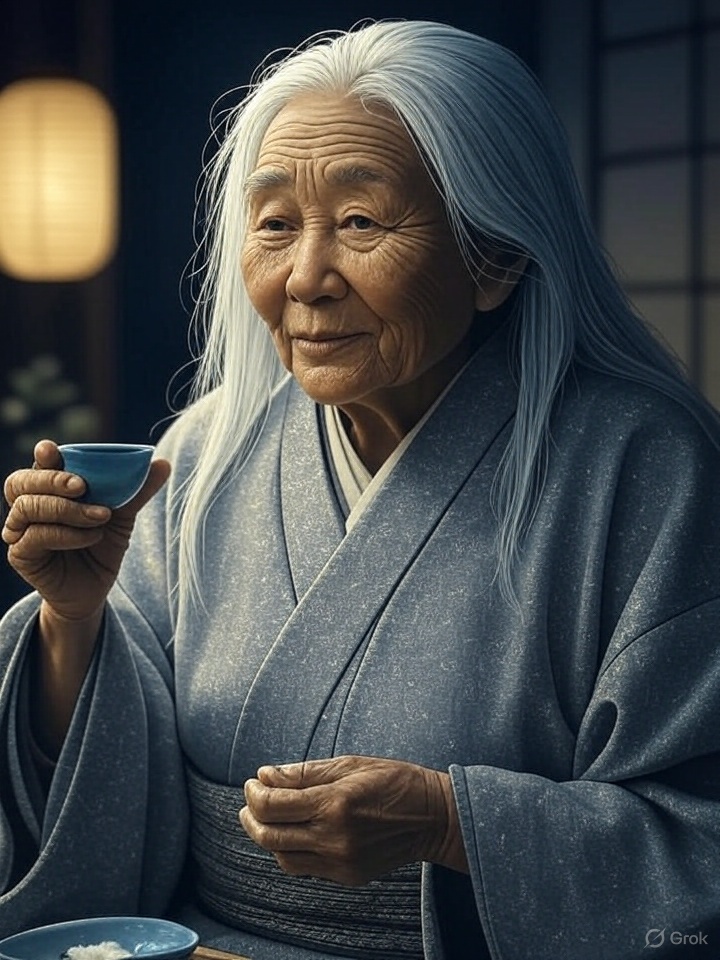
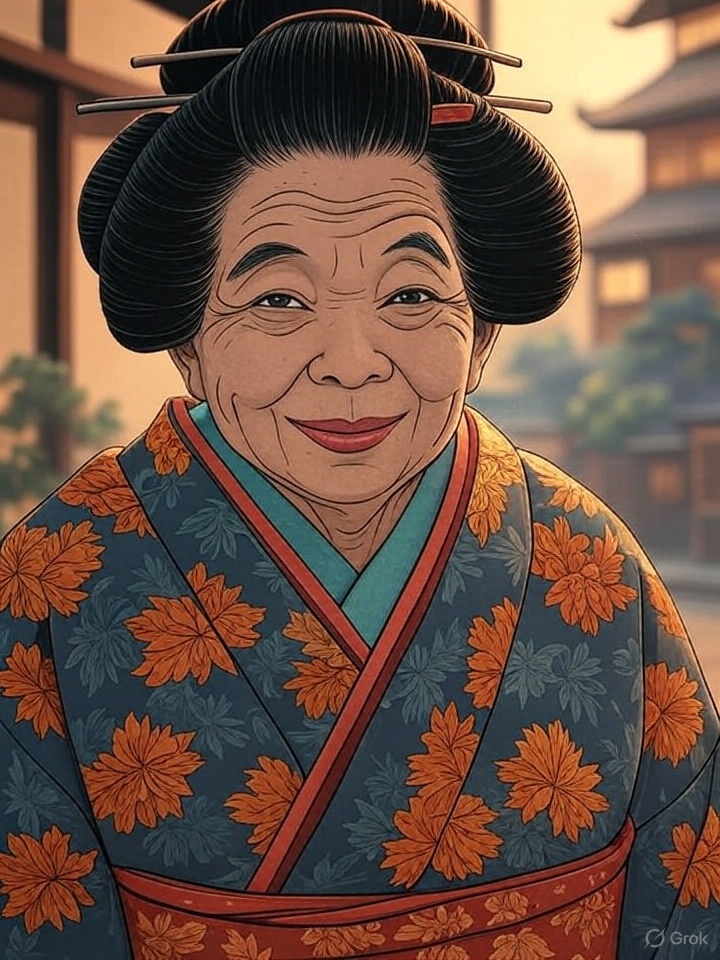
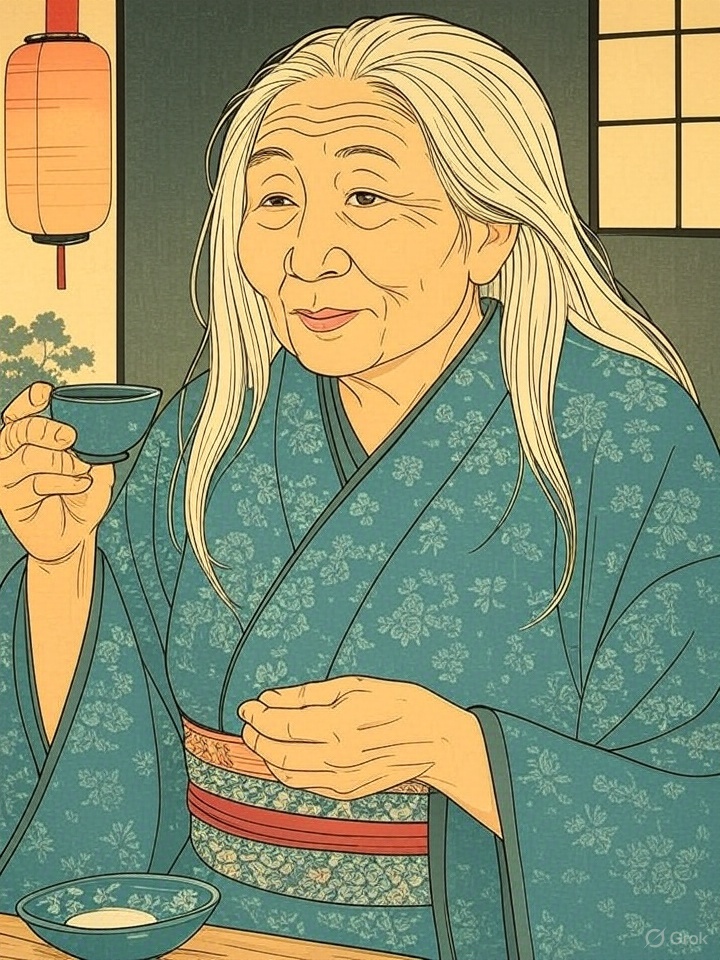
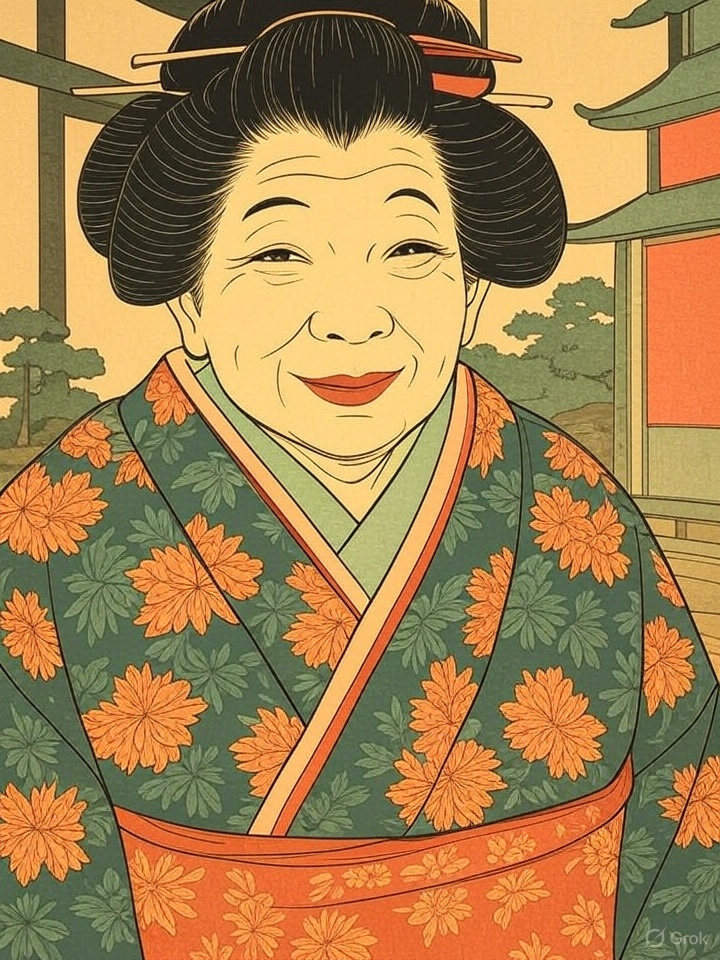
Amazake-babaa (甘酒婆) is a yokai known as the “Sweet Sake Old Woman.” She appears at night, asking for amazake (a traditional sweet fermented rice drink). Those who answer or engage with her are said to become ill.
Illustrated folktale

In the snow-shrouded streets of a mountain town, where cherry blossoms bloomed in unexpected harmony with frosty nights, there lived an elderly woman named O-Fumi. Her face was etched by time and hardship, like the bark of an ancient cedar tree. People whispered that she had once been a healer, renowned for her knowledge of herbs and ancient rituals to ward off illness. But as the years went by, her reputation shifted; now, whispers spoke of a harbinger spirit, feared by all who knew her name.
One winter evening, as the last wisps of sunlight faded behind the mountains, O-Fumi set out into the darkness. Her staff creaked beneath her weight, and her ragged robes seemed to billow with an otherworldly wind. The streets were empty, save for the soft crunch of snow underfoot and the distant hooting of owls.
She approached a small wooden house, its windows aglow like embers in the dark. O-Fumi's whispery voice carried on the night air: "Do you have any amazake?" The words hung like a challenge, as if testing the resolve of those within. The door creaked open, and a young mother peered out, her face creased with concern.
"Ah, grandmother," she said softly, mistaking O-Fumi for a kindly old woman from the neighborhood. "Come in, warm yourself by our fire."
O-Fumi's hood slid forward, casting a shadow over her face as she stepped into the house. The mother offered her a steaming cup of amazake, sweet with fermented rice and honey. As their hands touched, O-Fumi's eyes seemed to gleam, like frost on a winter's morning.
The next day, villagers reported a sudden outbreak of fever and chills in the young family's household. Their children ran high temperatures, and the mother herself was beset by dark dreams and visions. When they tried to seek help from O-Fumi, she had vanished into the snow, leaving behind only her staff, which now stood frozen in the doorframe like a sentry.
Word spread of the Amazake-babaa's visit, and people whispered that she had brought disease upon the family as punishment for their carelessness. Some said they saw O-Fumi's ghostly form flitting through the town at night, searching for those who would invite her into their homes with a cup of amazake.
In the midst of this fear and uncertainty, an old wise woman from the mountains came to offer counsel to the afflicted family. "Do not blame the Amazake-babaa," she said gently. "For in our world, there are spirits who embody the balance between life and death, illness and health. They remind us that even the smallest mistake can have far-reaching consequences."
As the snows receded with spring's arrival, the family slowly recovered from their ordeal. But whenever they looked up at the mountains, they whispered a silent thanks to O-Fumi, now a shadowy presence on the wind, reminding them of the fine line between life and death in their fragile world.
Yokai, oni, kitsune and spirits from folklore
Directory of Japanese board games and traditional games
Verified itch.io pixel-art gacha — fair odds, no ads
Reference guides for classic Japanese ham radios
Ancient joinery techniques of Japanese master craftsmen
Explore Japan's landmarks, shrines and hidden locations
SNES and Super Famicom collection tracker
Hoshi no Isan — a Japanese-aesthetic space RPG in development
Pixel art life sim MMO — start at zero, build your life
AI-powered educational stories for kids
Japanese-aesthetic design tokens & AI-ready UI prompts

Every day, one teaching. One moment of stillness.
Kanji, meaning, and a quiet reflection — rooted in the philosophy
behind Japan's forests, seasons, and sacred silences.
Content Warning: This website explores Japanese folklore and mythological beings—including yokai, oni, and other supernatural entities—that may be frightening to younger audiences or sensitive viewers. All material is presented for educational and cultural appreciation only. Viewer discretion is advised.
Parents and guardians are encouraged to preview content before sharing it with children. By continuing to use JapaneseMythicalCreatures.com, you acknowledge and accept this advisory.
Copyright © 2026 Japanese Mythical Creatures • All Rights Reserved.