

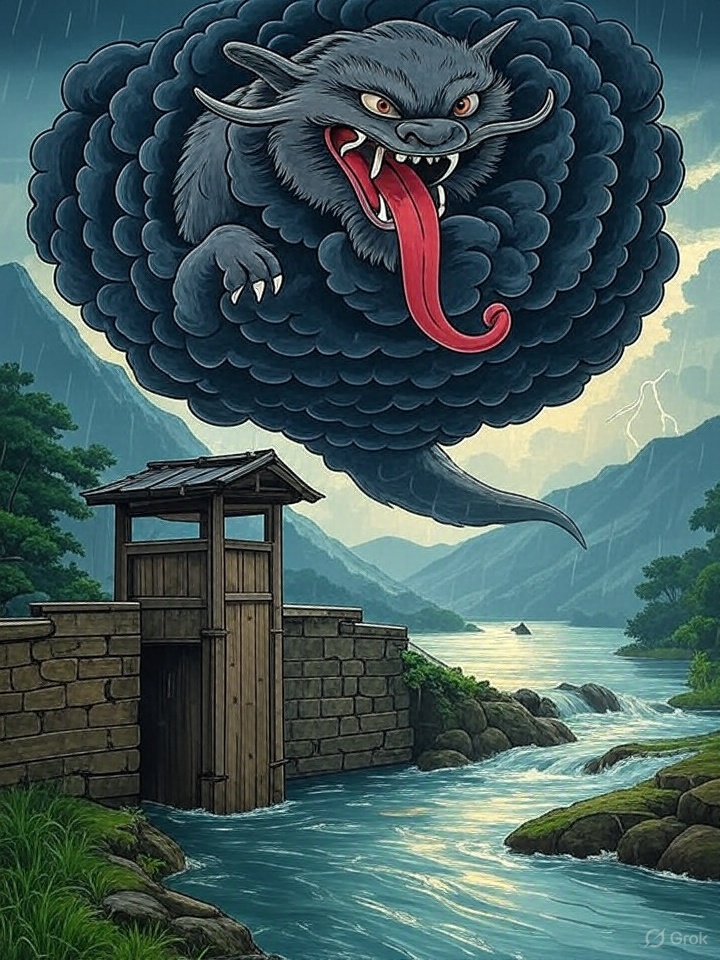
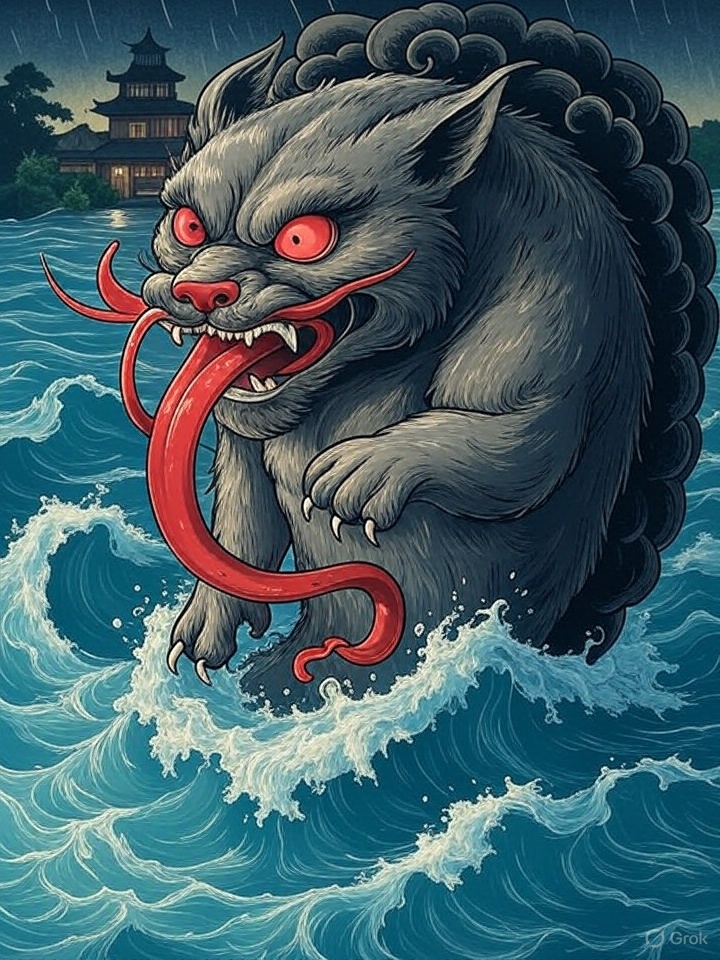
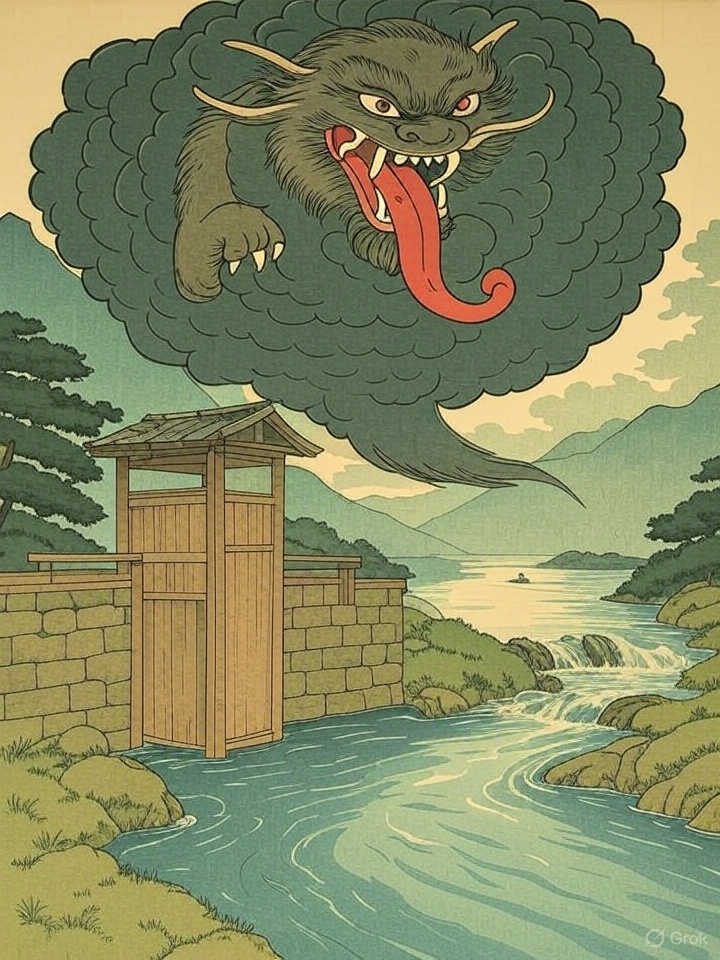
Akashita (赤舌) is a fearsome and ominous yōkai from Japanese folklore, known for its dramatic appearances and symbolic role as a punisher of greed and corruption. It’s one of the more visually striking spirits depicted in classical yōkai art.

Illustrated folktale

In the rural province of Mikawa, where paddy fields stretched as far as the eye could see, a wealthy landowner named Shinoda grew increasingly consumed by his own ambition. He had always been a shrewd businessman, but in recent years, he had begun to neglect the traditional irrigation canals that sustained the local farmers. His mind fixated on maximizing profits, Shinoda installed new locks and weirs to redirect the water flows, siphoning off more of the precious resource for his own private use.
The villagers whispered among themselves about the landowner's reckless actions, warning that he tampered with forces beyond human control. But Shinoda scoffed at their superstitions, convinced that his wealth and influence would shield him from any consequences.
As the summer solstice approached, a severe drought struck Mikawa, parching the fields and threatening the crops. The villagers begged for rain, but the skies remained stubbornly dry. Shinoda, however, continued to manipulate the water flows, redirecting the precious resource to his own storehouses and granaries.
One stormy night, as a tempest raged outside, a figure began to take shape above the ruined floodgate of the irrigation canal. The Akashita emerged from the swirling black clouds, its grotesque tongue lolling from its mouth like a crimson snake. Its eyes glowed with an otherworldly light, piercing through the darkness as it surveyed the land.
The villagers cowered in their homes, sensing the presence of the spectral creature. But Shinoda, fueled by his own hubris, refused to flee. He stood transfixed at the edge of the paddy field, staring up at the apparition with a mixture of awe and defiance.
"You," the Akashita spoke in a voice like thunder, its words echoing through the stormy night, "have disturbed the balance of nature, siphoning away the lifeblood of our land. You have ignored the whispers of the villagers, disregarding the ancient wisdom that guides us."
Shinoda trembled, but his pride would not permit him to beg for mercy. The Akashita watched him with an unblinking gaze, as if weighing the worthiness of its prey.
"Your greed will be your downfall," it declared, raising a spectral hand towards the heavens. "The floodgates will burst open, unleashing upon you the full fury of nature's retribution."
With those words, the storm intensified, and the paddy fields began to overflow. Water surged through the canals, inundating Shinoda's storehouses and granaries. The landowner stumbled, consumed by the raging torrent, as his wealth and power proved hollow against the might of the Akashita.
In the aftermath, the villagers found Shinoda's estate in shambles, the crops ruined beyond repair. But amidst the devastation, they spotted a glimmer of redemption – for on the edge of the paddy field, where the Akashita had first appeared, a small, humble shrine now stood, dedicated to the spirit that protected their land.
From that day forward, the people of Mikawa whispered stories of the Akashita's visitation, honoring its wrath as a reminder of the natural world's unyielding balance and the consequences of greed.
Yokai, oni, kitsune and spirits from folklore
Directory of Japanese board games and traditional games
Verified itch.io pixel-art gacha — fair odds, no ads
Reference guides for classic Japanese ham radios
Ancient joinery techniques of Japanese master craftsmen
Explore Japan's landmarks, shrines and hidden locations
SNES and Super Famicom collection tracker
Hoshi no Isan — a Japanese-aesthetic space RPG in development
Pixel art life sim MMO — start at zero, build your life
AI-powered educational stories for kids
Japanese-aesthetic design tokens & AI-ready UI prompts

Every day, one teaching. One moment of stillness.
Kanji, meaning, and a quiet reflection — rooted in the philosophy
behind Japan's forests, seasons, and sacred silences.
Content Warning: This website explores Japanese folklore and mythological beings—including yokai, oni, and other supernatural entities—that may be frightening to younger audiences or sensitive viewers. All material is presented for educational and cultural appreciation only. Viewer discretion is advised.
Parents and guardians are encouraged to preview content before sharing it with children. By continuing to use JapaneseMythicalCreatures.com, you acknowledge and accept this advisory.
Copyright © 2026 Japanese Mythical Creatures • All Rights Reserved.