

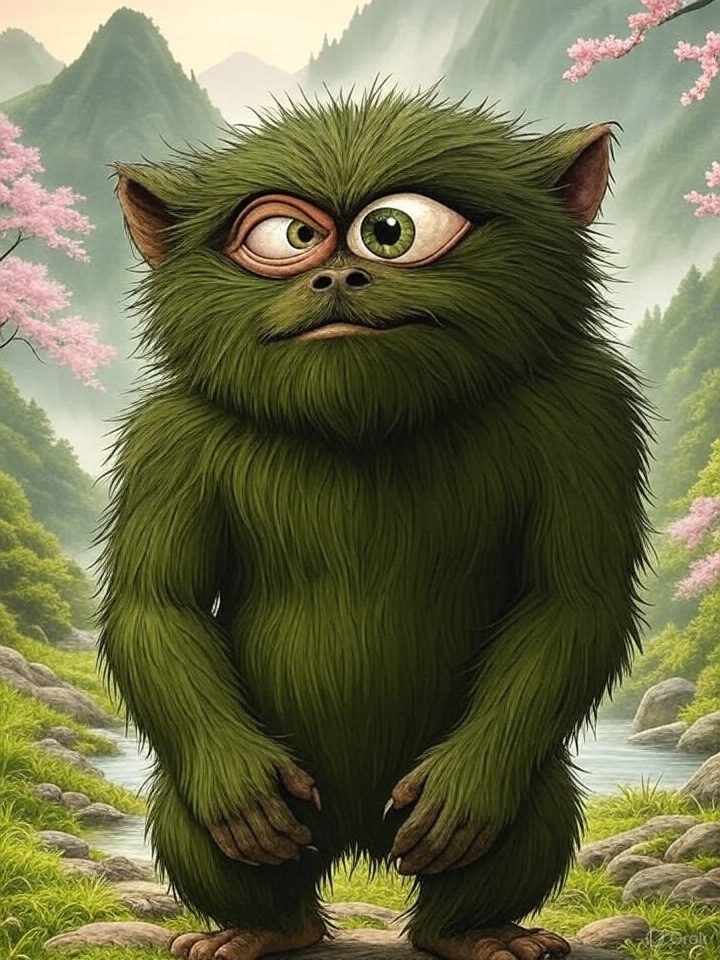
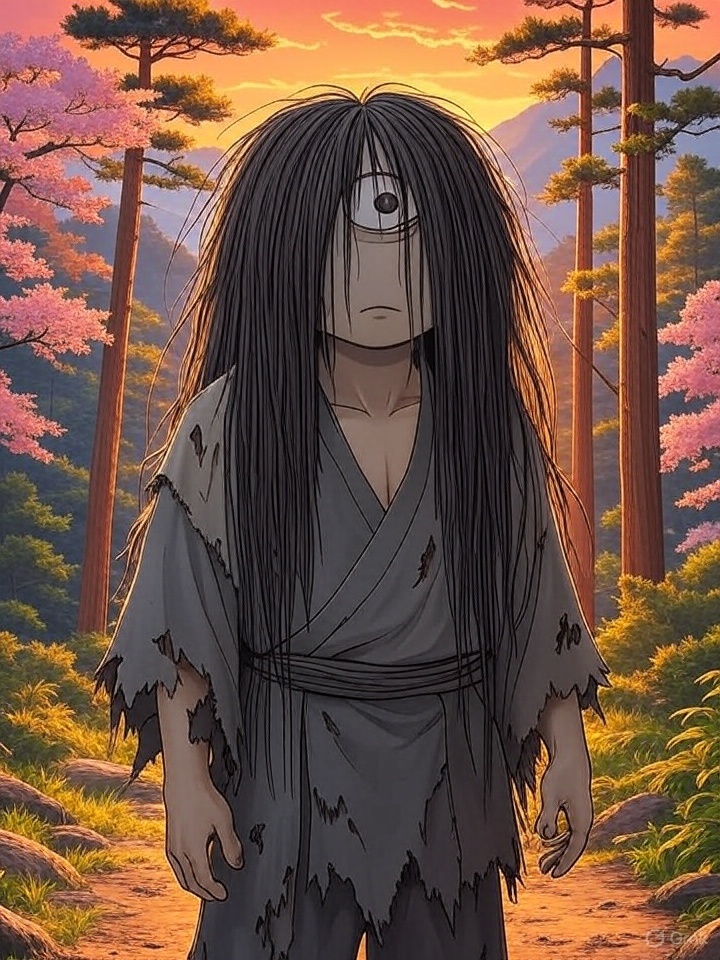
Yama-waro (山童) means “mountain child” or “mountain boy,” and is a term for a yokai believed to dwell in the forests of mountainous regions.
Illustrated folktale

In the depths of Akakawa mountain, where cedar trees pierced the sky and waterfalls sang to the wind, there lived a Yama-waro named Goro. His home was hidden behind a curtain of autumn leaves, and his existence was woven into the fabric of the forest like a spider's web.
As winter snows began to fall, Goro left the mountain's lower slopes for higher ground, where he might find companionship in the company of other Yama-waros. Together they would dance under starry skies, their feet weaving patterns on the frozen earth as they sang songs of ancient mountains and forgotten rivers.
One night, a lone woodcutter named Kaito ventured into Akakawa's depths, seeking firewood for his family's winter hearth. As he worked, Goro watched from the shadows, intrigued by the human's quiet dedication to his craft. The Yama-waro observed how Kaito's axe bit deep into the trunks of ancient trees, leaving behind a trail of sparks that vanished like fireflies in the darkness.
As the night wore on, Goro grew restless, his curiosity getting the better of him. He snuck closer, his hairy feet silent as a ghost's, and plucked Kaito's axe from its resting place. With a mischievous grin, he began to play tricks upon the human – hiding small items, leading him astray through the forest, and laughing like a mountain stream as Kaito stumbled in pursuit.
Yet, as the night deepened, Goro noticed something peculiar: Kaito did not scold or curse him for his antics. Instead, he spoke softly to the trees, offering words of gratitude for the wood they provided, and respect for the ancient power that lived within the mountain's heart. The Yama-waro listened intently, recognizing in Kaito a kindred spirit – one attuned to the subtle language of nature.
As the first light of dawn crept over Akakawa, Goro replaced Kaito's axe with a whispered apology. From that day forward, an unlikely friendship blossomed between the Yama-waro and the woodcutter. Together they explored the mountain's hidden corners, their footsteps weaving in harmony as they sought to understand the delicate balance between human and wild.
In time, Goro revealed his true form to Kaito – a dish-like head glistening with dew, surrounded by leaves that rustled softly like a chorus of tiny wind chimes. The woodcutter beheld the Yama-waro's single eye, now aglow with an inner light that illuminated the forest's hidden paths.
As winter gave way to spring, and the mountain's snows melted into a gentle rain, Kaito came to understand the language of the trees – their whispers carried on the wind, telling tales of seasons come and gone. And Goro, now his friend and guide, showed him the secret pathways that linked the mountain's heart to the human world beyond.
Thus, in the depths of Akakawa mountain, a Yama-waro's wild spirit merged with a woodcutter's respect for nature, forging a bond between two worlds – a testament to the ever-changing symphony of seasons, and the shifting forces that governed the balance of earth and sky.
Yokai, oni, kitsune and spirits from folklore
Directory of Japanese board games and traditional games
Verified itch.io pixel-art gacha — fair odds, no ads
Reference guides for classic Japanese ham radios
Ancient joinery techniques of Japanese master craftsmen
Explore Japan's landmarks, shrines and hidden locations
SNES and Super Famicom collection tracker
Hoshi no Isan — a Japanese-aesthetic space RPG in development
Pixel art life sim MMO — start at zero, build your life
AI-powered educational stories for kids
Japanese-aesthetic design tokens & AI-ready UI prompts

Every day, one teaching. One moment of stillness.
Kanji, meaning, and a quiet reflection — rooted in the philosophy
behind Japan's forests, seasons, and sacred silences.
Content Warning: This website explores Japanese folklore and mythological beings—including yokai, oni, and other supernatural entities—that may be frightening to younger audiences or sensitive viewers. All material is presented for educational and cultural appreciation only. Viewer discretion is advised.
Parents and guardians are encouraged to preview content before sharing it with children. By continuing to use JapaneseMythicalCreatures.com, you acknowledge and accept this advisory.
Copyright © 2026 Japanese Mythical Creatures • All Rights Reserved.