

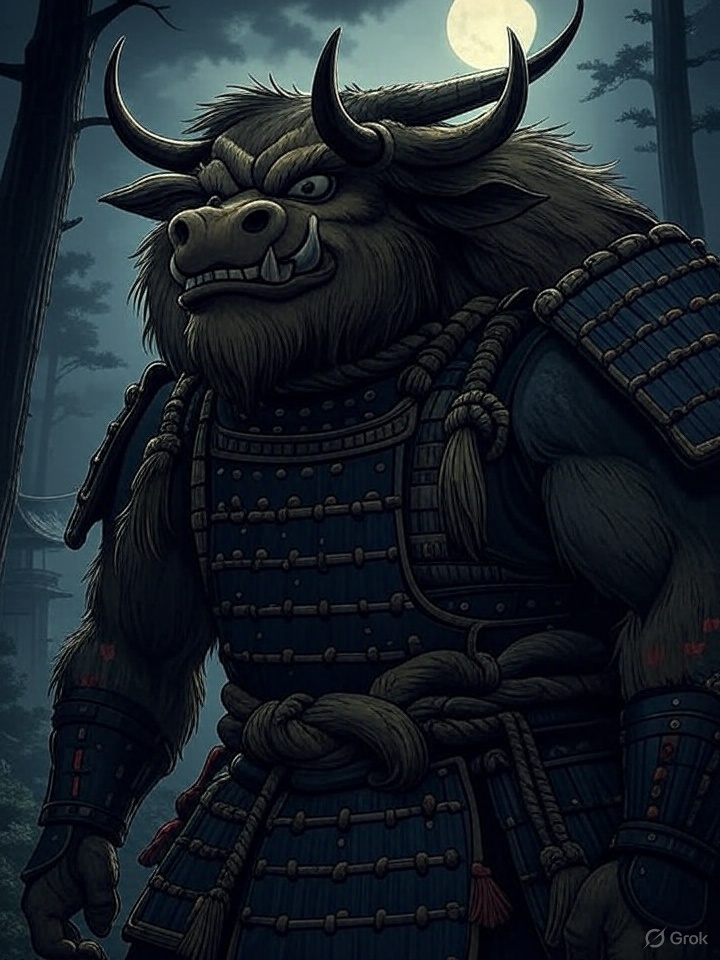
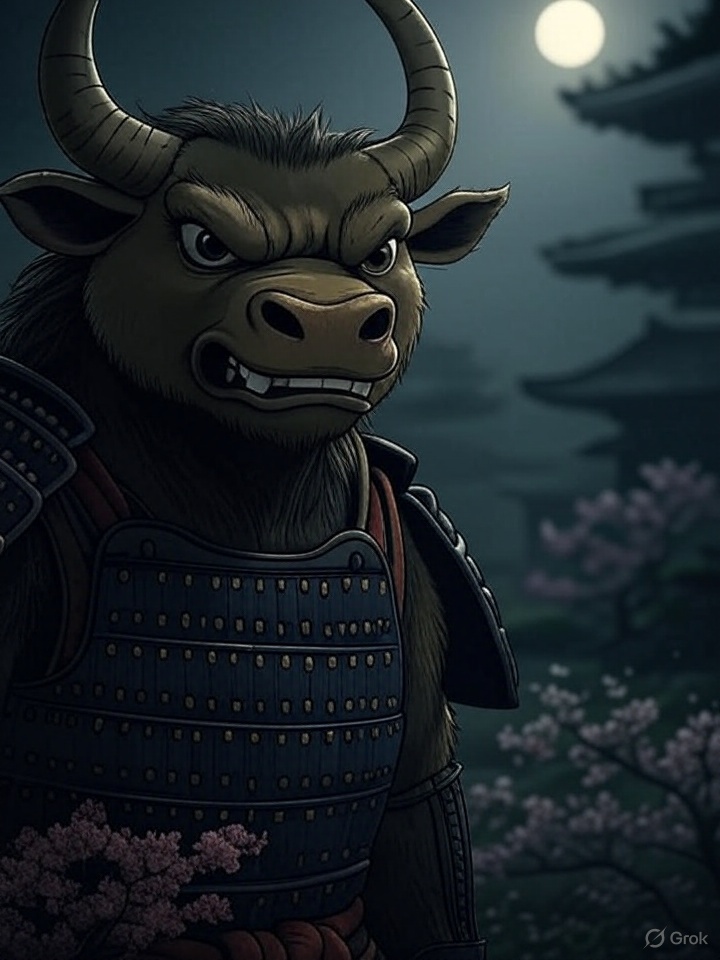
Ushi-oni (牛鬼) means "ox demon" or "ox ogre," and refers to various monstrous beings with the head of an ox.
Illustrated folktale

In the misty coves of Sanuki's eastern shore, where the pines stood sentinel over the restless sea, there lived a fisherman named Kaito. He was a humble soul, with calloused hands and eyes that held the secrets of the deep. For as long as anyone could remember, Kaito had braved the waves to bring back the day's catch, his small boat navigating the treacherous tides with a quiet confidence.
But one autumn evening, as the sun dipped into the western haze, Kaito spotted something amiss on the horizon. The sea itself seemed to be rippling and churning, like the surface of a pot left unattended over the fire. And there, at the heart of the disturbance, stood an Ushi-oni.
Its ox's head glared out from beneath a tangle of scaly legs and spindly arms, eyes blazing with a malevolent fury that seemed to scour the air itself. The creature's very presence sent ripples through the waves, causing Kaito's small boat to rock violently as he gazed upon its form.
The villagers had whispered tales of such creatures for generations – monstrous guardians of the sea's dark depths, feared and revered in equal measure. Some said they could summon the storms themselves, their cries echoing across the waves like a chorus of the damned. Others claimed that on certain nights, when the moon hung low in the sky, Ushi-oni would rise from the depths to exact vengeance upon those who dared to tread upon its domain.
Kaito knew he was no match for such a creature; still, his calloused fingers instinctively tightened around the oars as he urged the boat forward. The sea seemed to respond to his will, or perhaps it was merely echoing the turmoil within him – either way, the waters began to churn and froth with renewed ferocity.
The Ushi-oni loomed closer, its presence filling Kaito's world with an unspoken threat. For a moment, he forgot the stories and the legends; all that mattered was escaping this monstrous guardian of the sea. But then, as his boat bucked beneath him, something strange occurred to him: perhaps the Ushi-oni was not there to destroy, but to warn.
A wave crashed over the bow, extinguishing the lantern and plunging Kaito into darkness. He stumbled forward, his senses reeling, until he collided with a tangled mass of seaweed. As he struggled free, his hands brushed against something smooth – a stone, worn smooth by eons of sea-scrubbed tides.
It was an offering from the shrine at the foot of the mountain: a token to placate the Ushi-oni's wrath and grant safe passage through its realm. Kaito remembered now – he had seen such tokens scattered along the shoreline before, left as offerings by fishermen who sought to avoid the creature's wrath.
Slowly, his eyes adjusting to the darkness, he spotted the Ushi-oni receding into the depths, its blazing gaze fading with each passing moment. The sea itself seemed to calm, the waves ceasing their turmoil as if in response to some unseen command. And Kaito knew that this time, he had been given a gift: not just his life, but a glimpse of the balance between the world above and below.
From that day forward, when the moon hung low and the Ushi-oni roamed the waves, Kaito left tokens on the shore – small offerings to appease its wrath, reminders of the delicate harmony between the human world and the unfathomable depths.
Yokai, oni, kitsune and spirits from folklore
Directory of Japanese board games and traditional games
Verified itch.io pixel-art gacha — fair odds, no ads
Reference guides for classic Japanese ham radios
Ancient joinery techniques of Japanese master craftsmen
Explore Japan's landmarks, shrines and hidden locations
SNES and Super Famicom collection tracker
Hoshi no Isan — a Japanese-aesthetic space RPG in development
Pixel art life sim MMO — start at zero, build your life
AI-powered educational stories for kids
Japanese-aesthetic design tokens & AI-ready UI prompts

Every day, one teaching. One moment of stillness.
Kanji, meaning, and a quiet reflection — rooted in the philosophy
behind Japan's forests, seasons, and sacred silences.
Content Warning: This website explores Japanese folklore and mythological beings—including yokai, oni, and other supernatural entities—that may be frightening to younger audiences or sensitive viewers. All material is presented for educational and cultural appreciation only. Viewer discretion is advised.
Parents and guardians are encouraged to preview content before sharing it with children. By continuing to use JapaneseMythicalCreatures.com, you acknowledge and accept this advisory.
Copyright © 2026 Japanese Mythical Creatures • All Rights Reserved.