

Ungaikyō (雲外鏡) translates to “mirror beyond the clouds,” referring to its magical ability to show visions beyond the normal world.
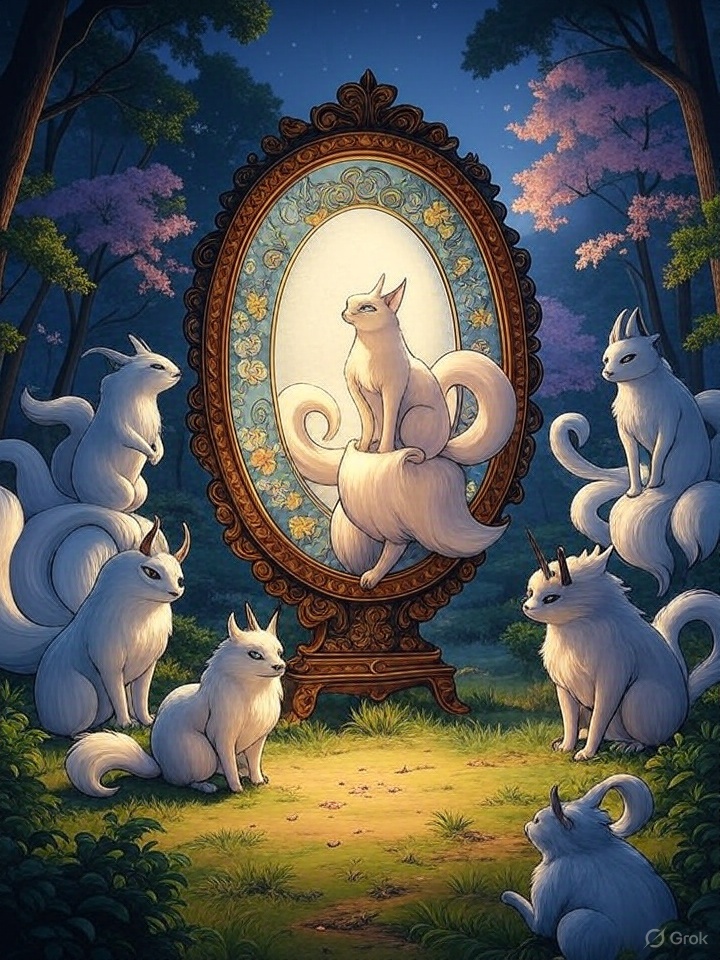
Illustrated folktale

In the twilight hours, when shadows danced upon the walls and the wind whispered secrets through the trees, a young monk named Kaito sought guidance from the Ungaikyō. The ancient mirror, passed down through generations of his order, hung in a secluded chamber deep within the monastery's labyrinthine corridors.
As Kaito approached the mirror, its surface seemed to ripple, like the gentle lapping of a summer breeze on still waters. He gazed into its depths, and at first, saw only his own reflection staring back – tired eyes, weary face, and unkempt hair. But as he delved deeper, visions began to unfold: lush forests swaying in autumn's hue; snow-capped mountains rising like sentinels from the earth; and faces – countless, fleeting faces – whispering secrets on the wind.
Entranced, Kaito forgot his surroundings, forgetting even his own identity. The mirror's power, it seemed, was not limited to revealing distant lands or hidden truths. It showed him glimpses of his own heart: its deepest longings, darkest fears, and unspoken desires. In that moment, the young monk felt the weight of his own mortality, the fleeting nature of life, and the infinite expanse of his own unknown potential.
The mirror's visions subsided, leaving Kaito shaken, yet strangely at peace. He realized that the secrets he sought were not hidden within its reflective surface but within himself. The Ungaikyō, a vessel for the whispers of the universe, had shown him the way to inner sight – to gaze upon his own soul with clarity and compassion.
But as Kaito turned to leave, the mirror's glow strengthened, bathing the chamber in an ethereal light. He felt a presence, old and wise, stirring within its depths. The Ungaikyō spoke in a voice like the rustling of leaves: "Remember, young one, that wisdom is not for the seeking but for the surrendering. Look within, and you shall find the truth. But beware, lest your gaze become too long, and you lose yourself in the abyss of your own reflection."
Kaito departed the chamber, his footsteps quiet on the worn stone floor. As he emerged into the night air, the stars twinkled above like a thousand scattered mirrors, reflecting the infinite mysteries of the universe. And though he never forgot the lessons of the Ungaikyō, he knew that its secrets were not to be grasped but to be lived – in the silence of his own heart.
Yokai, oni, kitsune and spirits from folklore
Directory of Japanese board games and traditional games
Verified itch.io pixel-art gacha — fair odds, no ads
Reference guides for classic Japanese ham radios
Ancient joinery techniques of Japanese master craftsmen
Explore Japan's landmarks, shrines and hidden locations
SNES and Super Famicom collection tracker
Hoshi no Isan — a Japanese-aesthetic space RPG in development
Pixel art life sim MMO — start at zero, build your life
AI-powered educational stories for kids
Japanese-aesthetic design tokens & AI-ready UI prompts

Every day, one teaching. One moment of stillness.
Kanji, meaning, and a quiet reflection — rooted in the philosophy
behind Japan's forests, seasons, and sacred silences.
Content Warning: This website explores Japanese folklore and mythological beings—including yokai, oni, and other supernatural entities—that may be frightening to younger audiences or sensitive viewers. All material is presented for educational and cultural appreciation only. Viewer discretion is advised.
Parents and guardians are encouraged to preview content before sharing it with children. By continuing to use JapaneseMythicalCreatures.com, you acknowledge and accept this advisory.
Copyright © 2026 Japanese Mythical Creatures • All Rights Reserved.