

Umibōzu (海坊主) literally means "sea monk," referring to its bald-headed, human-like appearance emerging from the sea.
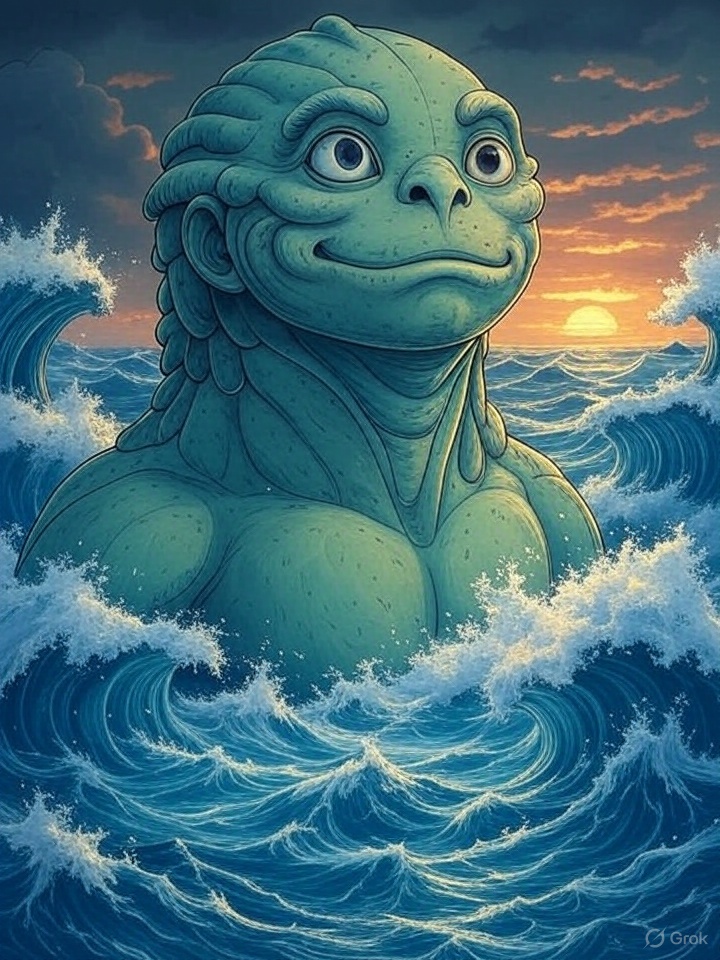
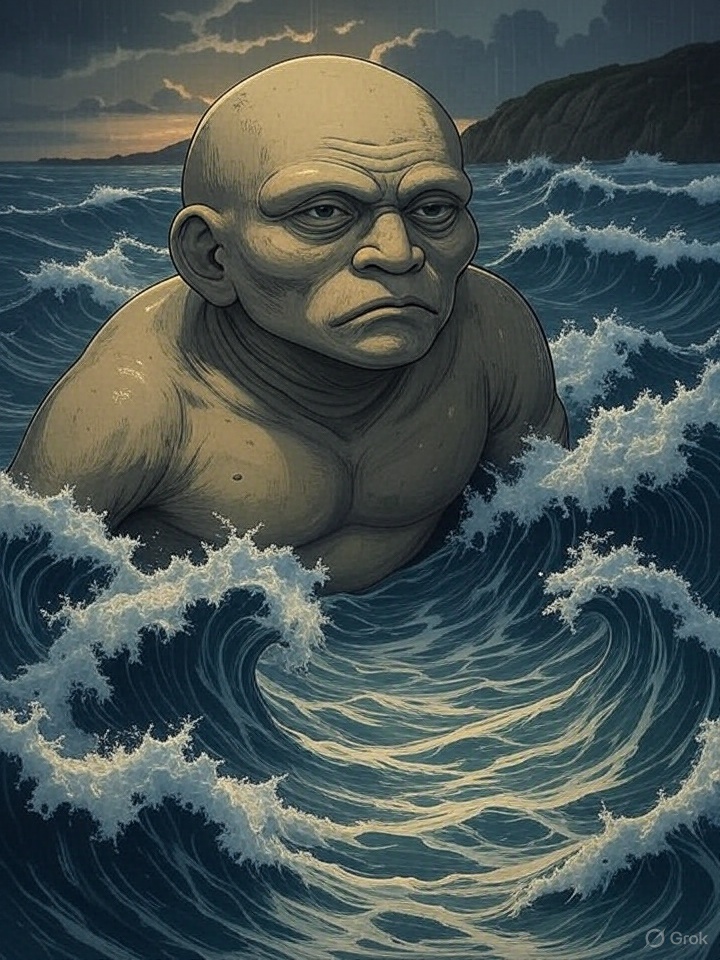
Illustrated folktale

In the village of Kurobayashi, where the sea met the shore in a soft caress, fishermen whispered tales of the Umibōzu's wrath. It was said that when the calm waters seemed to whisper secrets to the wind, the giant monk-ghost stirred from his slumber.
Kaito, a young fisherman, had always been skeptical of the stories. He scoffed at the idea of a vengeful spirit capsizing ships and drowning sailors. One day, as he set out to sea with his crew, the sun beat down on their worn sails, and the waters lay flat as a summer's breeze.
As they sailed farther from shore, Kaito spotted something in the distance – a colossal black form rising above the surface like a dark island. He squinted, thinking it might be a rock or a cloud, but his crewmates gasped as one, their voices lost on the still air.
"Umibōzu," they whispered in unison.
Kaito hesitated, his foot hovering over the water's edge. The giant's head and shoulders glistened with an oily sheen, its eyes blazing like lanterns lit within a cave. The wind picked up, carrying the faint scent of salt and decay, as if the sea itself was exhaling a sigh.
A wave as tall as a house rose from the depths, its crest churning the air with white foam. Kaito's crew scrambled to adjust their sails, but it was too late. The Umibōzu raised an enormous hand, fingers like anchors stretching towards them. A single stroke of its massive palm sent their vessel crashing into the trough.
Kaito clung to a splintered beam as his comrades were swept beneath the surface. In a desperate bid to escape, he hurled a wooden cask overboard, laughing maniacally as it rolled away with an enticing rattle.
For a moment, the Umibōzu's attention wavered. Its gaze followed the careening barrel, which bobbed and bounced on the waves like a playful child. As the spirit turned to confront the vessel, its eyes flashed with anger, but Kaito saw his chance. He leapt from the wreckage, embracing the creaking wooden hull as it drifted away.
When the sun dipped below the horizon, casting the sea in a bloody glow, the waters began to churn once more. The wind howled like a chorus of lost souls as the Umibōzu vanished into the darkness, its form dissolving into the turmoil like a mist before dawn.
Kaito clung to his makeshift raft, watching as his crew's bodies rose to the surface, their faces serene in death. He realized too late that he had merely delayed the inevitable – for when the sea takes notice of your disrespect, it will not be silenced so easily.
As the tide receded, Kaito was washed ashore, alone and broken. The villagers found him curled on the beach, his eyes wide with terror as if the Umibōzu's spirit still lingered within him. From that day forward, he became a shadow of his former self – a cautionary figure who whispered tales of the sea's fury to anyone willing to listen.
The villagers would say that when Kaito told his story by the firelight, the wind outside seemed to pick up its pace, as if the Umibōzu itself was listening, waiting for the next unsuspecting soul to tempt fate on the treacherous waters of the sea.
Yokai, oni, kitsune and spirits from folklore
Directory of Japanese board games and traditional games
Verified itch.io pixel-art gacha — fair odds, no ads
Reference guides for classic Japanese ham radios
Ancient joinery techniques of Japanese master craftsmen
Explore Japan's landmarks, shrines and hidden locations
SNES and Super Famicom collection tracker
Hoshi no Isan — a Japanese-aesthetic space RPG in development
Pixel art life sim MMO — start at zero, build your life
AI-powered educational stories for kids
Japanese-aesthetic design tokens & AI-ready UI prompts

Every day, one teaching. One moment of stillness.
Kanji, meaning, and a quiet reflection — rooted in the philosophy
behind Japan's forests, seasons, and sacred silences.
Content Warning: This website explores Japanese folklore and mythological beings—including yokai, oni, and other supernatural entities—that may be frightening to younger audiences or sensitive viewers. All material is presented for educational and cultural appreciation only. Viewer discretion is advised.
Parents and guardians are encouraged to preview content before sharing it with children. By continuing to use JapaneseMythicalCreatures.com, you acknowledge and accept this advisory.
Copyright © 2026 Japanese Mythical Creatures • All Rights Reserved.