

Uma-no-ashi (馬の脚) literally means "horse’s leg." This strange yokai appears as a disembodied horse leg hanging from trees.
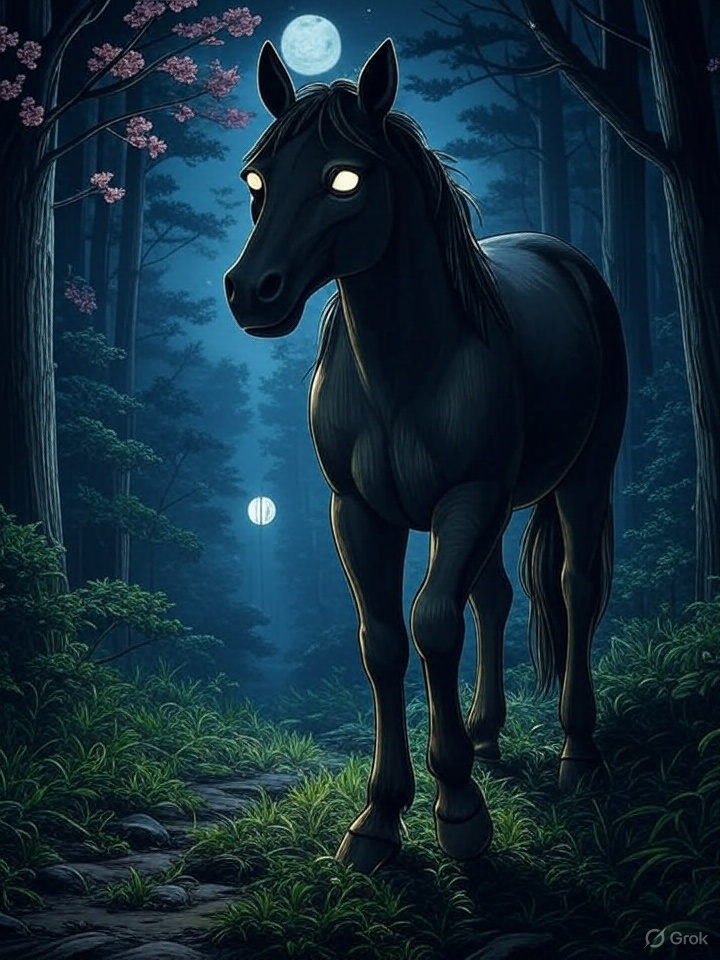
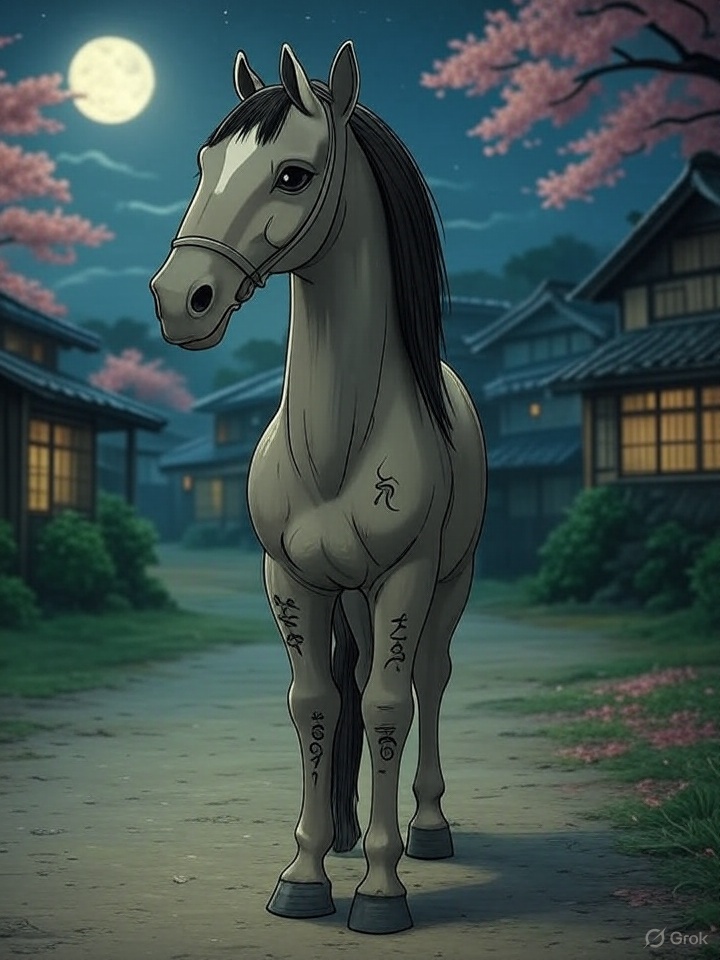
Illustrated folktale

In the heart of Akakawa Forest, where the mist-shrouded mountains whispered secrets to the wind, travelers often spoke in hushed tones of Uma-no-ashi's presence. Some claimed to have caught glimpses of a horse leg rising from the underbrush, while others swore they'd felt its kick, leaving them stumbling through the darkness.
One autumn evening, a young woman named Emiko decided to venture into Akakawa Forest, searching for rare yamabuki flowers to adorn her family's altar. As she walked along the winding path, the trees grew taller and darker, their branches creaking in the fading light. The air thickened with the scent of damp earth and decaying leaves.
As Emiko turned a bend, she noticed something peculiar. A long, hairy leg protruded from a tangle of vines above her head. It seemed to be gazing down at her, its tendons flexed as if coiled, waiting to strike. She froze, her heart beating in tandem with the forest's own pulse.
A gentle breeze rustled through the leaves, carrying Emiko's scent to Uma-no-ashi. The creature stirred, and with a sudden burst of speed, it kicked downwards. Emiko leapt back, narrowly avoiding the kick's impact. As she regained her footing, she saw Uma-no-ashi's leg withdraw into the underbrush, leaving behind only the faintest rustle of leaves.
Breathless and shaken, Emiko continued on her quest. The forest grew denser, and the air colder. Shadows danced around her, making it seem as though Uma-no-ashi's leg pursued her from every angle. Suddenly, a twig snapped beneath her foot, sending a small avalanche of pebbles cascading down the path.
As she stopped to dust herself off, Emiko spotted something glinting in the fading light. A yamabuki flower bloomed where none should have been, its delicate petals shimmering like moonlight on rippling water. She reached out, and as her fingers brushed against the petals, Uma-no-ashi's leg reappeared above her head.
This time, however, it did not kick. Instead, it seemed to be beckoning her forward, towards a clearing hidden among the trees. Emiko felt an inexplicable sense of calm wash over her, as if the forest itself had given its permission for her to pass. With the yamabuki flower in hand, she ventured into the clearing, where Uma-no-ashi's leg vanished once more.
From that day on, Emiko returned to Akakawa Forest often, collecting rare flowers and listening to the whispers of the trees. She knew Uma-no-ashi still lurked within the shadows, a reminder of nature's unpredictable power and the importance of humility in the face of its fury. As she walked through the forest paths at dusk, Emiko would glance upwards, expecting to see the telltale leg hovering above her head – but this time, it was not Uma-no-ashi that watched over her; rather, it was the spirit of the forest itself, guarding its secrets and teaching her to respect the balance between human and nature.
Yokai, oni, kitsune and spirits from folklore
Directory of Japanese board games and traditional games
Verified itch.io pixel-art gacha — fair odds, no ads
Reference guides for classic Japanese ham radios
Ancient joinery techniques of Japanese master craftsmen
Explore Japan's landmarks, shrines and hidden locations
SNES and Super Famicom collection tracker
Hoshi no Isan — a Japanese-aesthetic space RPG in development
Pixel art life sim MMO — start at zero, build your life
AI-powered educational stories for kids
Japanese-aesthetic design tokens & AI-ready UI prompts

Every day, one teaching. One moment of stillness.
Kanji, meaning, and a quiet reflection — rooted in the philosophy
behind Japan's forests, seasons, and sacred silences.
Content Warning: This website explores Japanese folklore and mythological beings—including yokai, oni, and other supernatural entities—that may be frightening to younger audiences or sensitive viewers. All material is presented for educational and cultural appreciation only. Viewer discretion is advised.
Parents and guardians are encouraged to preview content before sharing it with children. By continuing to use JapaneseMythicalCreatures.com, you acknowledge and accept this advisory.
Copyright © 2026 Japanese Mythical Creatures • All Rights Reserved.