

Ohaguro-bettari (お歯黒べったり) combines the words "ohaguro" (blackened teeth, a beauty practice in old Japan) and "bettari" (entirely or only), referencing the monster’s only facial feature.
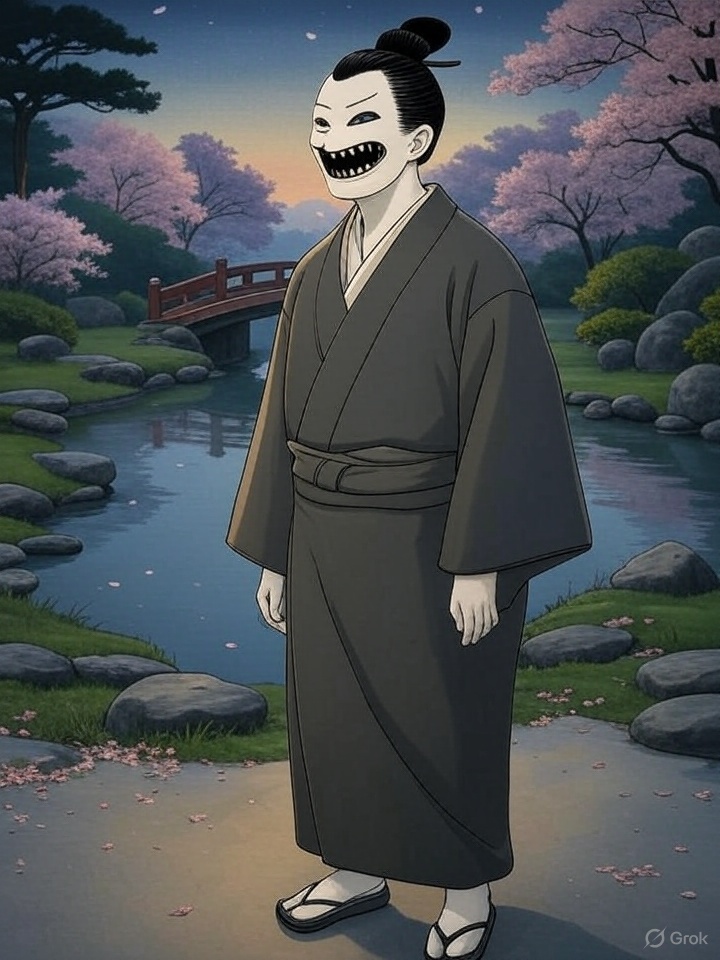

Illustrated folktale

In the depths of the moonless night, when the lanterns of the temple district flickered like fireflies, a young samurai named Kaito wandered into the narrow alleys. He had heard whispers of a mysterious beauty who roamed these streets, her presence as elusive as a shadow. Her name was whispered in hushed tones: Ohaguro-bettari.
Kaito's heart beat with excitement and trepidation as he stumbled upon a dimly lit bridge over the temple's central pond. The water's surface reflected the faint light above, creating an illusion of serenity. And there, standing at the bridge's edge, was the beauty. A vision in white, her bridal kimono shimmering like silk on moonlight.
Kaito approached with stealthy steps, his eyes locked onto hers. For a moment, their gazes met, and he felt a shiver run down his spine. The woman's face, however, remained enigmatic – its surface as smooth as polished stone, devoid of any feature except for the mouth. A gaping void that seemed to yawn with an otherworldly hunger.
As Kaito drew closer, the air around him began to thicken, heavy with anticipation. His footsteps echoed off the temple walls, growing louder with each step. The woman's presence seemed to grow, spreading like a dark stain across the moonlit pavement.
Without warning, her face contorted into a macabre grimace, revealing those pitch-black teeth in all their terrible glory. Kaito stumbled backward, his hand instinctively reaching for his sword. But the blade felt heavy in his grasp, as if weighed down by his own foolishness.
The woman began to laugh – a low, throaty sound that sent shivers down Kaito's spine. He watched in horror as her form began to shift, like the ripples on the pond's surface. Her kimono ripped and tore, exposing skin as white as snow. The beauty transformed into a being of pure darkness, its presence radiating from every pore.
In that instant, Kaito realized his mistake: he had underestimated the Ohaguro-bettari's power to deceive. His vanity, his attraction to the beautiful face, had blinded him to her true nature. The woman's laughter grew louder still, drowning out the temple's chanting monks and the distant sound of wind chimes.
Kaito turned to flee, but his feet seemed rooted to the spot. The darkness closed in around him, its presence suffocating. He knew then that he would never forget this night – nor the lesson it taught him: that beauty is a fleeting thing, and that true terror lies not in the face of the unknown, but in our own hearts.
As Kaito stumbled back through the alleys, the moon began to rise above the temple's tiled roofs. Its light illuminated the darkness, revealing the Ohaguro-bettari's true form: a being of empty spaces and voids, a harbinger of despair for those who sought beauty in superficial appearances. The young samurai never spoke of this night again, but his eyes would forever hold the memory of that monstrous face, its pitch-black teeth a constant reminder of the terror that lurked just beyond the reach of the moon's pale light.
Yokai, oni, kitsune and spirits from folklore
Directory of Japanese board games and traditional games
Verified itch.io pixel-art gacha — fair odds, no ads
Reference guides for classic Japanese ham radios
Ancient joinery techniques of Japanese master craftsmen
Explore Japan's landmarks, shrines and hidden locations
SNES and Super Famicom collection tracker
Hoshi no Isan — a Japanese-aesthetic space RPG in development
Pixel art life sim MMO — start at zero, build your life
AI-powered educational stories for kids
Japanese-aesthetic design tokens & AI-ready UI prompts

Every day, one teaching. One moment of stillness.
Kanji, meaning, and a quiet reflection — rooted in the philosophy
behind Japan's forests, seasons, and sacred silences.
Content Warning: This website explores Japanese folklore and mythological beings—including yokai, oni, and other supernatural entities—that may be frightening to younger audiences or sensitive viewers. All material is presented for educational and cultural appreciation only. Viewer discretion is advised.
Parents and guardians are encouraged to preview content before sharing it with children. By continuing to use JapaneseMythicalCreatures.com, you acknowledge and accept this advisory.
Copyright © 2026 Japanese Mythical Creatures • All Rights Reserved.