

Oboro-guruma (朧車) means “hazy cart” or “ghostly oxcart,” suggesting an ethereal or eerie presence associated with a traditional carriage.
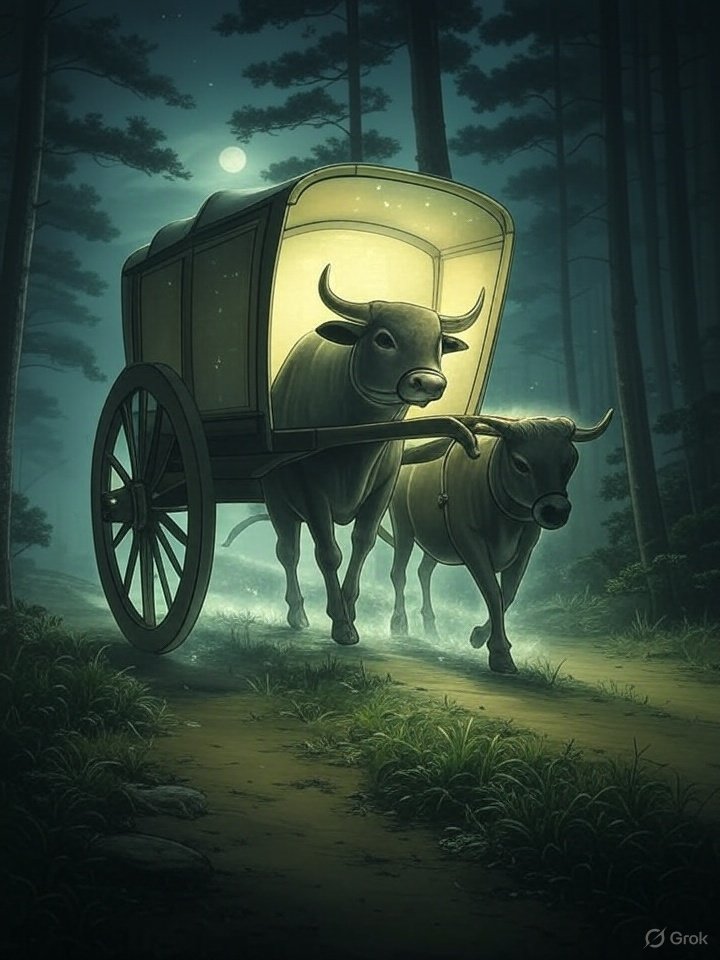
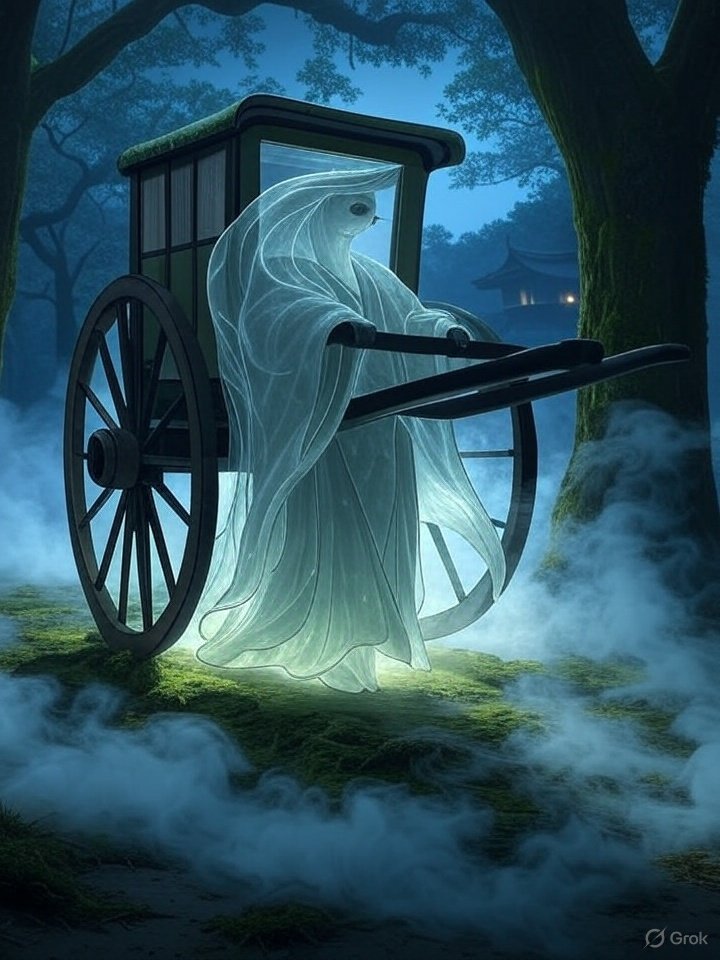
Illustrated folktale

In the depths of winter, when snowflakes fell gently upon Kyoto's tiled roofs, a young merchant named Kaito dwelled in his family's modest house. His mind was consumed by envy for the wealthy traders who lived nearby, their homes aglow with warmth and comfort. While Kaito toiled late into the night, tending to his shop's accounts and stockpiling wares for the coming year, he could not shake the feeling of inadequacy that gnawed at his heart.
As the final snowfall of winter descended, a soft creaking sound echoed through Kaito's neighborhood. At first, it seemed like the settling of old wooden beams in the cold weather, but soon the eerie whine grew louder and more insistent. People whispered among themselves about the Oboro-guruma, a legendary oxcart said to wander the streets under cover of darkness.
Kaito, however, did not believe in such superstitions. He scoffed at the notion that an old wooden cart could be haunted by spirits or possessed by malevolent entities. Yet, as he lay abed that night, the creaking grew louder still, until it seemed to come from right outside his window.
Kaito tossed aside his covers and rose, determined to confront whatever was causing the disturbance. Pushing open the sliding shoji, he gazed into the darkness beyond. The wind had died down, and an unearthly silence reigned over the streets. But then, like a ghostly apparition, the Oboro-guruma materialized before his eyes.
Its wooden frame glowed with an ethereal light, as if infused with a soft, otherworldly energy. A human face gazed back at Kaito from the cart's wheel, its features twisted in agony and despair. The face was weeping tears of ice, which fell to the ground like delicate snowflakes.
Transfixed by the apparition, Kaito felt an icy chill run down his spine. He tried to step backward, but his feet seemed rooted to the spot. As he gazed deeper into the wheel's countenance, a terrible realization crept over him: this was not just a simple oxcart, but a harbinger of misfortune – a manifestation of the karma that accrued from unrepented envy and pride.
The Oboro-guruma drew closer, its creaking growing louder still. Kaito felt his heart heavy with regret, as if the weight of his own desires had become a physical burden he could no longer bear. In that moment, he comprehended the error of his ways and vowed to alter his path.
The cart's wheel continued to stare at him, its human features softening ever so slightly into a gentle, sorrowful expression. Kaito felt an unseen force guiding him toward a nearby temple, where he spent the remainder of the night in prayer and contemplation. When dawn broke, the Oboro-guruma vanished as suddenly as it appeared, leaving behind only the faint scent of snowflakes and a sense of newfound humility within Kaito's heart.
From that day forward, his business flourished not through envy or resentment, but through compassion and kindness toward others. As for the Oboro-guruma, its spirit remained in Kyoto's streets, watching over those who had learned to balance their desires with humility – a reminder that even the darkness can hold a glimmer of hope, if only one dares to confront it head-on.
Yokai, oni, kitsune and spirits from folklore
Directory of Japanese board games and traditional games
Verified itch.io pixel-art gacha — fair odds, no ads
Reference guides for classic Japanese ham radios
Ancient joinery techniques of Japanese master craftsmen
Explore Japan's landmarks, shrines and hidden locations
SNES and Super Famicom collection tracker
Hoshi no Isan — a Japanese-aesthetic space RPG in development
Pixel art life sim MMO — start at zero, build your life
AI-powered educational stories for kids
Japanese-aesthetic design tokens & AI-ready UI prompts

Every day, one teaching. One moment of stillness.
Kanji, meaning, and a quiet reflection — rooted in the philosophy
behind Japan's forests, seasons, and sacred silences.
Content Warning: This website explores Japanese folklore and mythological beings—including yokai, oni, and other supernatural entities—that may be frightening to younger audiences or sensitive viewers. All material is presented for educational and cultural appreciation only. Viewer discretion is advised.
Parents and guardians are encouraged to preview content before sharing it with children. By continuing to use JapaneseMythicalCreatures.com, you acknowledge and accept this advisory.
Copyright © 2026 Japanese Mythical Creatures • All Rights Reserved.