

Nozuchi (野槌) is a variant name for the Tsuchinoko, a snake-like yokai from Japanese legend. The name can be interpreted as "field mallet."
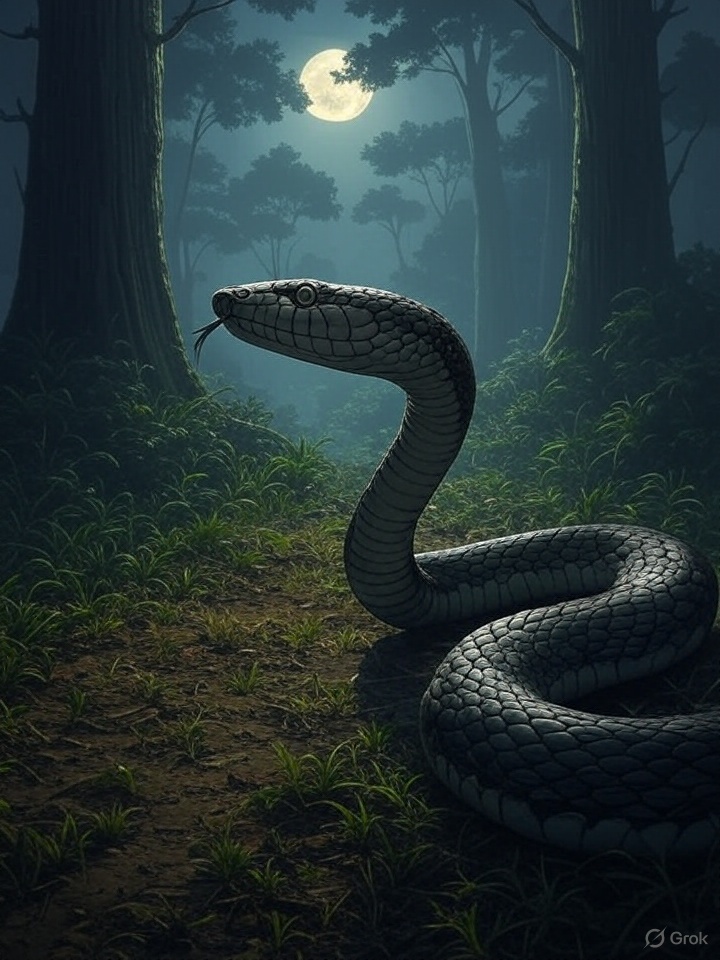
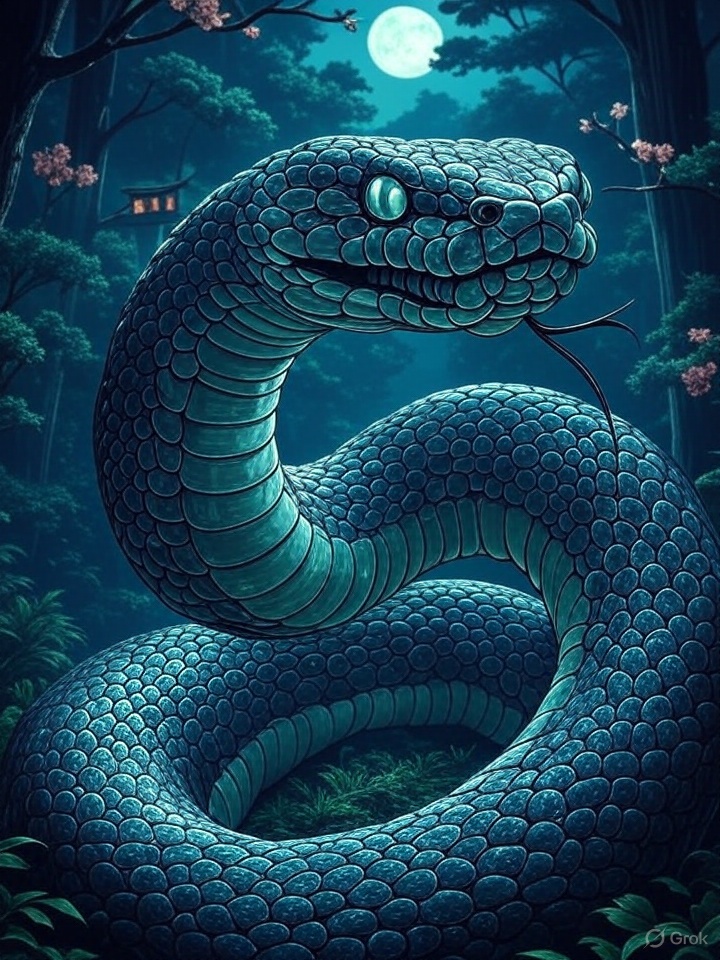
Illustrated folktale

In the mist-shrouded mountains of Awa, where the trees twisted and gnarled like withered fingers, there lived an old woodsman named Kaito. For nigh on forty years, he had wandered those hills, gathering firewood for his family's hearth and listening to the whispers of the forest. It was said that Kaito knew the names of every tree, every rock, and every creature that lived in those woods.
One autumn evening, as the sun dipped below the ridgeline, Kaito chanced upon a Nozuchi basking on a moss-covered boulder. The snake-like creature's flat head glowed like polished stone, and its bulging middle seemed to vibrate with an otherworldly energy. Kaito froze, his breath catching in his throat, for he had heard the tales of those who claimed to have seen the Nozuchi – how it could mimic human voices and curse those who lied or broke promises.
For a long moment, the two regarded each other in silence. The air was heavy with the scent of damp earth and decaying leaves. Kaito, sensing the weight of the creature's gaze, inclined his head in respect. He had heard that the Nozuchi was drawn to those who honored the land and its secrets.
Slowly, as if responding to Kaito's silent deference, the Nozuchi shifted onto its haunches and regarded him with an unblinking stare. Its flat head seemed to absorb the surrounding environment, drinking in the essence of the forest like a dry sponge soaking up rainwater. Then, without warning, it spoke – or rather, mimicked Kaito's own voice.
"Awa-ko, why do you venture into these hills?" The words were his own, yet not quite. A Nozuchi-like cadence imbued them with an unsettling familiarity. "You know the stories of our people, how we respect this land and its spirits."
Kaito bowed his head once more, acknowledging the creature's insight. "I have come to collect firewood for my family," he replied, "and to offer thanks to the spirits that dwell here."
The Nozuchi regarded him with an almost human-like understanding, as if sensing the depth of Kaito's commitment to preserving the balance between humans and nature. Satisfied, it spoke again – or rather, made a soft, rumbling sound that seemed to emanate from its very core.
"Then you shall have your firewood," it said, "and I will grant you a blessing for your family's hearth."
As Kaito gathered his harvest, the Nozuchi vanished into the underbrush like a ghostly apparition. He looked around, half-expecting to see its flat head peeking from behind a nearby sapling or boulder. But there was no sign of the creature, only an unsettling sense that it still lingered within the forest, watching and waiting.
From that day forward, Kaito's family prospered. Their fires burned bright and warm, fueled by the sacred firewood he had gathered from those mist-shrouded hills. And whenever he ventured into the mountains, the Nozuchi would appear to him once more – its presence felt as a gentle breeze rustling the leaves or the soft patter of tiny feet on distant rocks.
For in Awa's mystical mountains, where ancient secrets slumbered beneath the surface, Kaito knew that the Nozuchi watched over those who respected and honored the land, guarding the balance between humans and nature with an unspoken yet mighty presence.
Yokai, oni, kitsune and spirits from folklore
Directory of Japanese board games and traditional games
Verified itch.io pixel-art gacha — fair odds, no ads
Reference guides for classic Japanese ham radios
Ancient joinery techniques of Japanese master craftsmen
Explore Japan's landmarks, shrines and hidden locations
SNES and Super Famicom collection tracker
Hoshi no Isan — a Japanese-aesthetic space RPG in development
Pixel art life sim MMO — start at zero, build your life
AI-powered educational stories for kids
Japanese-aesthetic design tokens & AI-ready UI prompts

Every day, one teaching. One moment of stillness.
Kanji, meaning, and a quiet reflection — rooted in the philosophy
behind Japan's forests, seasons, and sacred silences.
Content Warning: This website explores Japanese folklore and mythological beings—including yokai, oni, and other supernatural entities—that may be frightening to younger audiences or sensitive viewers. All material is presented for educational and cultural appreciation only. Viewer discretion is advised.
Parents and guardians are encouraged to preview content before sharing it with children. By continuing to use JapaneseMythicalCreatures.com, you acknowledge and accept this advisory.
Copyright © 2026 Japanese Mythical Creatures • All Rights Reserved.