

Namazu (鯰) means "catfish" in Japanese and refers to the legendary giant catfish believed to cause earthquakes when it moves underground.
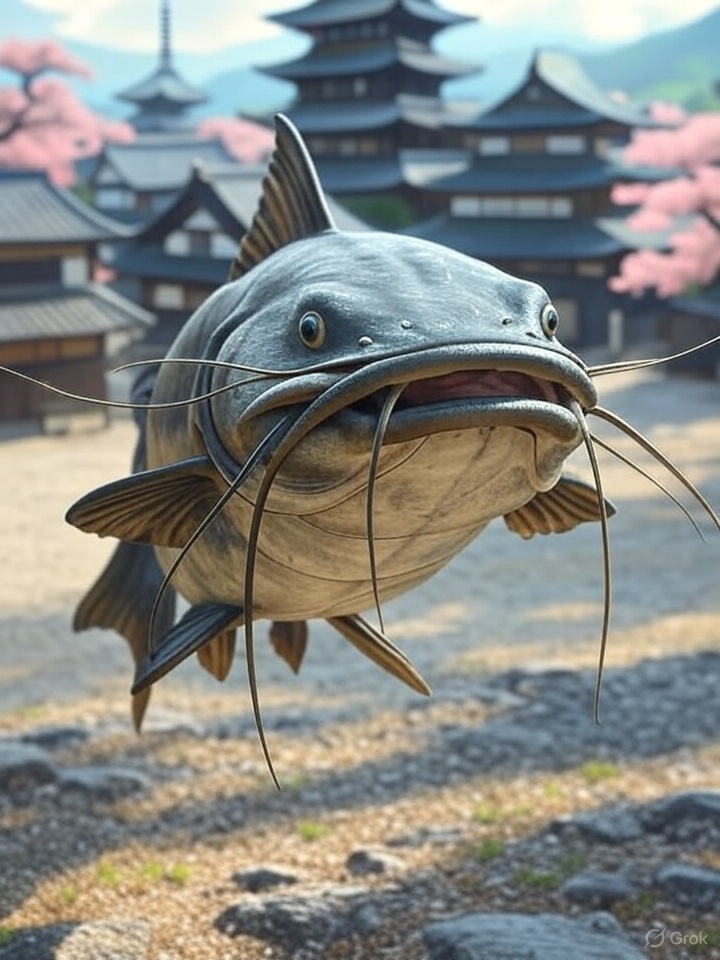
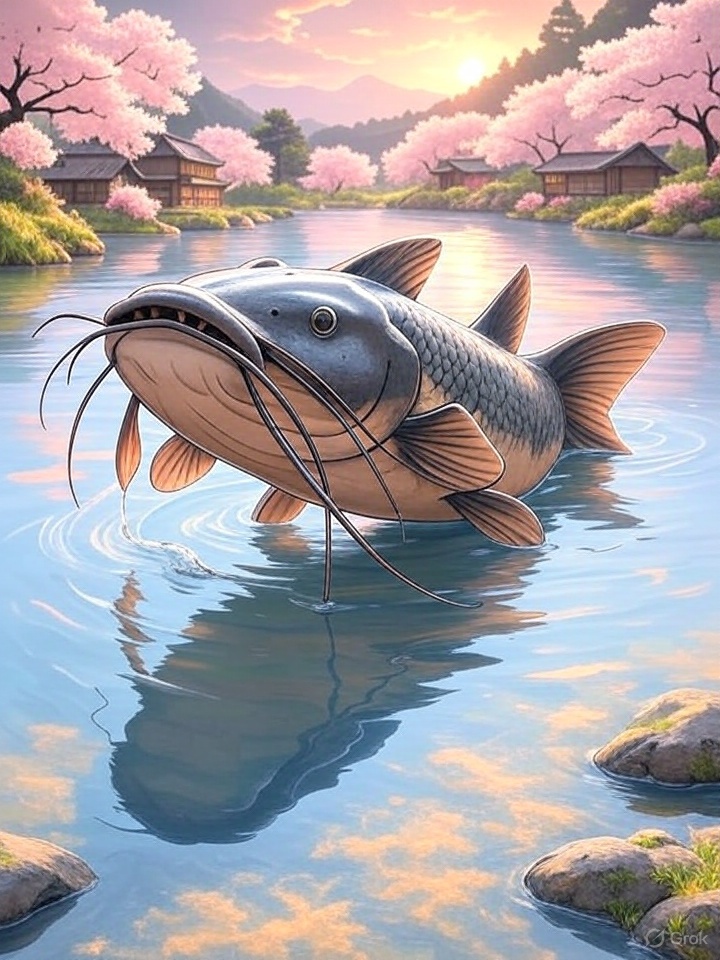
Illustrated folktale

In the depths of the mountains, where the air was heavy with the scent of wet earth and decaying leaves, there lived the Namazu, an enormous catfish with scales as black as coal and eyes that glowed like lanterns in the dark. Its presence was felt but not seen, a whispered rumor among the villages below.
The villagers knew that on certain nights, when the wind rustled through the bamboo thickets and the moon hung low in the sky, they could hear the Namazu's thrashing tail. The sound echoed through the valleys like thunder, making the very earth tremble beneath their feet. They would pray to Kashima, the great deity who kept the catfish in check with a sacred rock, the kaname-ishi.
One autumn evening, as the harvest moon rose over the mountains, a young hunter named Kaito set out into the forest. His family had long been farmers, and the changing seasons brought both prosperity and hardship to their land. The villagers whispered that the Namazu's restless stirring was a sign of imbalance in the natural world – that its power would soon be unleashed upon them.
As Kaito wandered deeper into the woods, he stumbled upon an old man sitting cross-legged beneath a withered cedar tree. His eyes were closed, and his hands cradled the sacred rock, which glowed with a soft blue light. The air around him seemed to vibrate with anticipation.
Kaito approached quietly, unsure whether the old man was a priest or a madman. "Why do you sit here," he asked softly, "when all are terrified of the Namazu's wrath?"
The old man opened his eyes, and they shone like stars on a clear night. He regarded Kaito with wisdom born of years spent in the mountains.
"The catfish stirs not out of malice, young one," he said, his voice barely above a whisper. "But because it remembers an ancient balance – one that has been disrupted by our own actions."
Kaito listened intently as the old man explained how human greed and neglect had disturbed the delicate harmony between earth and sea, forcing the Namazu to thrash its tail in protest.
That night, as Kaito watched from afar, the earthquake struck. The ground shook beneath his feet, and the wind roared through the mountains like a chorus of angry spirits. But when the dust settled, something remarkable happened: amidst the destruction, hidden treasures emerged – gold coins, precious jewels, and grains that had been buried for years.
The villagers, realizing that the Namazu's awakening was not an act of retribution but rather a reminder to rebalance their lives with nature, vowed to tend to their lands more carefully. As the seasons passed, the earth grew fertile once more, and the Namazu's thrashing tail slowed its rhythm.
From that day on, Kaito would often visit the old man by the cedar tree, listening as he shared tales of ancient wisdom and the Namazu's eternal vigilance beneath their feet. And when the harvest moon rose high in the sky, the villagers would smile, knowing that their land was a reflection of the delicate balance between earth and sea – and the Namazu's soothing thrumming, like a lullaby to the mountains themselves.
Yokai, oni, kitsune and spirits from folklore
Directory of Japanese board games and traditional games
Verified itch.io pixel-art gacha — fair odds, no ads
Reference guides for classic Japanese ham radios
Ancient joinery techniques of Japanese master craftsmen
Explore Japan's landmarks, shrines and hidden locations
SNES and Super Famicom collection tracker
Hoshi no Isan — a Japanese-aesthetic space RPG in development
Pixel art life sim MMO — start at zero, build your life
AI-powered educational stories for kids
Japanese-aesthetic design tokens & AI-ready UI prompts

Every day, one teaching. One moment of stillness.
Kanji, meaning, and a quiet reflection — rooted in the philosophy
behind Japan's forests, seasons, and sacred silences.
Content Warning: This website explores Japanese folklore and mythological beings—including yokai, oni, and other supernatural entities—that may be frightening to younger audiences or sensitive viewers. All material is presented for educational and cultural appreciation only. Viewer discretion is advised.
Parents and guardians are encouraged to preview content before sharing it with children. By continuing to use JapaneseMythicalCreatures.com, you acknowledge and accept this advisory.
Copyright © 2026 Japanese Mythical Creatures • All Rights Reserved.