

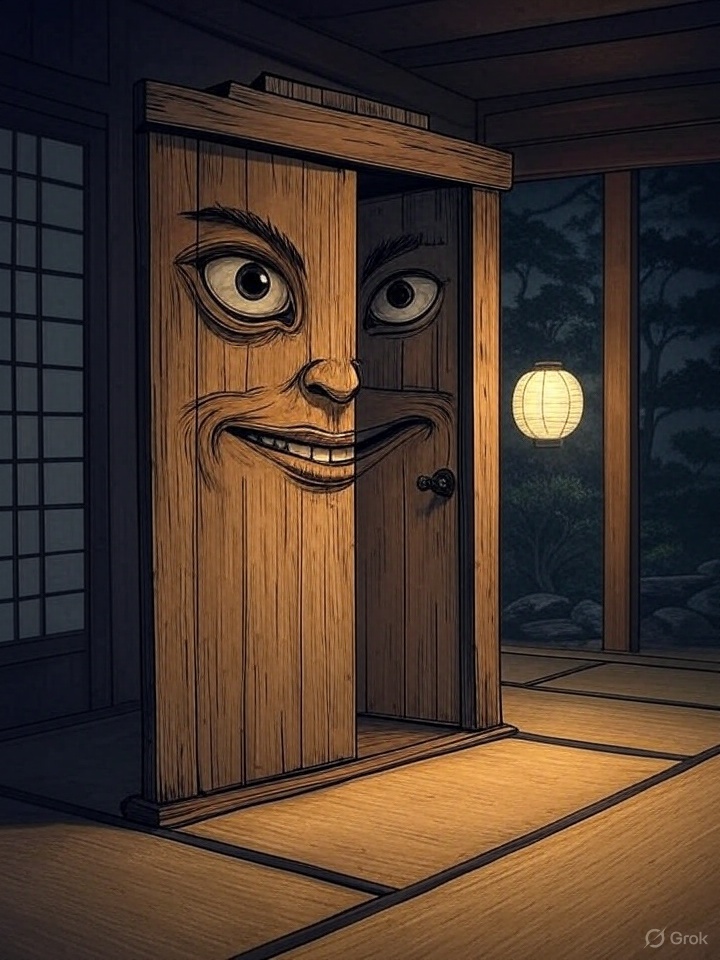
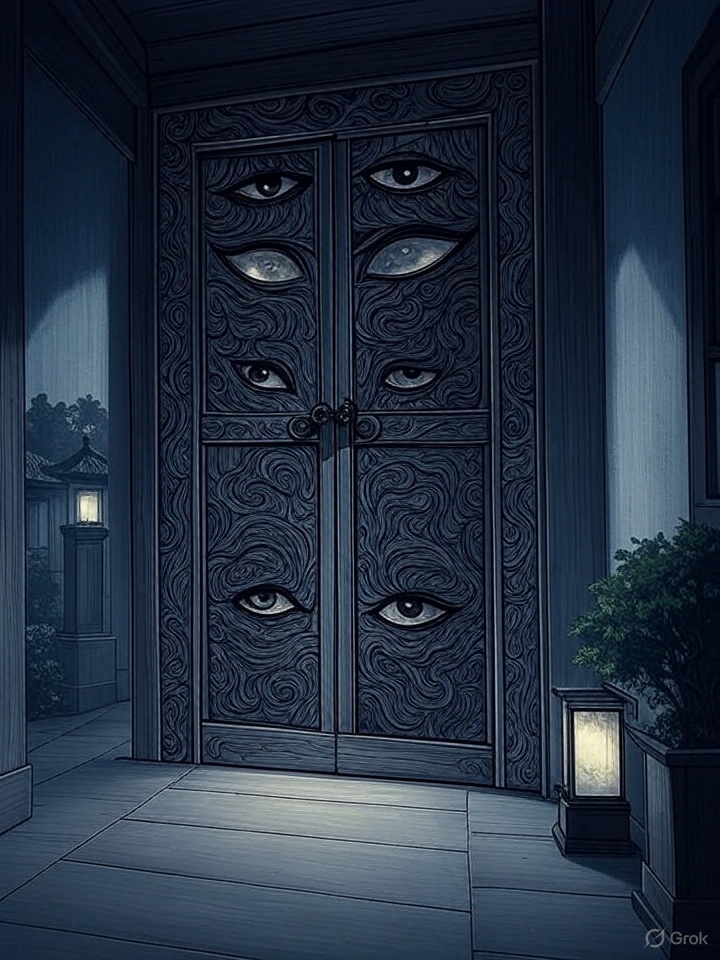
Mokumokuren (目目連) translates roughly to “many eyes” or “continuous eyes.” It refers to a mysterious yokai made up of countless eyes that appear on torn shoji (paper doors).
Illustrated folktale

In the sleepy village of Kakamura, where rice paddies stretched towards the mist-shrouded mountains, there stood an ancient inn called the Kokoro no Yado. Its wooden façade weathered to a soft silver, the once-proud sign creaking in the gentle breeze that carried whispers from the nearby forest.
A lone traveler, Kaito, stumbled upon the inn after dark, weary from days of walking and searching for shelter. As he pushed open the creaky door, a faint scent of incense wafted out, mingling with the damp air. The interior was dimly lit, the lanterns casting eerie shadows on the walls.
As Kaito made his way to the reception area, he noticed something peculiar: the shoji screens that lined the corridors were adorned with countless eyes, each one staring at him like tiny lanterns in the dark. At first, they seemed to blink in unison, as if watching a shared secret. But as he walked closer, their gaze grew fixed, their pupils seemingly sucking all light from the space.
Kaito's footsteps slowed, his heart thudding in his chest. He had heard whispers of the Mokumokuren, a creature said to haunt abandoned homes and inns, leaving its unsettling presence behind like a lingering specter. Some claimed it was an omen for places that needed purification, while others whispered it was a manifestation of guilt and secrets.
As Kaito approached his room, he felt an inexplicable sense of being watched from multiple angles. The eyes seemed to shift and ripple, as if they were alive, observing every move he made. He tried to shake off the feeling, telling himself it was mere superstition, but the more he looked away, the more pronounced their presence became.
The night wore on, with Kaito unable to sleep, his mind consumed by visions of the Mokumokuren's unblinking eyes. They seemed to sear themselves into his memory like hot coals. In a desperate bid to escape their oppressive gaze, he rose from bed and tried to repair the damaged shoji screen, hoping to banish the creature back to whatever realm it hailed from.
As his fingers moved deftly over the paper's worn surface, the eyes on the screen began to fade, like embers dying out in the morning light. But just as Kaito thought he'd succeeded in driving away the Mokumokuren, a stray breeze whispered through the cracks of the inn, and the eyes snapped back into being, their presence now even more oppressive than before.
Kaito fled the inn before dawn, leaving behind his worn-out sandals and a small portion of his soul. As he disappeared into the misty morning, the Mokumokuren's gaze remained fixed on him, like a spectral warning that still lingered in the air long after he was gone. Some say to this day, if you ever find yourself in Kakamura, and happen upon an abandoned inn with shoji screens riddled with eyes, you'll catch a glimpse of Kaito's fleeing form, forever trapped within the Mokumokuren's unblinking stare.
Yokai, oni, kitsune and spirits from folklore
Directory of Japanese board games and traditional games
Verified itch.io pixel-art gacha — fair odds, no ads
Reference guides for classic Japanese ham radios
Ancient joinery techniques of Japanese master craftsmen
Explore Japan's landmarks, shrines and hidden locations
SNES and Super Famicom collection tracker
Hoshi no Isan — a Japanese-aesthetic space RPG in development
Pixel art life sim MMO — start at zero, build your life
AI-powered educational stories for kids
Japanese-aesthetic design tokens & AI-ready UI prompts

Every day, one teaching. One moment of stillness.
Kanji, meaning, and a quiet reflection — rooted in the philosophy
behind Japan's forests, seasons, and sacred silences.
Content Warning: This website explores Japanese folklore and mythological beings—including yokai, oni, and other supernatural entities—that may be frightening to younger audiences or sensitive viewers. All material is presented for educational and cultural appreciation only. Viewer discretion is advised.
Parents and guardians are encouraged to preview content before sharing it with children. By continuing to use JapaneseMythicalCreatures.com, you acknowledge and accept this advisory.
Copyright © 2026 Japanese Mythical Creatures • All Rights Reserved.