

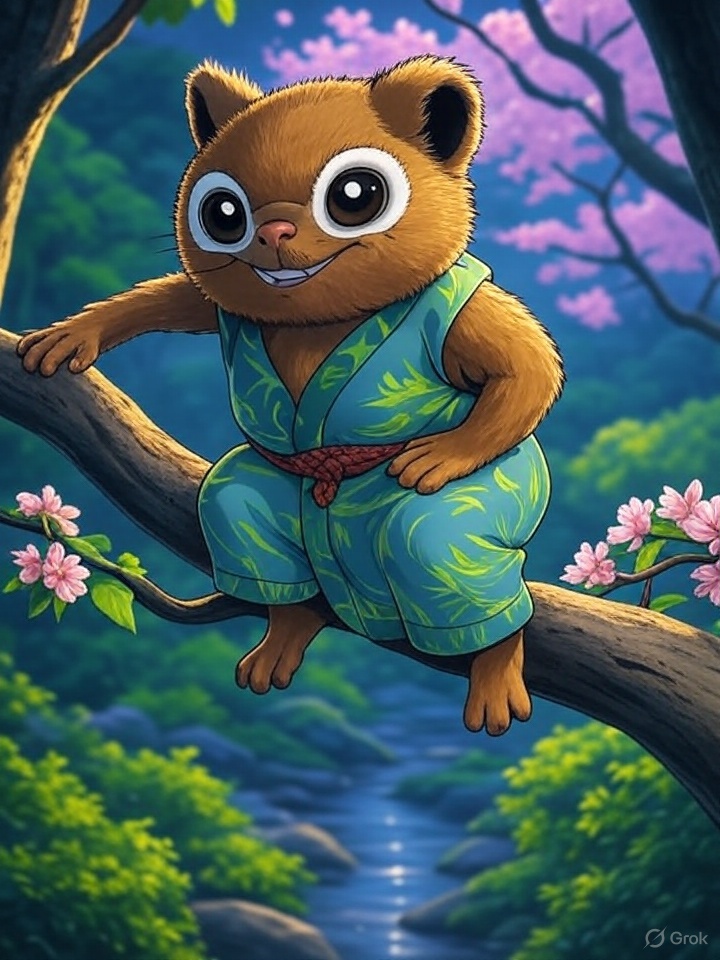
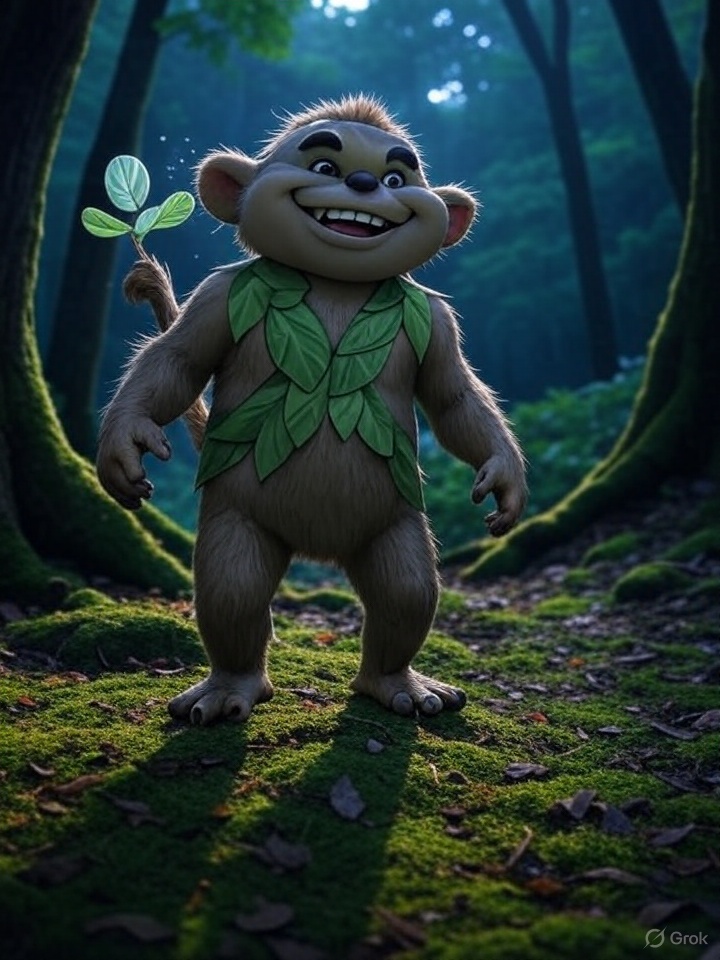
Kijimunaa (キジムナー) is a traditional Okinawan name. The word has no direct kanji but is tied to the spiritual lore of banyan tree spirits in Ryukyuan culture.
Illustrated folktale

In the heart of the ancient forest of Nakijin, where the sunlight filtering through the leaves created dappled patterns on the ground, there lived a Kijimunaa named Mōtō. For generations, the children of the village had whispered stories about the mischievous spirits that dwelled within the gajumaru trees, but few had ever laid eyes on one.
Mōtō was different from the others. He loved to play tricks on the villagers, tangling their fishing lines and stealing small trinkets, but he never meant harm. His bright red hair sparkled like embers in the sunlight as he flitted about, invisible to most adults. But Mōtō had a particular fondness for a young girl named Kikuko.
Kikuko lived on the outskirts of the village with her aging grandmother. The two spent their days tending to their garden and weaving traditional Ryukyuan patterns into delicate fabrics. One day, while gathering herbs in the forest, Kikuko stumbled upon Mōtō as he rode on a bird's back, chortling with glee.
From that moment on, Mōtō and Kikuko became inseparable friends. The Kijimunaa would perch on her shoulder, whispering tales of the forest's secrets and sharing the whispers of the wind. Together, they'd gather wildflowers to decorate their garden, and Mōtō would weave intricate patterns into the petals with his mischievous fingers.
However, not everyone in the village shared Kikuko's affection for the little spirit. The elderly blacksmith, Hiroshi-san, had long harbored a grudge against the gajumaru trees, which he believed siphoned the forest's sacred energy away from humanity. One evening, as Mōtō was busy weaving a garland of starflowers, Hiroshi-san stormed into their garden, brandishing his hammer.
"You Kijimunaa!" he shouted, eyes blazing with anger. "Leave our village and never return! You're nothing but pests, draining the life from our land!"
Mōtō's mischievous grin faltered as he watched Hiroshi-san raise his hammer. In a flash of pain and sorrow, the spirit vanished into thin air, leaving Kikuko to shield her grandmother.
As the seasons passed, the once-lively forest grew quiet and still. No longer did the wind whisper secrets to those who listened, and no longer did Mōtō's laughter echo through the gajumaru trees. The villagers whispered among themselves that Hiroshi-san's anger had woken a long-dormant curse, driving the Kijimunaa from their midst.
Kikuko spent her days wandering the forest, searching for any sign of her dear friend. At night, she'd whisper Mōtō's name into the wind, hoping against hope that he might hear and return to guide her through life's uncertain paths.
In time, a new generation grew up in Nakijin, one who spoke little of the Kijimunaa but much of their own stories and legends. Yet, hidden away in a forgotten corner of the forest, Mōtō remained – waiting for someone to acknowledge his presence, and to understand that respect for nature's unseen spirits is not about fear, but reverence.
The wind rustled through the leaves of the gajumaru trees, carrying with it an ancient wisdom: the balance between human and spirit worlds must be tended like a delicate garden.
Yokai, oni, kitsune and spirits from folklore
Directory of Japanese board games and traditional games
Verified itch.io pixel-art gacha — fair odds, no ads
Reference guides for classic Japanese ham radios
Ancient joinery techniques of Japanese master craftsmen
Explore Japan's landmarks, shrines and hidden locations
SNES and Super Famicom collection tracker
Hoshi no Isan — a Japanese-aesthetic space RPG in development
Pixel art life sim MMO — start at zero, build your life
AI-powered educational stories for kids
Japanese-aesthetic design tokens & AI-ready UI prompts

Every day, one teaching. One moment of stillness.
Kanji, meaning, and a quiet reflection — rooted in the philosophy
behind Japan's forests, seasons, and sacred silences.
Content Warning: This website explores Japanese folklore and mythological beings—including yokai, oni, and other supernatural entities—that may be frightening to younger audiences or sensitive viewers. All material is presented for educational and cultural appreciation only. Viewer discretion is advised.
Parents and guardians are encouraged to preview content before sharing it with children. By continuing to use JapaneseMythicalCreatures.com, you acknowledge and accept this advisory.
Copyright © 2026 Japanese Mythical Creatures • All Rights Reserved.