

Kawatarō (川太郎) is an alternate name for the kappa (河童) used in Edo-period Japan and in classical texts. It means “river boy” or “river elder”: kawa (川, river) and tarō (太郎, a common male name suffix). It refers to the same iconic water spirit—the creature with a dish on its head, webbed hands and feet, and a fondness for cucumbers and sumo wrestling.
Kawatarō is described the same way as the kappa: a small, humanoid water spirit with greenish skin, a bowl-shaped depression (sara) on the head that holds water, webbed limbs, and sometimes a turtle-like shell. It pulls people into the water, challenges them to sumo, and can be weakened by bowing (so it spills the water). It loves cucumbers and can be offered them to gain favor or safe passage.
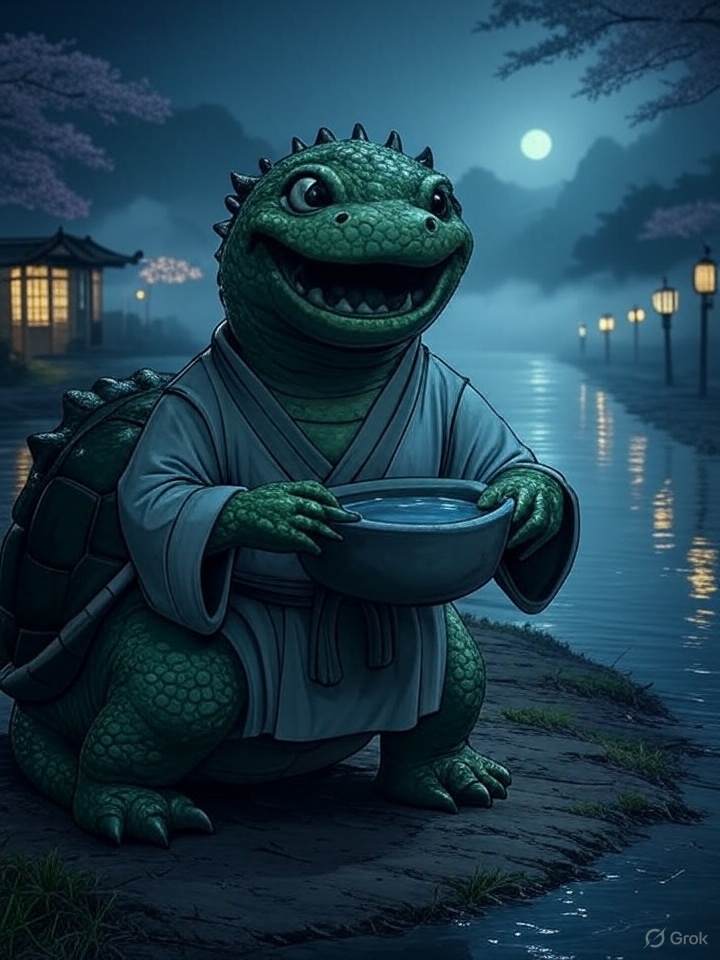
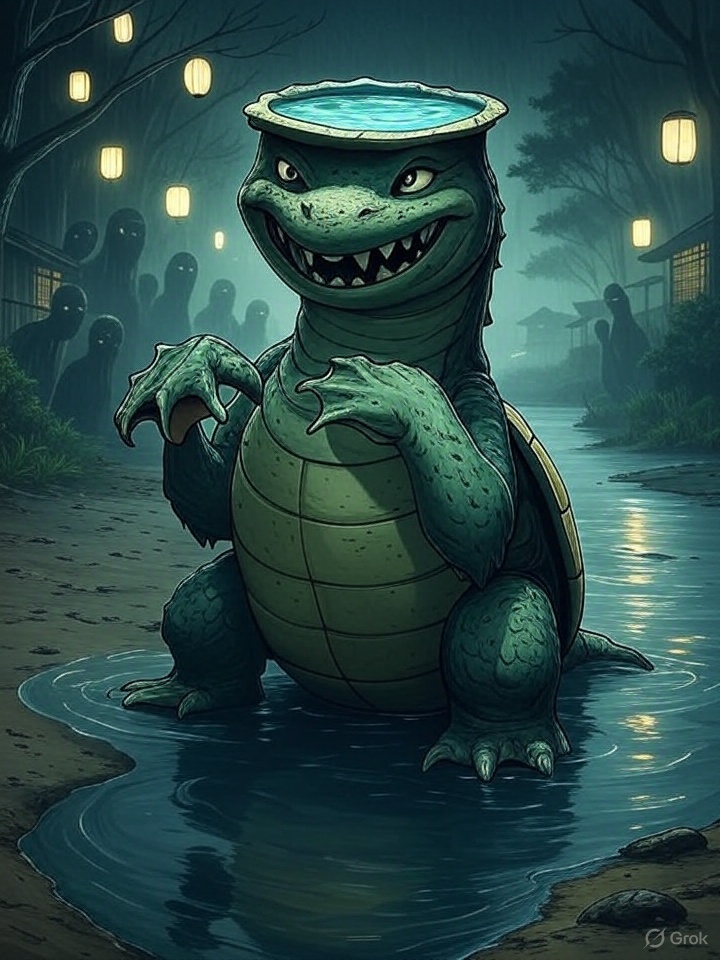
Japanese folklore often uses multiple names for the same yokai. Kappa (河童) literally means “river child.” Kawatarō (川太郎) gives the spirit a more person-like, almost familial tone (“river Tarō”). Both names appear in period art and stories; “kappa” eventually became the default in modern usage, while “Kawatarō” remains the Edo-era name for the river child of Japanese mythology.
Illustrated folktale

In the depths of summer, when the sun beats down upon the rice fields and the river's waters seem to shimmer with heat haze, there lived an elderly fisherman named Hiro. For years, he had fished these waters, knowing its rhythms as intimately as his own heartbeat. Yet, despite his familiarity, he had never encountered the Kawatarō that was said to haunt these very streams.
They called it a gentle spirit, yet also a trickster, one who played upon the lives of those who crossed its path. Some claimed to have seen it in the dead of night, its bowl-shaped head aglow with an ethereal light, beckoning travelers into the water's depths. Others spoke of the Kawatarō's sumo wrestling prowess, how it would challenge even the bravest of souls to a match beneath the rippling waves.
One sweltering evening, as Hiro paddled his canoe back towards shore, he noticed a peculiar cucumber sitting on the riverbank. It was larger than any he had ever seen, its skin a vibrant green that seemed almost otherworldly. The fisherman felt an inexplicable pull towards it and reached out to touch the gourd.
As soon as his fingers made contact with the cucumber's flesh, a faint ripple spread across the water's surface. Hiro sensed movement beneath the waves and turned to behold a small, humanoid form emerging from the depths. Its skin was indeed greenish, like the very river itself, and it wore an air of quiet dignity as it approached the canoe.
"Greetings, fisherman," the Kawatarō spoke in a low, raspy voice. "I have been watching you for some time now. You are respectful and kind to the waters, offering them the bounty they deserve." The creature nodded its head towards Hiro's oar, where a cucumber was secured by twine.
"You possess an understanding of our ways," it continued, "one that few mortals share with us spirits of the water. I propose a challenge: let us wrestle beneath the sun tomorrow morning, if you are brave enough to accept."
Hiro thought back on his years of living alongside the river, all the tales and whispers he had heard about the Kawatarō's prowess. But there was something in its eyes that made him hesitate – a flicker of genuine curiosity, perhaps even longing.
"I will wrestle with you," Hiro replied finally, "but not as a challenge. Let us do so instead to honor the balance between our worlds. I want to understand your nature better."
The Kawatarō smiled, revealing sharp teeth in the fading light. "You are wise beyond your years, fisherman," it said, "and thus deserving of my respect." The creature reached out with a webbed hand and gently touched Hiro's forehead.
Tomorrow would come, and Hiro knew he must face whatever lay ahead. Yet as he guided his canoe towards shore, the cucumber cradled in his hands like a small, precious child, he felt an unusual sense of calm settle upon him – one that might only be broken by the waters themselves.
Yokai, oni, kitsune and spirits from folklore
Directory of Japanese board games and traditional games
Verified itch.io pixel-art gacha — fair odds, no ads
Reference guides for classic Japanese ham radios
Ancient joinery techniques of Japanese master craftsmen
Explore Japan's landmarks, shrines and hidden locations
SNES and Super Famicom collection tracker
Hoshi no Isan — a Japanese-aesthetic space RPG in development
Pixel art life sim MMO — start at zero, build your life
AI-powered educational stories for kids
Japanese-aesthetic design tokens & AI-ready UI prompts

Every day, one teaching. One moment of stillness.
Kanji, meaning, and a quiet reflection — rooted in the philosophy
behind Japan's forests, seasons, and sacred silences.
Content Warning: This website explores Japanese folklore and mythological beings—including yokai, oni, and other supernatural entities—that may be frightening to younger audiences or sensitive viewers. All material is presented for educational and cultural appreciation only. Viewer discretion is advised.
Parents and guardians are encouraged to preview content before sharing it with children. By continuing to use JapaneseMythicalCreatures.com, you acknowledge and accept this advisory.
Copyright © 2026 Japanese Mythical Creatures • All Rights Reserved.