

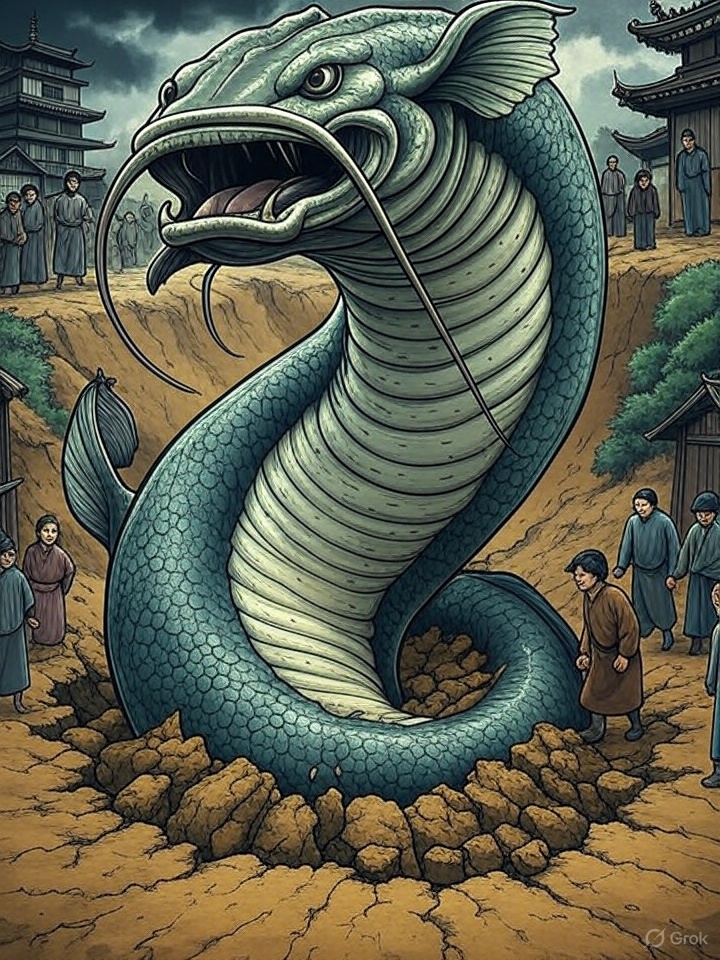
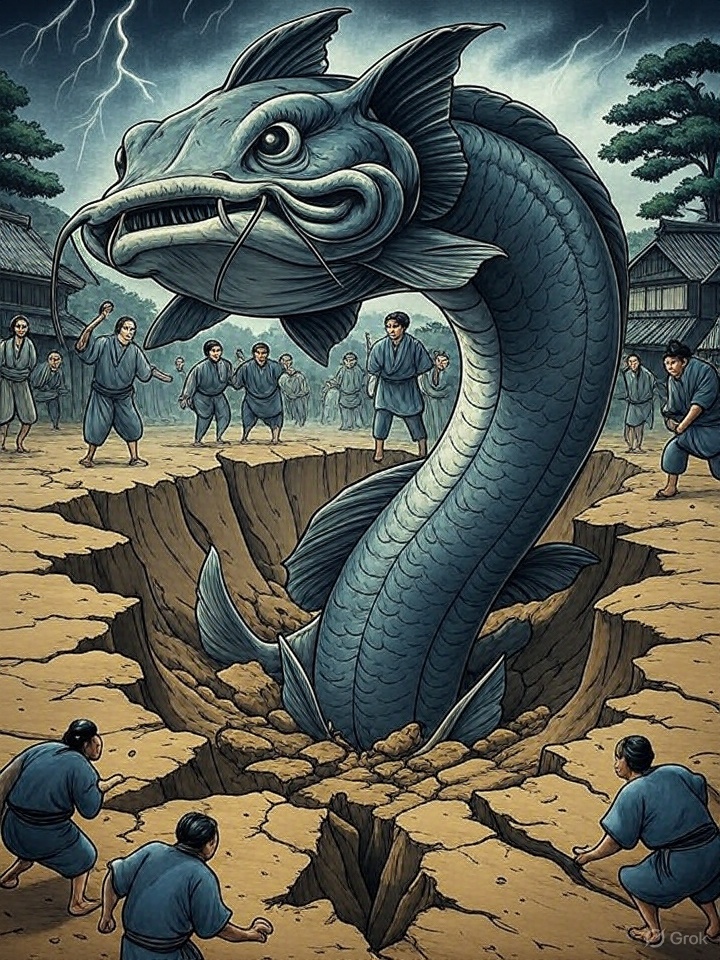
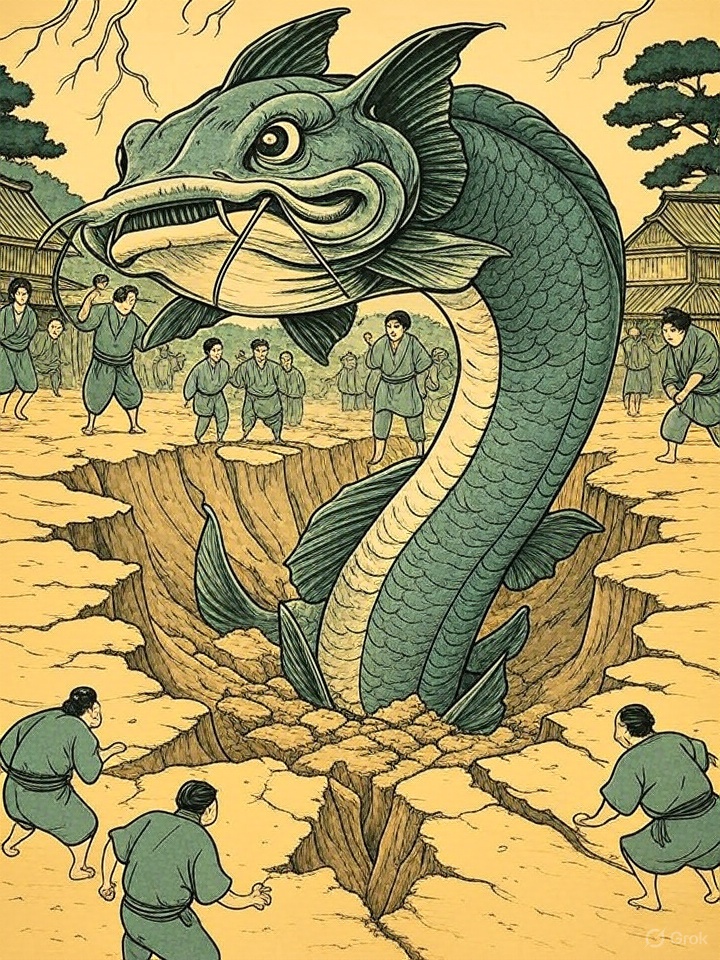
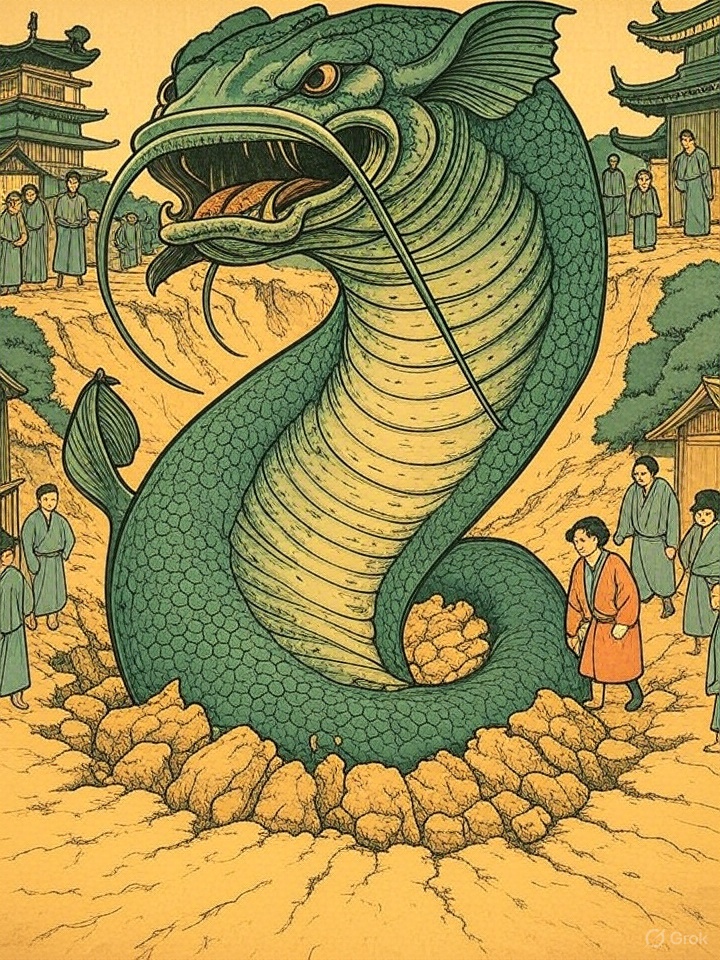
Jishin-namazu (地震鯰) combines "jishin" (earthquake) and "namazu" (catfish), reflecting the belief that this creature causes seismic tremors.
Illustrated folktale

In the depths of the Inland Sea, where the sunlight barely reaches, the Jishin-namazu stirred its massive body. The earth trembled as it swished its tail, sending ripples through the darkness. The sea gods whispered warnings to those on land: "The fish stirs, the earthquake approaches."
A humble rice farmer, Kaito, lived in a small village on the coast. He had always been attuned to the rhythms of nature, listening for the subtle signs that foretold the changing seasons. But even he was not prepared for the day the Jishin-namazu's agitation reached new heights.
As Kaito worked in his fields, the ground beneath him began to shudder. The earth cracked and groaned like an ancient gate creaking open. He stumbled, his foot slipping on the uneven soil. The sky darkened, as if a shadow had descended upon the land.
In the distance, the sound of drums echoed through the valleys. It was the village priest, Taro, calling out to the gods for protection and peace. But Kaito knew that the Jishin-namazu's fury could not be tamed so easily. He saw it then – a colossal shape beneath the waves, its scales glinting like dark jewels.
The fish rose higher, its eyes blazing with an inner fire. The villagers fled in panic as the earthquake intensified. Kaito watched, frozen, as the Jishin-namazu thrashed its tail, sending shockwaves through the land.
In the chaos that followed, Taro was seen standing at the edge of the village, his hands clasped together in prayer. His eyes were closed, but a faint smile played on his lips. As the earthquake raged on, he whispered an ancient incantation: "Kashima-sama, gentle one, calm the fish's fury."
The Jishin-namazu continued to writhe and twist, its power coursing through the earth like a tempest. But Kaito sensed a subtle change in the air – as if the deity Kashima had indeed taken hold of the fish, restraining it with an invisible thread.
Slowly, the tremors subsided. The villagers emerged from their hiding places, surveying the damage to their homes and fields. Taro opened his eyes, which shone with a deep understanding. "The Jishin-namazu stirs," he said softly, "but Kashima-sama holds it in balance."
Kaito looked out at the Inland Sea, where the waves still churned from the fish's disturbance. He realized that even the earth itself was a realm of fragile equilibrium – where the gods and natural forces danced in an eternal ballet. The Jishin-namazu remained beneath the waves, its power simmering like a great furnace. But for now, the balance had been restored.
Yokai, oni, kitsune and spirits from folklore
Directory of Japanese board games and traditional games
Verified itch.io pixel-art gacha — fair odds, no ads
Reference guides for classic Japanese ham radios
Ancient joinery techniques of Japanese master craftsmen
Explore Japan's landmarks, shrines and hidden locations
SNES and Super Famicom collection tracker
Hoshi no Isan — a Japanese-aesthetic space RPG in development
Pixel art life sim MMO — start at zero, build your life
AI-powered educational stories for kids
Japanese-aesthetic design tokens & AI-ready UI prompts

Every day, one teaching. One moment of stillness.
Kanji, meaning, and a quiet reflection — rooted in the philosophy
behind Japan's forests, seasons, and sacred silences.
Content Warning: This website explores Japanese folklore and mythological beings—including yokai, oni, and other supernatural entities—that may be frightening to younger audiences or sensitive viewers. All material is presented for educational and cultural appreciation only. Viewer discretion is advised.
Parents and guardians are encouraged to preview content before sharing it with children. By continuing to use JapaneseMythicalCreatures.com, you acknowledge and accept this advisory.
Copyright © 2026 Japanese Mythical Creatures • All Rights Reserved.