

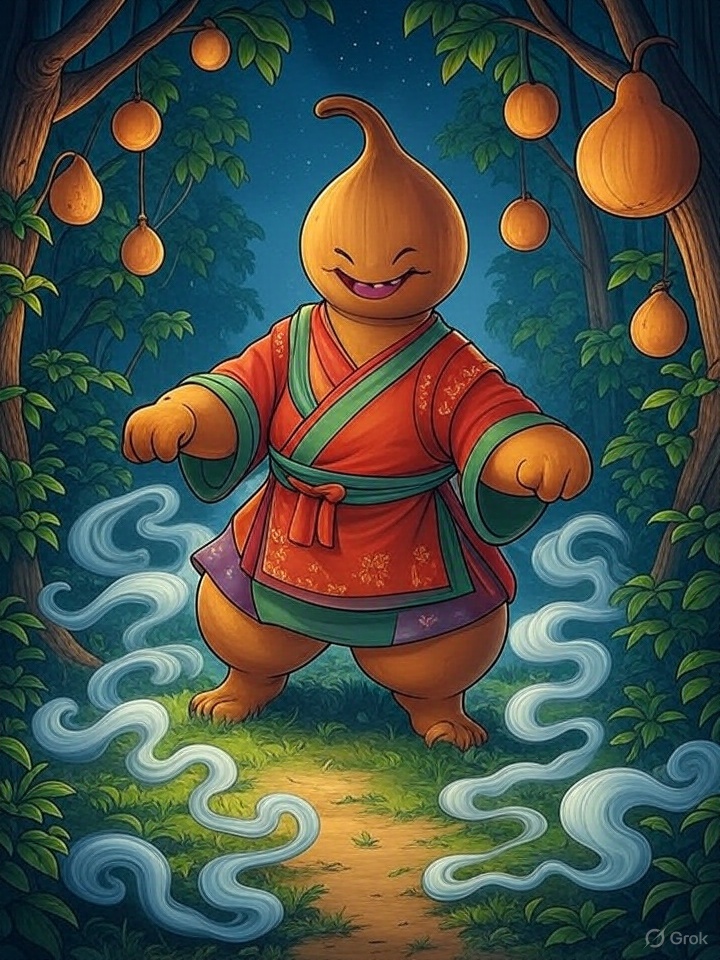
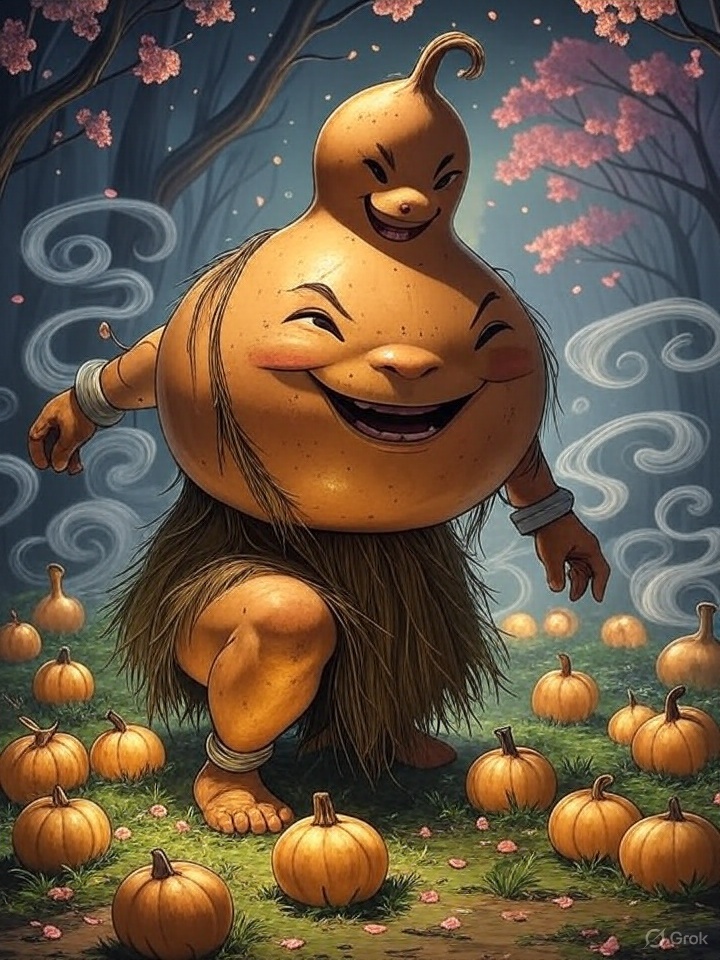
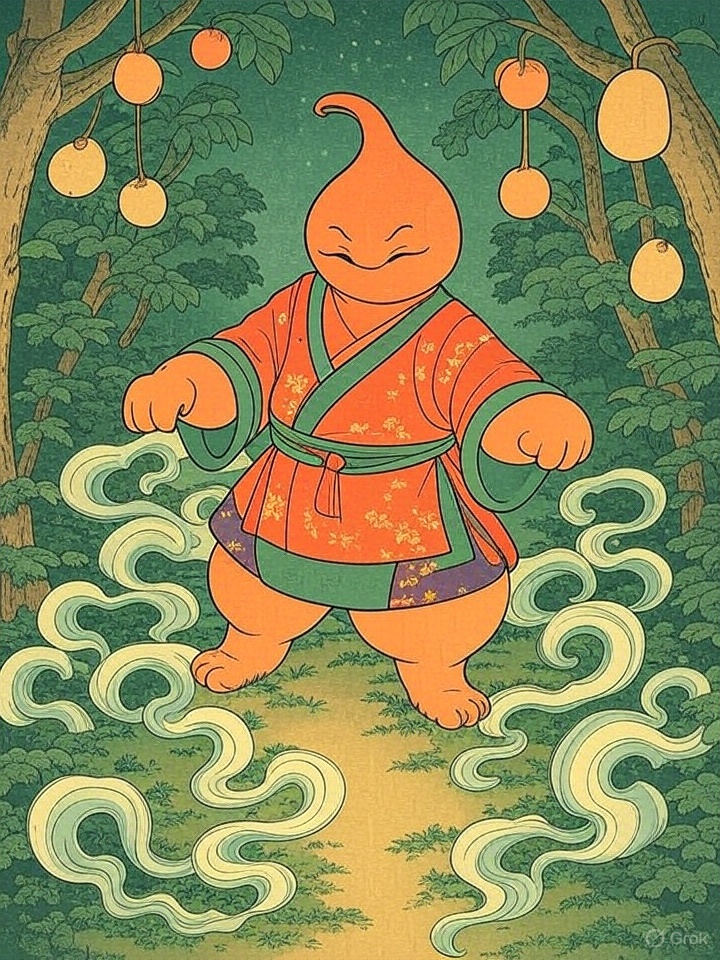
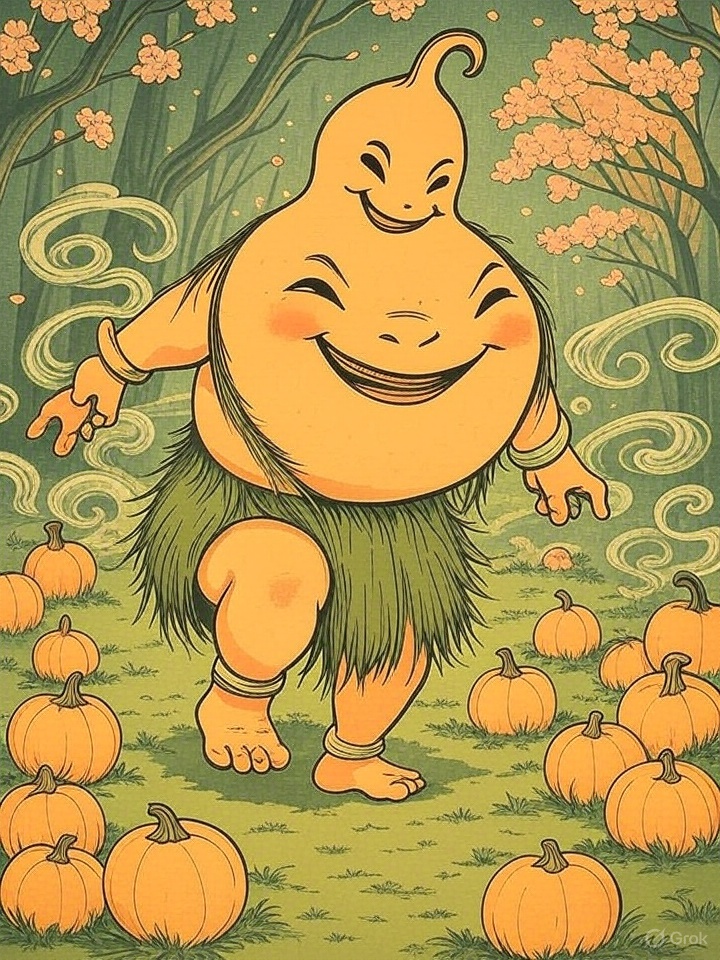
Hyōtan-kozō (瓢箪小僧) translates to “Gourd Boy.” This yokai is known for its lighthearted and mischievous nature, often surprising people in the night by popping up with its large gourd.
Illustrated folktale

In the sleepy village of Akakawa, where the mountain mist veiled the valleys below, there lived an elderly woodcarver named Kaito. His days were filled with chiseling and shaping the sacred woods that held the spirits of the forest. As dusk descended upon the village, casting long shadows across the rice fields, Kaito would pack his tools into a worn leather satchel and make his way back to the family temple.
It was on one such evening, as he strolled down the narrow shrine road, his footsteps echoing off the stone walls, that he chanced upon the Hyōtan-kozō. The mischievous creature, with its oversized ears and eyes shining like stars in the fading light, perched atop a moss-covered stone pedestal. It carried a gourd of considerable size on its back, which seemed to hum with an otherworldly vibration.
Kaito's initial startle gave way to a gentle smile as the Hyōtan-kozō let out a playful whoop, its laughter echoing off the temple walls. The woodcarver approached cautiously, recognizing the creature's signature mischievous grin. He had heard tales of these harmless yokai, but never thought he'd cross paths with one.
As Kaito drew near, the Hyōtan-kozō began to swing its gourd in rhythmic motion, like a child dancing to an unheard melody. The vibration emanating from it seemed to harmonize with the beating of Kaito's heart, filling his chest with a deep sense of peace.
"Ah, little one," Kaito said, crouching beside the pedestal, "what mischief do you brew here tonight?" The Hyōtan-kozō chirped in response, its language as unintelligible as the wind rustling through the pines. Yet, somehow, Kaito understood that it spoke of good fortune and blessings.
Moved by a sense of compassion, Kaito offered the creature a handful of fresh rice from his satchel. The Hyōtan-kozō's grin broadened as it accepted the gift, its laughter mingling with the soft rustle of leaves in the night air. For a fleeting moment, time seemed to stand still, and the world was bathed in an ethereal glow.
As the villagers often said, if one treated the Hyōtan-kozō kindly, it would bestow good fortune upon them. Kaito felt his hands grow warmer as he received the wood shavings from his latest creation – a beautiful wooden Buddha, adorned with delicate patterns of intertwining vines and leaves.
When he arrived back at the temple, his hands moved with renewed purpose, chiseling out the last touches on the statue's face. It was as if the Hyōtan-kozō had awakened within him a deeper connection to the forest spirits, channeling their wisdom through the woodcarver's skilled hands.
From that night forward, whenever Kaito's work took him near the shrine road at dusk, he would glance over his shoulder, half-expecting to catch sight of the mischievous creature, gourd slung proudly on its back. For in a world where the boundaries between reality and myth blurred like the mist-shrouded mountains, it was clear that the Hyōtan-kozō had etched itself into Kaito's heart – as a reminder to cherish whimsy, and never underestimate the power of kindness.
Yokai, oni, kitsune and spirits from folklore
Directory of Japanese board games and traditional games
Verified itch.io pixel-art gacha — fair odds, no ads
Reference guides for classic Japanese ham radios
Ancient joinery techniques of Japanese master craftsmen
Explore Japan's landmarks, shrines and hidden locations
SNES and Super Famicom collection tracker
Hoshi no Isan — a Japanese-aesthetic space RPG in development
Pixel art life sim MMO — start at zero, build your life
AI-powered educational stories for kids
Japanese-aesthetic design tokens & AI-ready UI prompts

Every day, one teaching. One moment of stillness.
Kanji, meaning, and a quiet reflection — rooted in the philosophy
behind Japan's forests, seasons, and sacred silences.
Content Warning: This website explores Japanese folklore and mythological beings—including yokai, oni, and other supernatural entities—that may be frightening to younger audiences or sensitive viewers. All material is presented for educational and cultural appreciation only. Viewer discretion is advised.
Parents and guardians are encouraged to preview content before sharing it with children. By continuing to use JapaneseMythicalCreatures.com, you acknowledge and accept this advisory.
Copyright © 2026 Japanese Mythical Creatures • All Rights Reserved.