

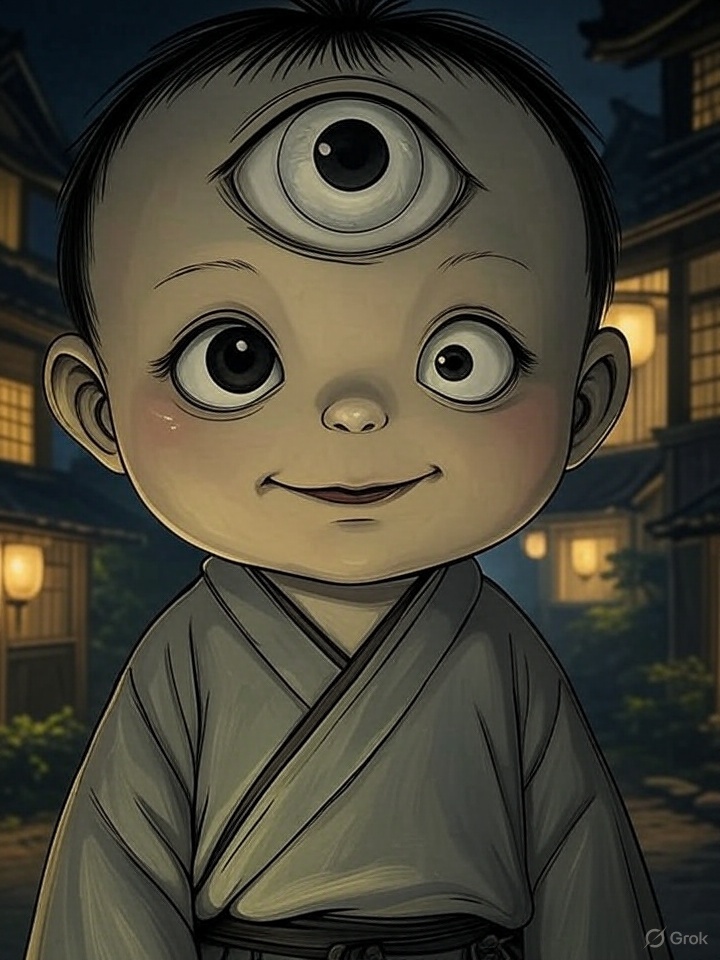
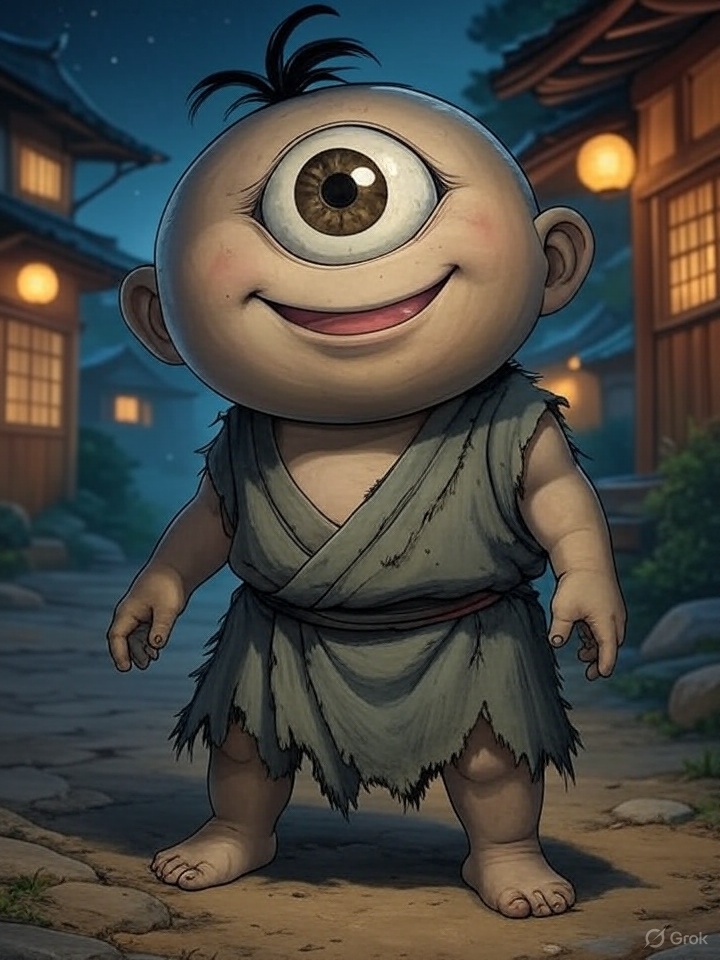
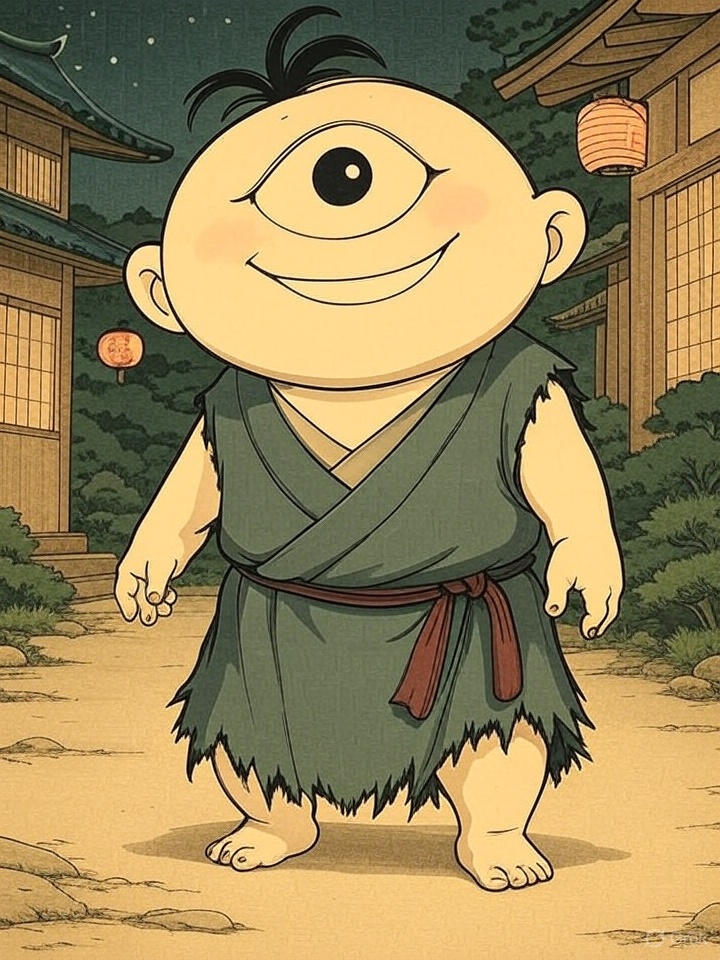
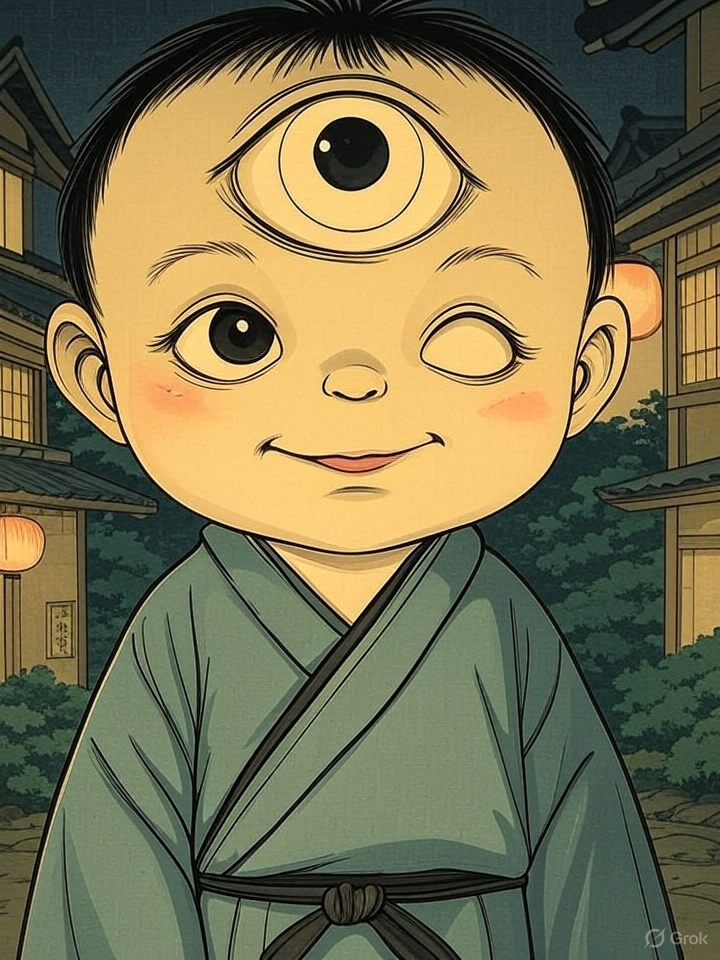
Hitotsume-kozō (一つ目小僧) means "one-eyed boy." This yokai resembles a young monk or child with a single large eye in the middle of its face.
Illustrated folktale

In the depths of autumn, when the wind whispers secrets to the trees and the moon casts an eerie glow on the streets, a lone traveler stumbled upon a small village nestled between two great mountains. The villagers, huddled in their homes, spoke in hushed tones of a mysterious presence that roamed the night: the Hitotsume-kozō.
Rumors swirled that this enigmatic creature would appear to unsuspecting travelers, its single eye glowing like a lantern in the dark. Some claimed it brought warnings from beyond the veil, while others whispered tales of mischief and mayhem. The traveler, a young man named Kaito, laughed at these stories, convinced that the Hitotsume-kozō was nothing more than a myth.
As night fell, Kaito settled into a small inn on the village's edge, surrounded by flickering candles and the murmur of villagers' conversations. He dozed off to the sound of wind chimes and the creaking of wooden beams, but his rest was short-lived. A sudden chill ran down his spine as he felt a presence in the doorway.
Kaito opened his eyes to find himself face-to-face with the Hitotsume-kozō. The creature's single eye glowed like embers from a dying fire, and its bald head seemed to absorb the light around it. For an instant, they locked gazes, and Kaito felt a shiver run down his spine.
The creature, dressed in simple monk robes, regarded Kaito with a curious expression, as if studying a peculiar insect. Then, without warning, it vanished into thin air, leaving behind only the faint scent of incense and a whispered phrase on the wind: "Mōri no ya."
Kaito stumbled out of his room, seeking answers from the villagers. They told him that "Mōri no ya" was an ancient phrase, a message from the spirit world warning of impending danger. Some believed it foretold a great storm, while others whispered that it signaled the arrival of a vengeful spirit.
As Kaito pondered the Hitotsume-kozō's enigmatic visit, he felt the air grow heavy with an otherworldly presence. Clouds gathered on the horizon, and the wind began to howl like a chorus of restless spirits. The villagers scrambled to secure their homes as a fierce storm swept in, threatening to consume the village.
Kaito remembered the Hitotsume-kozō's glowing eye and its cryptic message. He realized that the creature had brought more than just a warning – it had awakened Kaito's own curiosity and fear of the unknown. As the storm raged on, he sat by a candlelit window, reflecting on the eerie encounter.
In the midst of chaos, the Hitotsume-kozō reappeared, its single eye aglow in the tempestuous darkness. This time, it did not vanish; instead, it stood still, watching as Kaito struggled to understand the mysteries of the spirit world. With a knowing glint in its eye, the creature vanished once more into the stormy night.
As the winds died down and the village returned to normal, Kaito felt an unshakeable sense of awe for the Hitotsume-kozō's enigmatic presence. He came to realize that this strange creature was not a harbinger of doom or mischief but rather a reminder of the magic and mystery that lay just beyond the edge of everyday life.
Yokai, oni, kitsune and spirits from folklore
Directory of Japanese board games and traditional games
Verified itch.io pixel-art gacha — fair odds, no ads
Reference guides for classic Japanese ham radios
Ancient joinery techniques of Japanese master craftsmen
Explore Japan's landmarks, shrines and hidden locations
SNES and Super Famicom collection tracker
Hoshi no Isan — a Japanese-aesthetic space RPG in development
Pixel art life sim MMO — start at zero, build your life
AI-powered educational stories for kids
Japanese-aesthetic design tokens & AI-ready UI prompts

Every day, one teaching. One moment of stillness.
Kanji, meaning, and a quiet reflection — rooted in the philosophy
behind Japan's forests, seasons, and sacred silences.
Content Warning: This website explores Japanese folklore and mythological beings—including yokai, oni, and other supernatural entities—that may be frightening to younger audiences or sensitive viewers. All material is presented for educational and cultural appreciation only. Viewer discretion is advised.
Parents and guardians are encouraged to preview content before sharing it with children. By continuing to use JapaneseMythicalCreatures.com, you acknowledge and accept this advisory.
Copyright © 2026 Japanese Mythical Creatures • All Rights Reserved.