

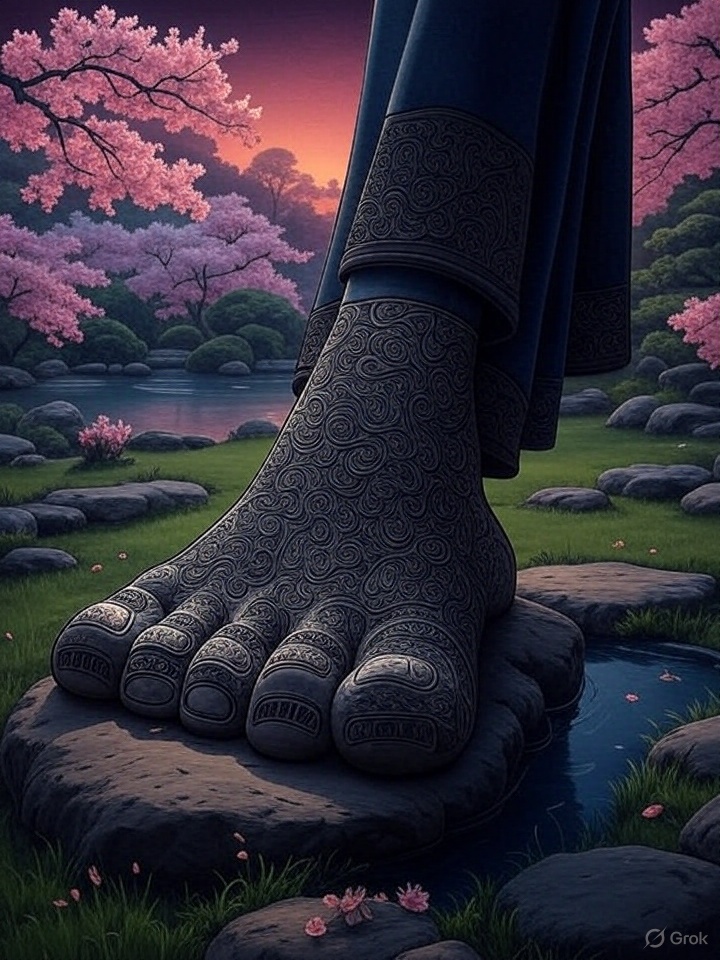
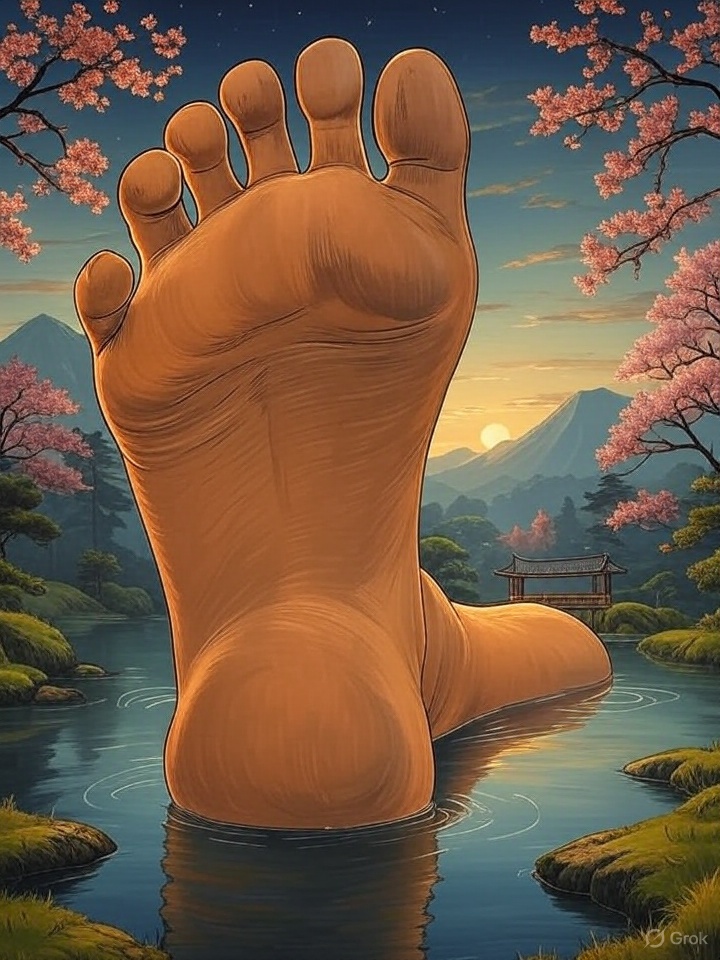
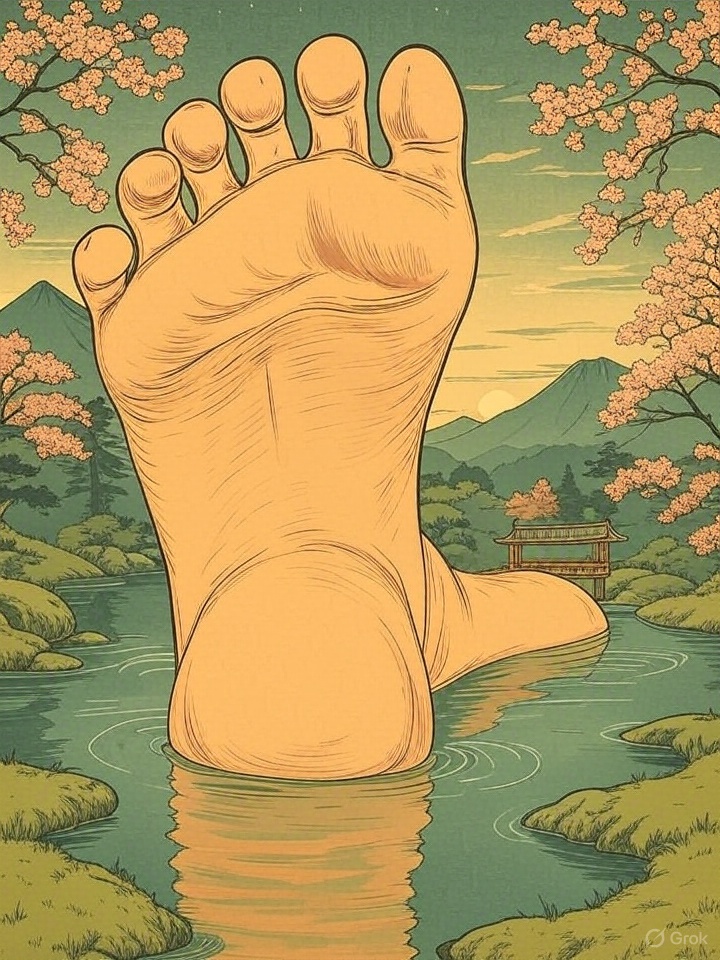
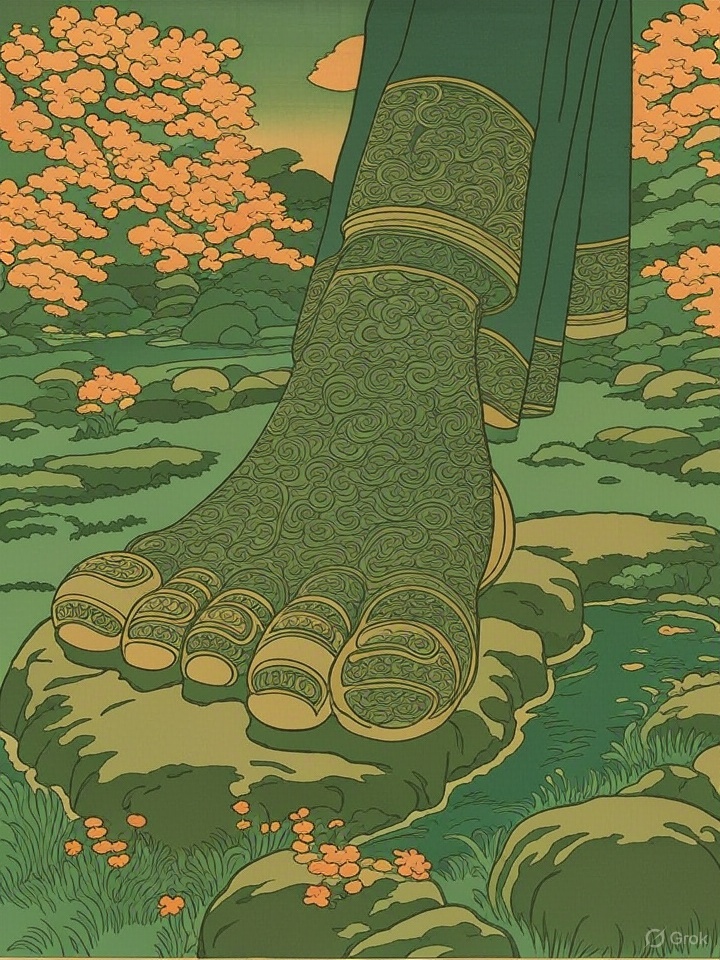
Ashiaraiyashiki (足洗邸) means “Foot-Washing Mansion.” It refers to a bizarre and unsettling story of a giant demonic foot crashing through the ceiling of a house and demanding to be washed.
Illustrated folktale

In a small village nestled between two great cedar trees, there stood an old manor known as Ashiaraiyashiki – the Washing Guest House. Its name echoed whispers of a long-forgotten tale, one that spoke of a peculiar and mischievous spirit.
Akira, a young villager with a heart full of curiosity, often strolled by the manor's worn gates. He would pause to admire its crumbling stone walls and ornate wooden eaves, imagining the grandeur it once held. However, his visits were not without consequence. Each time he entered the grounds, a gentle breeze would carry an unsettling phrase: "Akira no miyage," – Akira's gift.
At first, the villagers dismissed it as mere wind rustling through the cypress trees. But when Akira started noticing other strange occurrences – shoes placed on his path in odd patterns, wooden sandals laid out in deliberate disarray, and wisps of paper carrying cryptic messages – the community grew uneasy. They sensed an unseen presence lurking within the manor's decaying halls.
One evening, as a fierce rain pounded against the thatched roofs, Akira decided to investigate further. He pushed open the creaking gate and stepped into the musty foyer. Water dripped from his hood, echoing the beat of the rain outside. The air inside was heavy with an unwholesome silence.
Without warning, the lights flickered to life – lanterns suspended from beams swaying in tandem with Akira's footsteps. In each room he entered, shoes waited patiently on low tables or scattered about the floor. A paper slip on a tea stand read: "Naiyō ni aru mono o yūshi." Ah, the absurd gift of the absent.
Akira couldn't decipher the meaning behind these offerings. He sensed that some ancient power stirred within the manor's walls – an invisible host who playfully nudged him toward hidden truths. Yet his unease deepened as he stumbled upon a shrine dedicated to Ashiaraiyashiki, its wooden deities worn from countless prayers.
As Akira stood before the shrine, the wind outside died down, leaving behind only the rain's gentle patter. A gust carried the faint scent of incense – not the bitter smoke of burning paper, but something more refined and mystical. It was then that he understood: the Washing Guest House demanded respect for the unknown.
Akira retreated from Ashiaraiyashiki with a heart both amazed and chastened. From that day forward, whenever passing by the manor, he would bow deeply to its crumbling gates – an act of deference to the invisible presence watching over him. And when whispers carried the phrase "Akira no miyage" once more, he smiled knowingly: for in respecting the unexplained, one finds peace amidst life's mysteries.
As Akira vanished into the crowd, the wind revived its gentle rustling – a reminder that Ashiaraiyashiki still whispered its cryptic messages, guarding secrets and nudging villagers toward reverence. And though his story passed into the village's collective memory, it remained but a small thread in the intricate tapestry of forgotten tales. The Washing Guest House continued to watch over its domain, awaiting the next visitor willing to acknowledge the whispers within.
Yokai, oni, kitsune and spirits from folklore
Directory of Japanese board games and traditional games
Verified itch.io pixel-art gacha — fair odds, no ads
Reference guides for classic Japanese ham radios
Ancient joinery techniques of Japanese master craftsmen
Explore Japan's landmarks, shrines and hidden locations
SNES and Super Famicom collection tracker
Hoshi no Isan — a Japanese-aesthetic space RPG in development
Pixel art life sim MMO — start at zero, build your life
AI-powered educational stories for kids
Japanese-aesthetic design tokens & AI-ready UI prompts

Every day, one teaching. One moment of stillness.
Kanji, meaning, and a quiet reflection — rooted in the philosophy
behind Japan's forests, seasons, and sacred silences.
Content Warning: This website explores Japanese folklore and mythological beings—including yokai, oni, and other supernatural entities—that may be frightening to younger audiences or sensitive viewers. All material is presented for educational and cultural appreciation only. Viewer discretion is advised.
Parents and guardians are encouraged to preview content before sharing it with children. By continuing to use JapaneseMythicalCreatures.com, you acknowledge and accept this advisory.
Copyright © 2026 Japanese Mythical Creatures • All Rights Reserved.