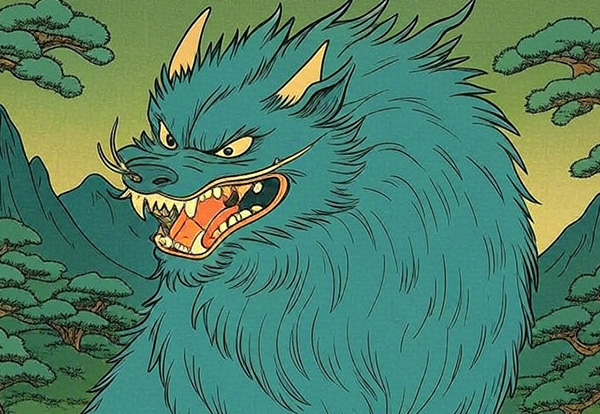

Raijū (雷獣) means “thunder beast” or “lightning beast.” It is believed to be a creature born from lightning and storm clouds.
Raijū is inseparable from Raijin (雷神), the god of thunder and lightning in Japanese mythology. Raijū is often depicted as Raijin's companion, messenger, or mount—descending to earth with each lightning strike. In some tales, Raijin sends Raijū to punish the wicked or to wake the beast when it has curled up inside a sleeping person's navel.
Traditional folklore holds that Raijū is drawn to navels. To avoid being struck by lightning or having Raijū nest inside them, people were advised to sleep on their stomachs during thunderstorms. This belief was widespread in rural Japan and is still referenced in modern culture.
Raijū appears across Japanese pop culture as a lightning-element creature or boss. It features in the Pokémon series (as inspiration for electric types), in anime such as Naruto and InuYasha, and in numerous video games as a thunder beast or summon. Its design often keeps the wolf- or weasel-like form with lightning motifs.
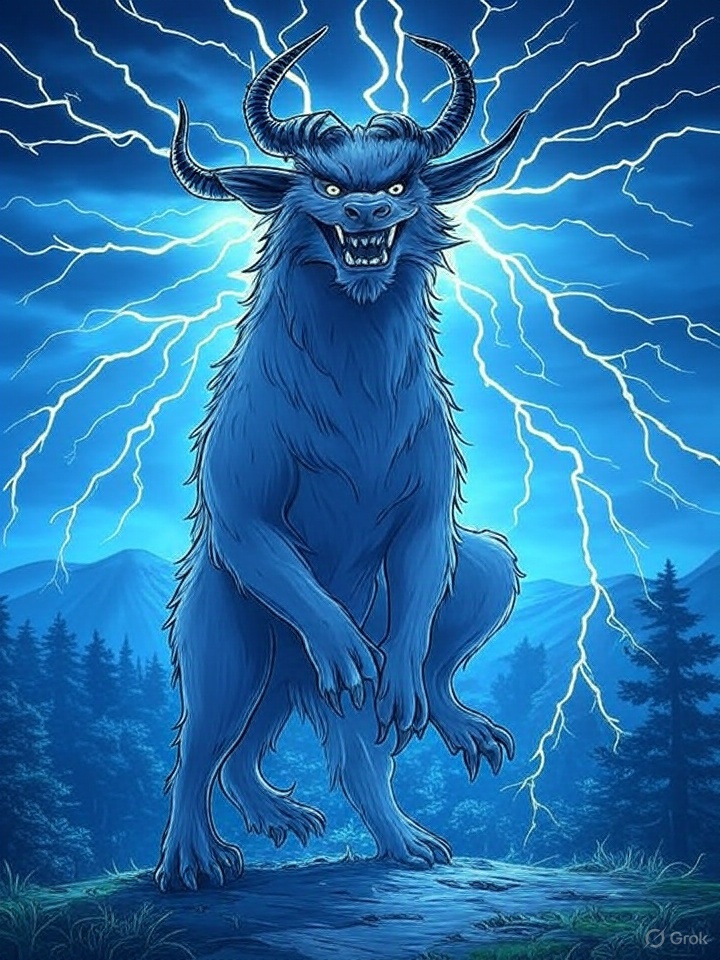
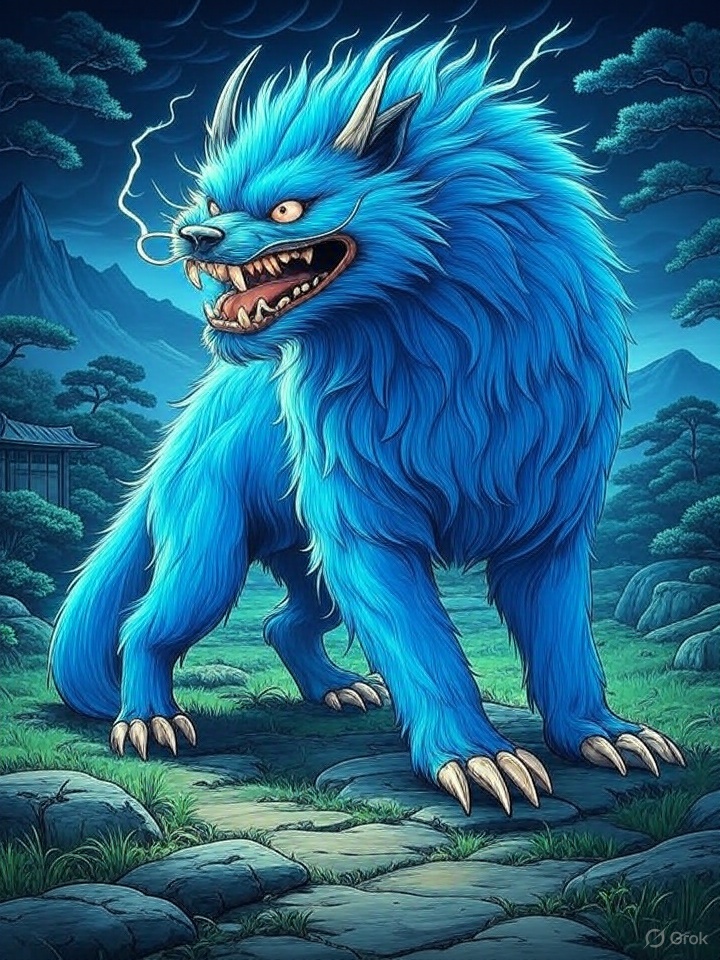
Illustrated folktale

In the depths of summer, when the air hung heavy with the scent of blooming yamabuki and the sun beat down upon the earth, our village was beset by an unrelenting drought. Crops withered, rivers shrunk to mere trickles, and the people grew anxious. The rice spirits, usually so benevolent, seemed distant and unforgiving.
One evening, as a lone storm cloud gathered on the horizon, our village elder, Hiro-san, called upon his granddaughter, Kaito, to tend to her newborn niece in the family's humble hut. As Kaito settled into the silence of the night, a sudden clap of thunder shook the thatched roof above them. Lightning danced across the sky, casting an otherworldly glow within the room.
In the commotion, a small, swirling vortex materialized before them – the Raijū, in all its feral beauty. Coils of crackling electricity entwined its limbs, imbuing it with an aura both mesmerizing and terrifying. The creature's eyes, two piercing orbs of blue-white light, fixed upon Kaito and her sleeping niece.
As if drawn by some unseen force, the Raijū padded closer, its ethereal form oscillating in time with the thunder. It sniffed at the babe's still chest, then, with a curious nuzzle, curled up against her warmth. The air around them seemed to thrum with an electric presence, as if the very fabric of reality had been touched.
Hiro-san, sensing the creature's arrival, entered the hut, his eyes aglow with reverence. "Kaito-chan," he whispered, "the Raijū has chosen our family for its solace. Its power is a gift from Raijin himself – a reminder that even in desiccation and hardship, divine presence remains."
As night deepened, Kaito felt the baby's breathing slow, then quicken, as if awakened by the creature's gentle purring. When dawn broke, the storm had passed, leaving behind an eerie stillness. Our villagers emerged to survey the aftermath: parched fields now refreshed by a gentle rain; crops revived, their green shoots bursting forth like new life.
From that day on, Kaito and Hiro-san treated the Raijū with respect and caution. They offered it milk from their goats and sweet rice cakes, leaving them outside the hut at dusk, when its wild form would appear, drawn by some primal call to rest within the heart of our village family. As the seasons passed, stories spread about this small miracle: the Raijū's sacred bond with us, and the enduring promise it brought – that even in darkness, the radiance of the divine would ignite the spark of renewal.
In those quiet evenings, when stars twinkled like diamonds scattered across the velvet expanse, our villagers would whisper an ancient truth to one another: "The Raijū's presence is a harbinger of change – a reminder that, like lightning, life itself flashes and transforms."
Take our eight-question quiz and see if Raijū is your true yokai match — or discover another spirit from Japanese folklore.
Take the quizYokai, oni, kitsune and spirits from folklore
Directory of Japanese board games and traditional games
Verified itch.io pixel-art gacha — fair odds, no ads
Reference guides for classic Japanese ham radios
Ancient joinery techniques of Japanese master craftsmen
Explore Japan's landmarks, shrines and hidden locations
SNES and Super Famicom collection tracker
Hoshi no Isan — a Japanese-aesthetic space RPG in development
Pixel art life sim MMO — start at zero, build your life
AI-powered educational stories for kids
Japanese-aesthetic design tokens & AI-ready UI prompts

Every day, one teaching. One moment of stillness.
Kanji, meaning, and a quiet reflection — rooted in the philosophy
behind Japan's forests, seasons, and sacred silences.
Content Warning: This website explores Japanese folklore and mythological beings—including yokai, oni, and other supernatural entities—that may be frightening to younger audiences or sensitive viewers. All material is presented for educational and cultural appreciation only. Viewer discretion is advised.
Parents and guardians are encouraged to preview content before sharing it with children. By continuing to use JapaneseMythicalCreatures.com, you acknowledge and accept this advisory.
Copyright © 2026 Japanese Mythical Creatures • All Rights Reserved.